
Picturing Time: Temporality and US Imperialism in Oceania
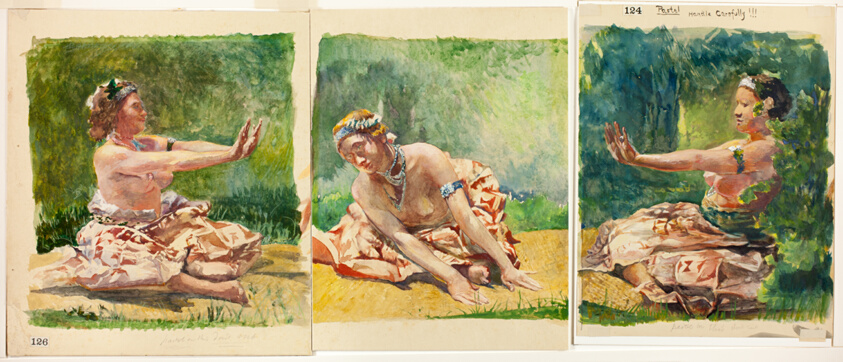
How might art history reveal the epistemological contours of nineteenth-century US imperialism? This talk examines the American artist John La Farge’s depictions of Oceania and ideas of temporality, arguing that his paintings, like those of other foreign artists, imposed a colonizers’ system of knowledge upon Indigenous subjects. Many of La Farge’s sketches, made in 1890-91, shortly before the US took control of what is today American Samoa, depict Indigenous dance—an artform not just predicated upon keeping time but also associated with history and memory. Colonial temporality had a lasting effect in Oceania, and I examine its legacy through the work of contemporary Samoan artist Yuki Kihara, who manipulates the Western mediums most associated with ordering time—photography and video— to contest temporal sources of colonial power on both human and planetary scales.
Maggie Cao is an Associate Professor of Art History and David G. Frey Scholar at the University of North Carolina at Chapel Hill. Her research focuses on the intersections of art with histories of technology, natural science, and economics in eighteenth and nineteenth-century United States. She is the author of two books, The End of Landscape in Nineteenth-Century America (University of California Press, 2018) and Painting US Empire: Nineteenth-century Art and Its Legacies, published last year by the University of Chicago Press. Her current research examines art and ecological temporalities. She is also an editor of the interdisciplinary journal Grey Room.