
Wide-Temperature-Range Superelasticity in an Additively Manufactured Shape Memory Alloy
Dr Kang Jingtao, Dr Niu Pengda, Dr Li Ruidi, Dr Ji Weiming, Dr Zheng Dan, Dr Xiao Junfeng, Dr Wang Minbo, Dr Gan Kefu, Dr Chen Huaican, Dr Yin Wen, Dr Yuan Tiechui, Dr Xu Sheng, Professor Zhou Kun
Introduction:
Additively manufactured superelastic components that operate across wide temperature ranges are attractive for aerospace, robotics and reusable energy-absorbing systems. However, achieving tensile superelasticity over a broad sub-ambient temperature range while maintaining robust additive manufacturability remains challenging. This challenge limits the use of additively manufactured shape-memory alloys in applications involving substantial temperature variations below room temperature.
Key Highlights:
- We developed a powder-decoration strategy incorporating 2 at.% Ni into pre-alloyed Cu–Al–Mn powder, improving laser absorption, densification and grain refinement during laser powder bed fusion while stabilizing austenite at sub-ambient temperatures.
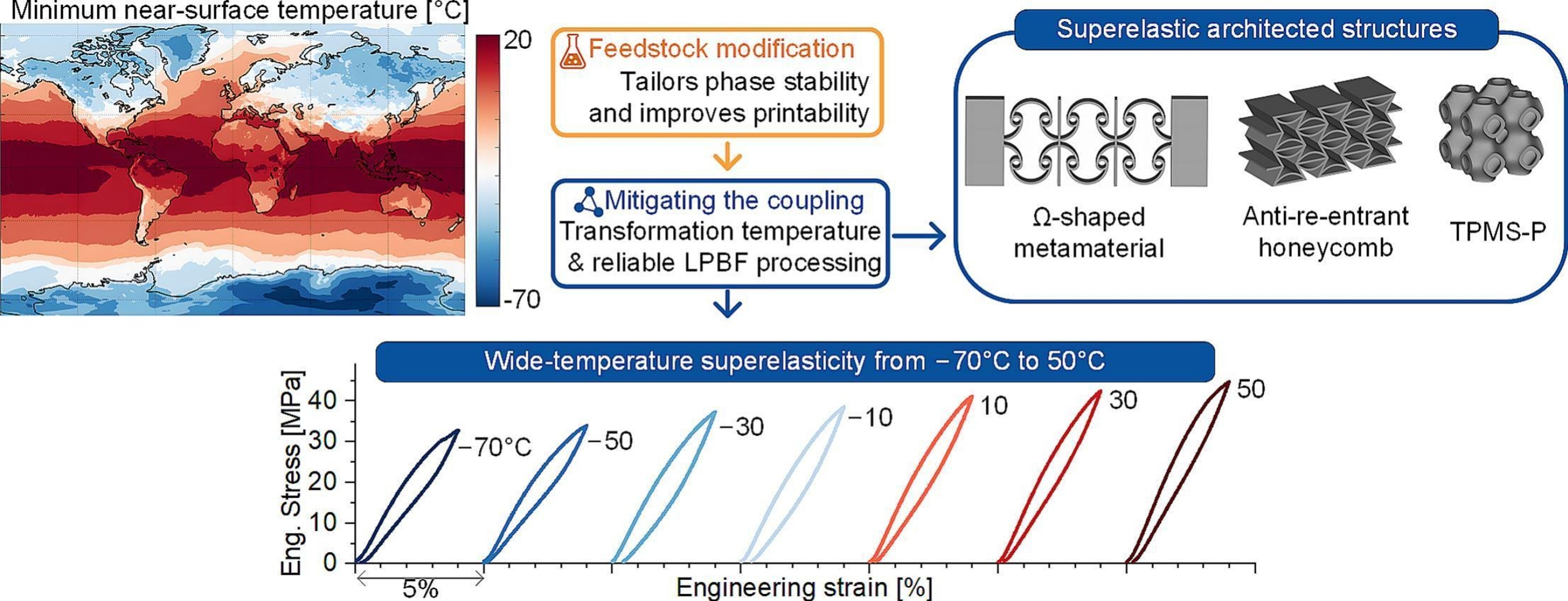
- The additively manufactured alloy exhibits bulk tensile superelasticity from −70 °C to 50 °C, together with a tensile strength of ~1.3 GPa, an elongation of 9% and a recoverable tensile strain of ~4%.
- In situ neutron diffraction reveals a highly reversible martensitic transformation between L2₁ and 6M underlying the superelastic response, with bulk specimens dissipating 15.6 MJ m⁻³ of energy during a tensile loading–unloading cycle to 4.8% strain.
The superelastic response extends to architected structures: Ω-shaped metamaterials achieve ~30% recoverable tensile strain over 10 cycles at room temperature, while TPMS and auxetic lattices retain ~4% recoverable compressive strain from −70 °C to 50 °C, enabling reusable energy absorption across a wide temperature range.
This study demonstrates that decorating Cu–Al–Mn powder with 2 at.% Ni enables reliable additive manufacturing of superelastic components that operate from −70 °C to 50 °C, combining high tensile strength with recoverable deformation. These capabilities extend to complex architected structures, enabling reusable energy absorption across the same temperature range.
Source: https://www.sciencedirect.com/science/article/abs/pii/S1369702126003226