
Rationalising the Onset of Bistability in Polylactic Acid (PLA) Bilayer Laminates using Fused Filament Fabrication (FFF)
Professor Eleonora Ferraris and Associate Professor Hortense Le Ferrand, Dr Hongyu Zhou, Dr Jie Zhang, Shi En Lim
Introduction:
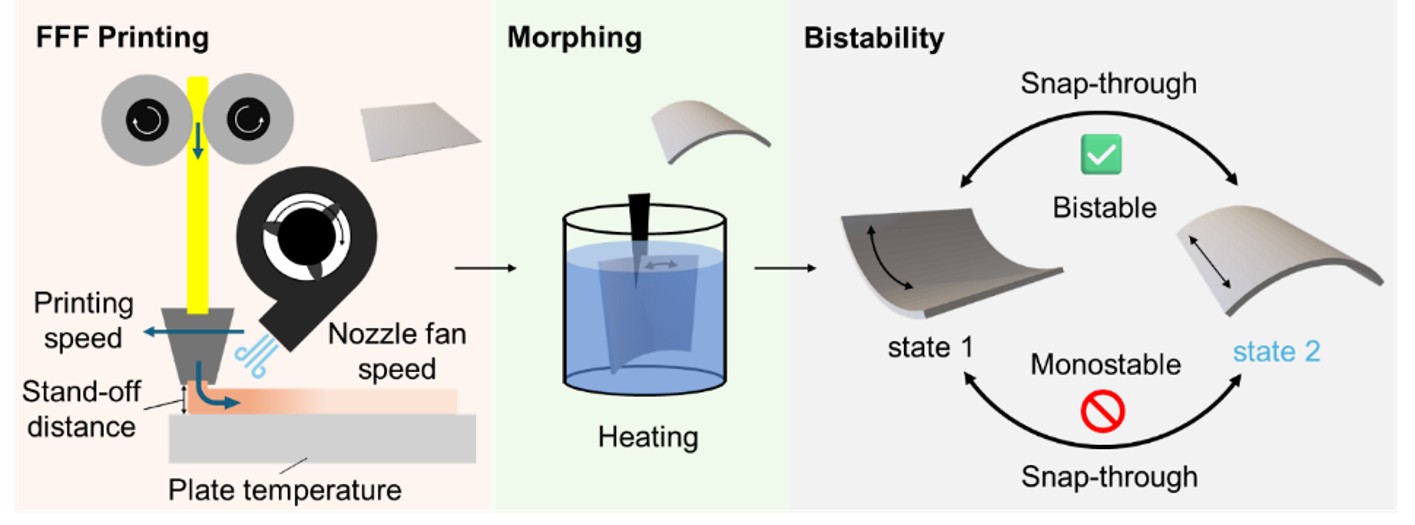
Whilst 4D printing via Fused Filament Fabrication (FFF) enables the creation of shape-morphing structures, programming advanced mechanical functionalities like bistability into the material is challenging. This study investigates the effects of in-situ printing parameters on PLA bilayer laminates by combining experimental characterisation with 3D transient thermal process simulations (T4F3). This combined approach systematically rationalises how printing parameters translate into the internal energetic landscape for bistability.
Key Highlights:
- Demonstrated that bistability is fundamentally governed by the energetic process where pre-strains are induced, stored and released, arising from the entropic elasticity of amorphous PLA polymer chains stretched during extrusion and post-heating treatment.
- Identified printing speed as the primary factor for inducing pre-strain (curvature ranging from 0.1 to 1.0 cm−1). A bistability window was also mapped where the top layer printing speed is controlled between 20 and 65 mm∙s-1 when the bottom layer printing speed fixed at 30 mm∙s-1.
- Proved that rapid in-situ cooling (higher fan speed and lower plate temperatures) effectively freezes stretched polymer chains, storing pre-strain to enhance macroscopic curvature upon post-printing heating.
- Utilised 3D transient thermal simulations to quantify the cumulative thermal effect, revealing a 4-second inter-layer reheating peak above Tg. This successfully decoupled in-situ viscoelastic stress relaxation from shear-induced chain elongation.
Conclusion:
This study establishes a comprehensive framework for programming bistability directly using PLA via FFF. By outlining the energetic principles of morphing controlled by printing parameters, this work paves the way for cost-effective, customisable deployable structures, such as smart packaging or aerospace components, where manufacturing simplicity and one-time shape changes are prioritised over infinite fatigue life.
Source: https://doi.org/10.1080/17452759.2026.2618395