
Robotic Rebar Insertion and Grouting for Reinforcement of 3D Printed Concrete: Technique Development and Bond Behavior Characterization
Professor Ming Jen Tan, Associate Professor Teck Neng Wong, Dr Xiangyu Wang, Dr Sizhe Wang, Dr Beifang Deng, Dr Zhenbang Liu, Dr Mingyang Li, Dr Kah Jun Yam, Dr Quoc Nghia Vuong, Dr Bak Koon Teoh
Introduction:
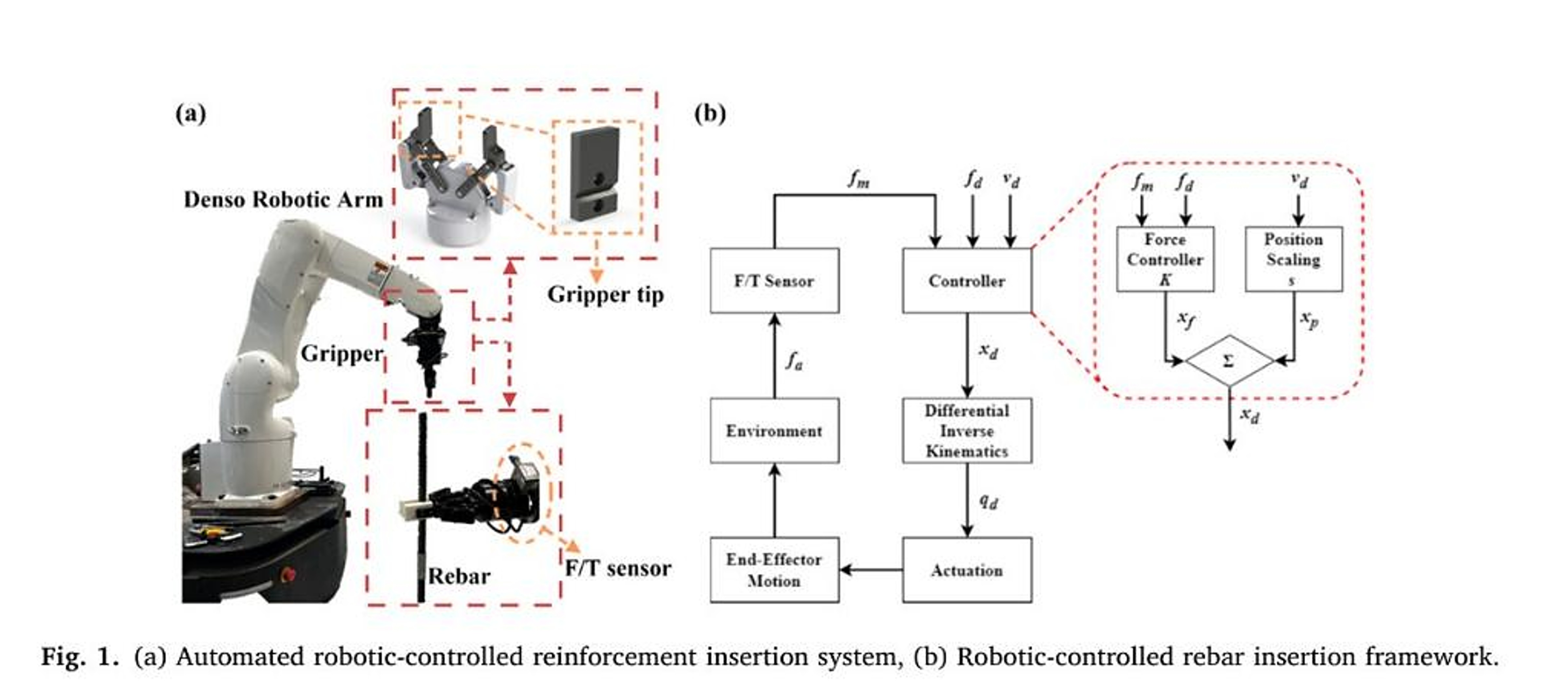
This study explores vertical insertion of steel rebars into 3D printed concrete (3DPC) using a mobile robotic arm, enabling reinforcement during the printing process. A robotic system comprising a mobile base, a 6-axis robotic arm, a force/torque sensor, and a gripper was employed, alongside a dedicated algorithm for self-calibrating surface detection and force-controlled insertion. To enhance bond performance, grouting with epoxy or high-flowability cementitious materials was investigated-Existing bond-slip models were evaluated for robotically inserted rebars, showing reasonable predictions for splitting failure but limited accuracy for pull-out failure. An analytical model was developed based on thick-walled cylinder and fictitious crack models. Overall, robotic rebar insertion (combined with grouting) achieved an acceptable bond performance by observing rebar fracture during the pull-out test, demonstrating the feasibility and potential of this automated reinforcement strategy in 3D printed concrete structures.
Key Highlights:
- Robotic rebar insertion and grouting is proposed for vertical reinforcement of 3D printed concrete.
- A robotic arm with surface detection and force control is developed for automation.
- Pull-out tests show failures such as splitting, pull-out, and rebar fracture.
- Rebar insertion (with grouting) achieves bond strength comparable to conventional cast concrete.
- Bond-slip curves are analyzed and compared with existing models.
Conclusion:
This study investigates an automated reinforcement method for 3D printed concrete (3DPC). It is demonstrated that the bond between the inserted rebars and the printed concrete attains sufficient strength for effective anchorage, allowing rebar fracture to serve as the primary failure mode. The findings establish the feasibility of the robotic rebar insertion strategy and underscore its potential for engineering applications.
Source: https://doi.org/10.1016/j.addma.2026.105078