
Physicochemical-informed Predictive Modelling on Small Datasets for Designing Conductive Polymer Inks in Soft Bioelectronics
Dr Jia Min Lee, Dr Xinchao Gao and Professor Wai Yee Yeong
Introduction
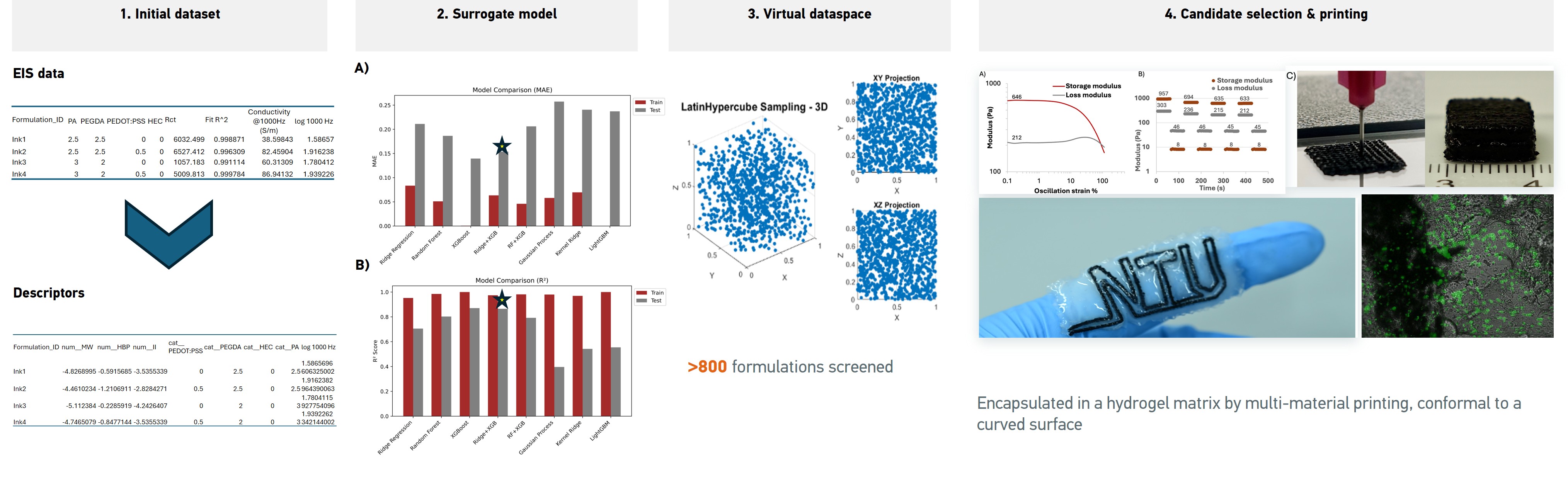
In conductive bioink design, small composition changes cause non-linear properties, making optimisation slow and expensive. Bioprinting datasets rarely exceed a few dozen samples. Instead, the model uses physicochemical descriptors derived from SMILES, including hydrogen-bonding potential, and ionic interaction. The workflow prints a predicted formulation and tests its biocompatibility.
Key Highlights
- We developed a pipeline that screens data by fitting impedance spectroscopy results to a modified Randles circuit. Only fits with R² above 0.9 enter training. It then log-transforms conductivity and molecular weight, which span several orders of magnitude.
- A stacked ensemble of Ridge and XGBoost regression models gave the best balance, with a test R² of 0.865 and an MAE of 0.154. SHAP analysis showed the ensemble relies about 59% on Ridge and 41% on XGBoost. HEC, added mainly to control viscosity, also helps build the conductive network through hydroxyl–sulfonate interactions.
- Over 800 virtual formulations screened for high-conductivity candidates. The selected ink showed shear recovery suitable for multi-material extrusion. Embedded in hydrogel, it conformed to curved surfaces. Printed alongside C2C12-laden hydrogel, it kept cell viability above 95%.
Conclusion
This study shows that descriptor design, an ensemble model, and bootstrapped evaluation can produce a useful surrogate model from a small dataset of soft materials. The authors hope to integrate this closed-loop approach towards automating material pre-selection with language models or knowledge graphs, and moving the ink into in vitro electrophysiology models and wearable bioelectronics.
Source: https://www.nature.com/articles/s41528-026-00587-9