Shared discovery in 21st-century classrooms
Prof Chen Wenli's research is improving collaborative learning experiences with technology-enhanced teaching.
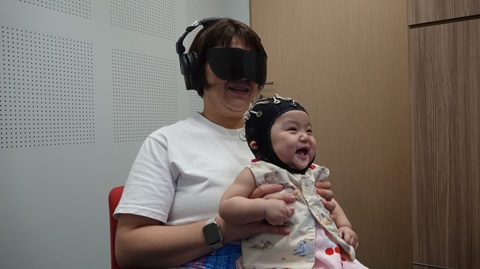
.jpg?sfvrsn=fba51b63_1) The research team uses technologies, such as neuroimaging and eye-tracking pictured here, in studies to better understand the effect of differently designed learning activities on students when they learn collaboratively. Credit: NIE.
The research team uses technologies, such as neuroimaging and eye-tracking pictured here, in studies to better understand the effect of differently designed learning activities on students when they learn collaboratively. Credit: NIE.
By Chen Wenli and Lyu Qianru
Students in the 21st century engage in collaborative learning, where they learn, discuss ideas and solve problems together as a group. Simply grouping students together, however, does not guarantee effective collaborative learning.
For collaborative learning to be successful, students in a group need to work towards a shared objective. They need to depend on and support one another while building their knowledge in the process. And technology, supported by appropriate teaching methods, can improve the process.
At NTU’s National Institute of Education, our research develops technologies and pedagogies to help students work together more effectively, so that they can understand what they learn more deeply. Students also acquire skills crucial for success in today’s world – dubbed “21st century competencies” – particularly in communicating and collaborating, gathering and processing information, adjusting to different situations, and thinking critically and creatively.
MAPPING IDEAS TOGETHER
One of our key technological innovations is AppleTree, an online diagram-based learning platform designed to help students collaborate in coming up with arguments for and against a given topic.
Like mind maps, the system helps students visually organise their ideas, the claims presented to them, and the evidence for and made against these claims during group discussions. Instead of writing conventional argumentative essays that start with an introduction and end with a conclusion, students work together to build “argument diagrams” that create webs of interconnected ideas on a screen.
For example, students can use AppleTree to organise their ideas into separate bubbles and visually link related ideas with arrows. The goal is to help students focus on the big picture of their arguments, identifying the main claim and understanding how different ideas support or challenge it.
AppleTree has mechanisms built in to enhance the learning process by helping students refine their arguments when they work together. It also enables educators to assess and analyse learning outcomes in real time.
.jpg?sfvrsn=dcb79ac3_1) An illustration of how the AppleTree platform visually displays and organises points to help students learn together. The light blue cloud represents an idea that students have not yet classified as a claim or as evidence for or against a claim. The dark blue oval represents a claim. The green boxes represent evidence for (with green arrow) and against (with red arrow) an idea, a claim or another piece of evidence. Credit: NIE.
An illustration of how the AppleTree platform visually displays and organises points to help students learn together. The light blue cloud represents an idea that students have not yet classified as a claim or as evidence for or against a claim. The dark blue oval represents a claim. The green boxes represent evidence for (with green arrow) and against (with red arrow) an idea, a claim or another piece of evidence. Credit: NIE.
AppleTree encourages students to learn together in five phases, based on a “spiral model of collaborative knowledge improvement”, developed by our research team.
First, students are asked to come up with ideas on a given topic and share them with their classmates on the platform. Next, they work in small groups to discuss these individual ideas, consolidate their diverse ideas on the platform, and identify the best ones.
In the third phase, students review ideas shared by other groups on AppleTree and provide constructive feedback. Then, each group revisits and refines its own ideas based on the comments received. Finally, each student is asked to reflect on the exercise and write down their learning outcomes.
Our research team has implemented AppleTree in various Singapore classrooms across subjects like science, language learning and social studies. Whether students are debating environmental policies, analysing literary texts or exploring historical events, the platform helps them see multiple perspectives and build stronger arguments together.
Empirical findings from statistical analyses on AppleTree usage show tangible benefits – students could come up with more comprehensive and coherent arguments, indicating improved logical reasoning and critical thinking. Their motivation to learn also increased and their understanding of a topic deepened. More importantly, students showed enhanced cognitive abilities and greater cognitive awareness when communicating, debating and critiquing one another’s arguments in complex problem-solving settings.
GETTING INSIGHTS TO DESIGN BETTER LESSONS
Beyond targeted classroom teaching strategies like AppleTree, our team is also taking a closer look at how students learn together.
Harnessing cutting-edge technologies, we are exploring how differently designed learning activities affect students’ cognitive, social, emotional and behavioural engagement during collaborative learning. These technologies include neuroimaging, eye-tracking, electrodermal activity sensors and techniques using artificial intelligence (AI) for facial recognition and gesture analysis.
These studies help us capture detailed learning behaviours across different factors, bridging the fields of educational neuroscience and AI. Ultimately, this work will provide valuable insights to help teachers develop more nuanced ways to design and facilitate collaborative learning.
Our research innovations have been successfully implemented in primary and secondary schools, as well as in higher education settings across Singapore. With our technology-enhanced teaching strategies and tools, educators can implement meaningful collaborative learning activities even in large classrooms for students to brainstorm, share and build upon their ideas. In the process, they collectively make sense of information to expand and improve their knowledge, often in fast-paced environments.
As classrooms continue to evolve, our research contributes to building future-ready learning environments, where students not only acquire knowledge, but also develop the collaboration and critical thinking skills needed for the world ahead.
---
Prof Chen Wenli is Associate Dean for Research Support at the National Institute of Education’s (NIE) Office for Research in NTU. Her research interests include computer-supported collaborative learning and learning analytics. Assoc Prof Chen’s interdisciplinary research seeks to bridge theory and practice to transform classroom practices through innovative technology-enhanced teaching strategies for interactive group learning.
Dr Lyu Qianru is a former PhD student at NIE supervised by Assoc Prof Chen. She is currently a Postdoctoral Researcher at the Human-Computer Interaction Institute at Carnegie Mellon University.
Details of this research can be found in Instructional Science (2025), DOI: 10.1007/s11251-025-09704-z; Journal of Computer Assisted Learning (2024), DOI: 10.1111/jcal.13073; and Educational Technology Research and Development (2023), DOI: 10.1007/s11423-023-10258-5.
The article appeared first in NTU's research & innovation magazine Pushing Frontiers (issue #25, August 2025).
.tmb-listing.jpg?sfvrsn=6ddb47de_2)
.tmb-listing.jpg?sfvrsn=f43836b1_2)
.tmb-listing.jpg?sfvrsn=ba129532_2)