NTU scientists predict severe dengue with urine test
The test can help doctors assess if dengue patients require further care in hospital.
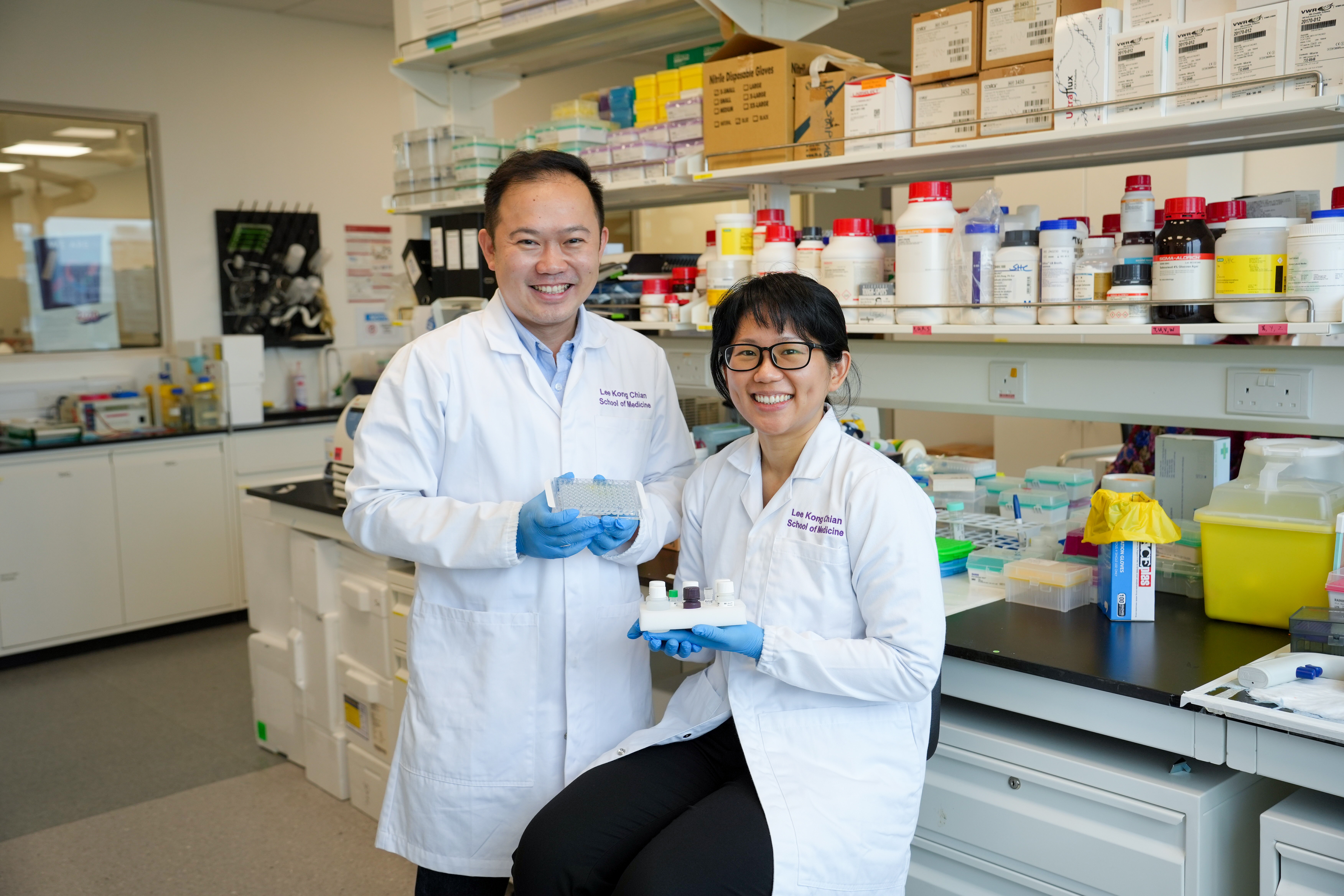
Dr Andrew Teo (left) and Dr Chia Po Ying, one of the co-authors of the study.
Scientists led by Nanyang Technological University, Singapore have discovered that specific proteins in urine can accurately predict the likelihood of dengue patients developing severe dengue.
The findings could help doctors assess if a dengue patient can be sent home for recovery or if they require hospitalisation for further treatment, prioritising care for those who need it most as well as easing the burden on healthcare resources.
According to the researchers, this is the first-of-its-kind test to predict the risk of severe dengue.
The study was led by Dr Andrew Teo and Assoc Prof Yeo Tsin Wen of NTU’s LKCMedicine, and published in Open Forum Infectious Diseases in January.
Predicting if dengue is life-threatening
Dengue, one of the world’s most prevalent mosquito-borne diseases, is spread through the bite of infected mosquitoes. Although most patients with dengue recover fully at home without the need for additional care in hospital, between two to five per cent of dengue patients will develop severe dengue. The complications of severe dengue include severe bleeding, organ failure and death.
Dengue patients experience high fever in the first 72 hours, followed by a critical phase when the fever subsides, before recovering. Severe dengue usually develops during the critical phase, when complications of the disease arise. To determine which patients will progress to severe dengue, physicians use a checklist of seven warning signs from the World Health Organization to identify those at risk of developing life-threatening dengue. However, subjective interpretation of these symptoms can result in unnecessary hospitalisations.
Detecting severe dengue early
Increased levels of neutrophil gelatinase-associated lipocalin (NGAL) and soluble urokinase plasminogen activator receptor (suPAR) – proteins associated with inflammation – have been linked to severe dengue and could be indicators of life-threatening dengue.
The researchers measured NGAL and suPAR concentrations in urine samples from dengue patients as well as healthy individuals, and the results suggested that urinary NGAL and suPAR levels were significantly elevated in dengue patients compared to the individuals without dengue, with concentrations rising with disease severity.
Both suPAR and NGAL levels in the patients’ urine collected before the onset of the critical phase could predict the likelihood of patients developing severe dengue three to four times more accurately than warning signs alone.
“Our results indicate that measuring urinary NGAL and suPAR, in combination with dengue warning signs, can significantly reduce unnecessary hospital admissions without an increased risk of misdiagnosis of severe cases,” says Dr Teo, who is a senior research fellow at LKCMedicine.
“This will help healthcare professionals identify if a patient is likely to develop life-threatening dengue before severe symptoms surface and provide better care, especially during dengue outbreaks,” adds Dr Chia Po Ying, senior consultant and head of the Research Office at the National Centre for Infectious Diseases in Singapore, who was one of the co-authors of the study.
“The discovery of urinary biomarkers to predict severe dengue is a game-changer, and this simple, non-invasive urine test has the potential to transform clinical management of the disease by enabling timely intervention,” says Prof Neelika Malavige, a dengue expert from the University of Sri Jayewardenepura in Sri Lanka who was not involved in the study.
The researchers are currently working to develop and validate an all-in-one test that measures NGAL, suPAR and dengue proteins in urine, potentially allowing patients to monitor their condition at home.
Find out more in "Urinary neutrophil mediators as predictive biomarkers for severe dengue in adults", Open Forum Infectious Diseases (2026), DOI: 10.1093/ofid/ofaf813.

.tmb-listing.jpg?sfvrsn=8d60272d_1)