Building nanomaterials with tiny dumbbells
Scientists from NTU and Fudan University have created dumbbell-shaped nanoparticles that assemble on their own to form novel nanomaterials.
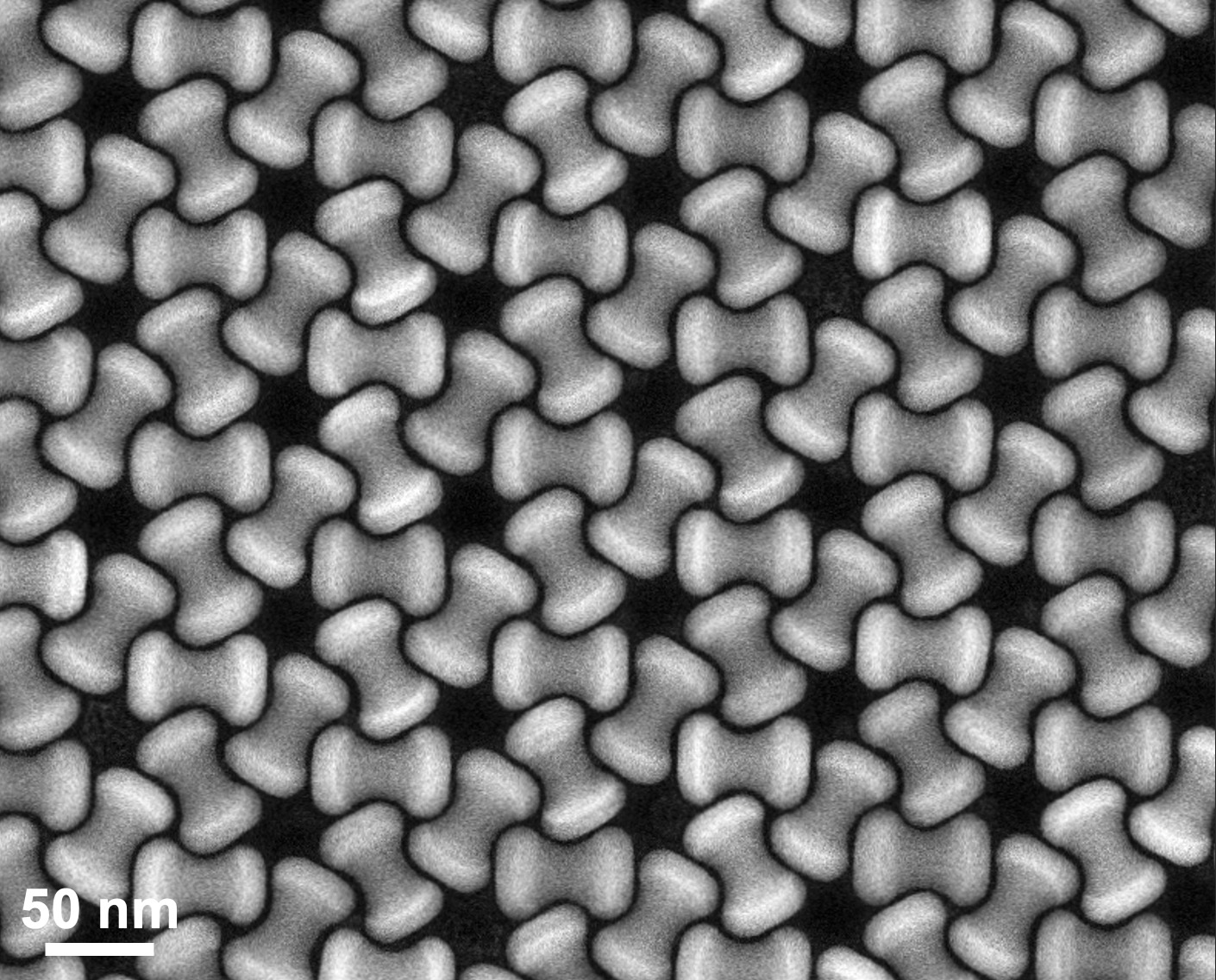 The dumbbell-shaped nanoparticles can assemble on their own to form various arrangements, including a structure called a Kagome lattice, which has novel photonic properties (above). Credit: Science, 2025, 387, 978–984.
Scientists from NTU and Fudan University, China, have developed a new type of nanoparticle that can self-assemble into various diverse and intricate arrangements without aggregating or clumping – a long-standing challenge associated with self-assembly.
To prevent clumping, the researchers created nanodumbbells that can interlock with one another like tiles to form various ordered arrangements. They found that adding oleic acid – a type of “healthy fat” commonly found in everyday foods – into the nanoparticle suspension increases the attraction between adjacent nanoparticles, which pushes them together as the solvent evaporates.
Using the nanoparticles, the researchers formed a two-dimensional lattice pattern called a Kagome lattice – a structure with novel photonic properties that is difficult to create with conventional self-assembling nanoparticles.
“Our nanodumbbells are versatile building blocks that can be used for various applications, such as to create nanomaterials with unique properties,” says Assoc Prof Ni Ran of NTU’s School of Chemistry, Chemical Engineering & Biotechnology, who co-led the research.
Read more in “Curvature-guided depletion stabilises Kagome superlattices of nanocrystals” in Science (2025), DOI: 10.1126/science.adu4125.
The article appeared first in NTU's research & innovation magazine Pushing Frontiers (issue #26, May 2026).