The Twist That Transformed Quantum Materials: The 2026 Kavli Prize in Nanoscience
Assistant Prof Su Rui | School of Physical and Mathematical Sciences, NTU
Imagine placing two transparent sheets with repeating patterns on top of each other. When one sheet is rotated slightly, an entirely new pattern emerges from the interaction between the two layers. This phenomenon, known as a moiré pattern, may seem like a simple optical effect, but at the atomic scale it can unlock a new world of possibilities.
e380af8b-efc1-4d88-8fbe-5385677b72fb.png?sfvrsn=253fdc94_1 "IAS websitenewsletter thumbnail (480 x 288 px)") Image Credit: https://www.kavliprize.org/prizes/nanoscience/2026
Image Credit: https://www.kavliprize.org/prizes/nanoscience/2026
This remarkable discovery has transformed the way scientists design and understand quantum materials. The 2026 Kavli Prize in Nanoscience has been awarded to Prof Eva Y. Andrei (Rutgers University, USA), Prof Pablo Jarillo-Herrero (Massachusetts Institute of Technology, USA) and Prof Allan H. MacDonald (University of Texas at Austin, USA) for their pioneering contributions to the field of twistronics, harnessing the twist between atomic layers to engineer new quantum states and explore the frontiers of nanoscience.
The story of twistronics began in 2009, when Prof Eva Y. Andrei and her research team made a pioneering discovery using two slightly misaligned graphene layers. They found that even a small twist between the layers could dramatically alter the material's electronic properties. Most remarkably, they identified a special twist angle where electrons slowed down and interacted much more strongly, giving rise to a new collective electronic state. This breakthrough established the experimental foundation of twistronics and introduced twist angle as a powerful new degree of freedom for engineering quantum materials.
With these observations, Prof Allan H. MacDonald and his collaborators made a landmark theoretical prediction in 2011. They developed a model showing how twisting two graphene layers by specific "magic" angles dramatically reshapes their electronic structure, creating nearly flat energy bands where electrons interact much more strongly than usual. His theory explained the unusual electronic behaviour observed in earlier experiments and predicted that these flat bands could host a wide range of exotic quantum states. This elegant framework transformed a surprising experimental observation into a general design principle, providing scientists with a powerful roadmap for engineering new quantum materials.
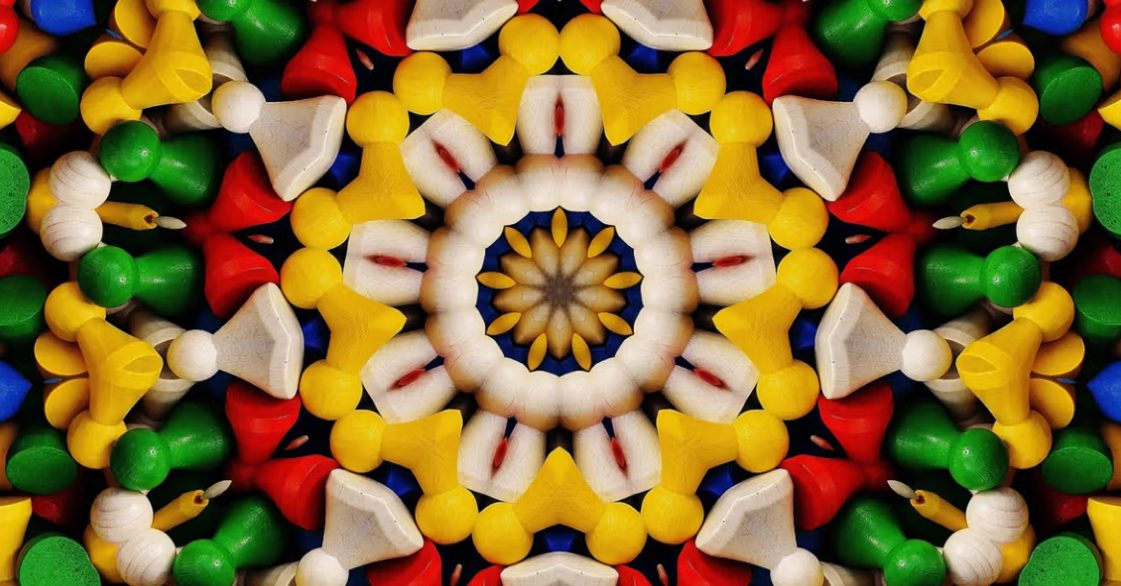 Rotationally symmetrical structure that can be seen by peering into a kaleidoscope.
Image Credit: https://www.kavliprize.org/prizes/nanoscience/2026#ownwords
The field reached a major breakthrough in 2018, when Prof Pablo Jarillo-Herrero and his collaborators experimentally realised magic-angle twisted bilayer graphene. They discovered that this simple twisted structure could exhibit both insulating behaviour and superconductivity, where electricity flows without resistance. This discovery demonstrated that changing only the relative orientation of two atomic layers could transform the fundamental properties of a material, establishing twistronics as a new frontier in quantum materials research.
Since then, twistronics has expanded far beyond graphene. At NTU, multiple groups have applied twist engineering to a wide range of atomically thin materials, uncovering novel magnetism, topological phases, correlated quantum states, and unconventional optical properties. More recently, these concepts have been further extended to moiré photonics, where twisted photonic structures enable flat bands, topological light, and engineered light–matter interactions. Building on this emerging direction, one of key research interests from our group at NTU explores moiré polaritonics, combining twist engineering with exciton polaritons to realize flat-band condensation, topological phases, and non-Hermitian phenomena. These efforts establish a versatile platform for investigating strongly interacting quantum fluids of light and developing next-generation quantum photonic devices.
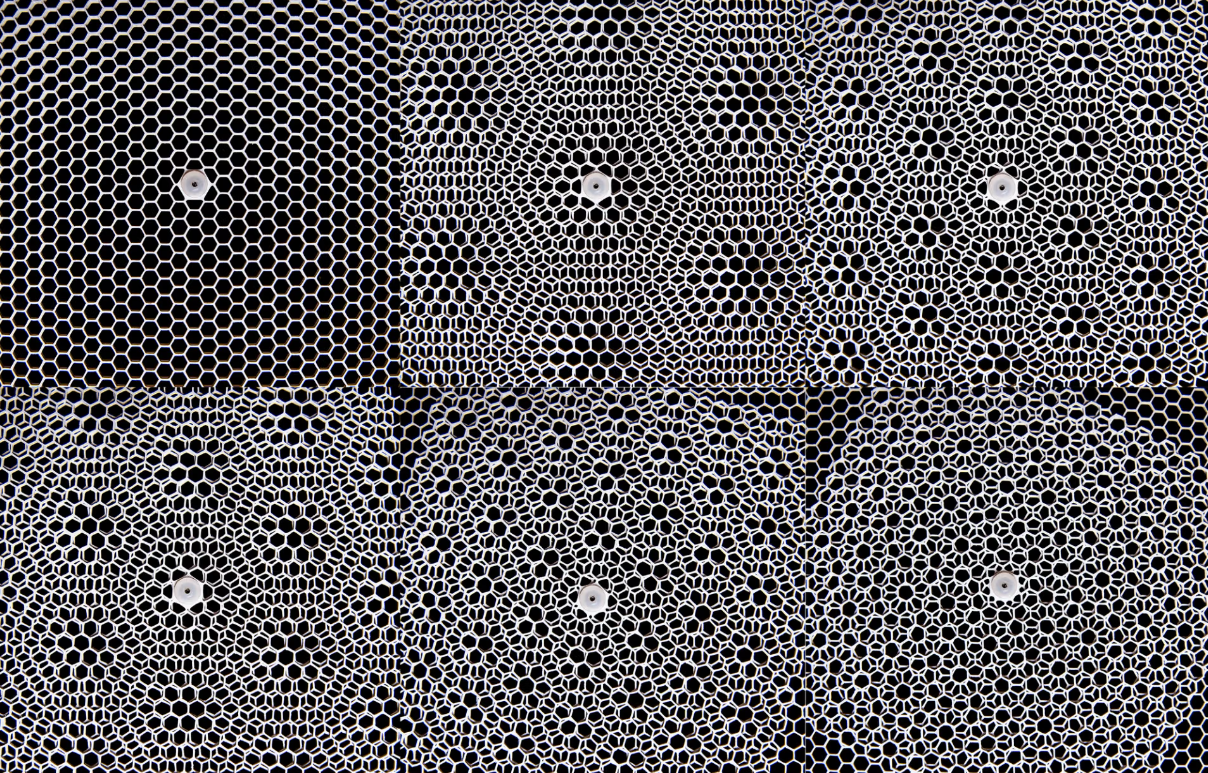 Moiré pattern formed when twisting to overlapping graphene layers.
Image Credit: https://www.kavliprize.org/prizes/nanoscience/2026#ownwords
The 2026 Kavli Prize in Nanoscience celebrates not only three remarkable scientific achievements, but also a new way of thinking about nanomaterials. The work of Eva Andrei, Pablo Jarillo-Herrero and Allan MacDonald show that even a tiny twist between atomic layers can unlock an entirely new world of possibilities. Their discoveries have reshaped our understanding of quantum materials and continue to inspire the development of future technologies.
For more information, watch the video on The 2026 Kavli Prize in Nanoscience here.

.tmb-listing.jpg?sfvrsn=192338ba_1)
.tmb-listing.jpg?sfvrsn=c45c3c7e_2)