Spotting the Aftermath of Milky Way Galaxy’s Violent Past: The 2026 Kavli Prize in Astrophysics
Dr Leek Meng Lee | School of Physical and Mathematical Sciences, NTU
The 2026 Kavli Prize in Astrophysics is awarded to Vasily Belokurov, Amina Helmi and Rodrigo Ibata who had carried out detailed data analysis of enormous datasets from the Sloan Digital Sky Survey (SDSS) and the Gaia space mission to uncover the debris fields when small galaxies merged into Milky Way galaxy, thereby providing clear observational evidence that our galaxy is formed from repeated, violent mergers.
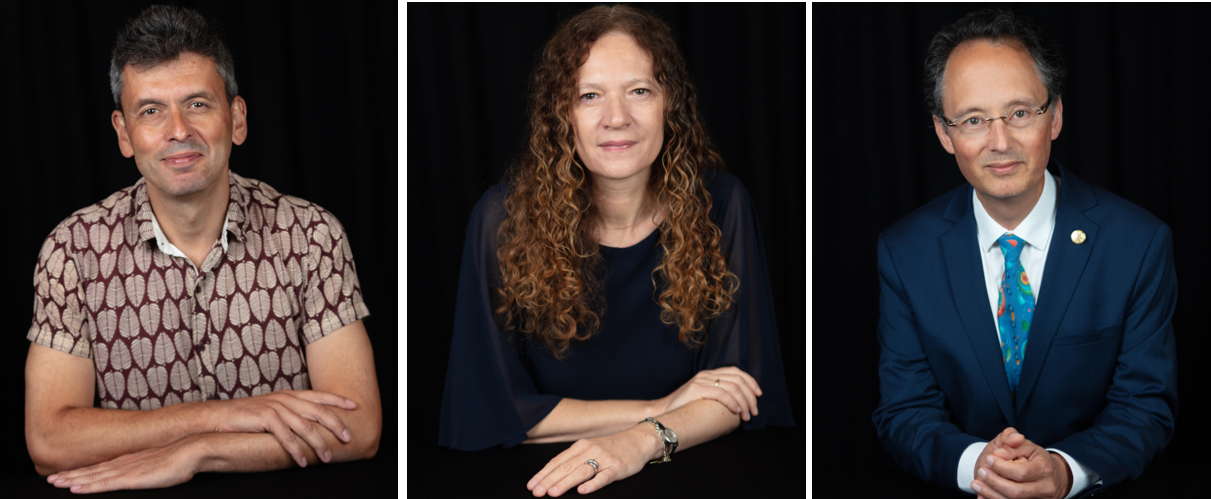 From left: Vasily Belokurov (University of Cambridge); Amina Helmi (University of Groningen); Rodrigo Ibata (CNRS and University of Strasbourg). Image credit: www.kavliprize.org
Astrophysics and Archeology are similar in the sense that they are both trying to reconstruct history by making observations at one point in time, i.e. the present day. In astrophysics, this is done through building telescopes that are increasingly powerful in order to obtain highly precise data. The European Space Agency (ESA) Gaia mission has obtained a huge amount of data on distances to stars, their velocities and chemical compositions (through spectroscopy). These datasets are a treasure trove but they require researchers to ask meaningful questions and connect the dots in order to make sense of the data and piece together groundbreaking results. The 3 Laureates demonstrated exactly that by seeking to understand the evolution of our Milky Way galaxy and other large galaxies from the data.
It is worth mentioning more about the Gaia mission to see why it may drastically improve our understanding of galactic structure formation. Gaia is essentially a giant camera with a billion pixels. It operated from July 2014 to January 2025 while taking very precise measurements of two billion stars within and beyond Milky Way galaxy. It mapped their motions, luminosity, temperature and composition. It has since released three datasets and the fourth dataset is expected to be released in December 2026 while the 5th dataset is the final one that will be released by the end of 2030. With the first 3 datasets, there is already a great discovery that is mentioned in this article. That means there are potentially many more discoveries to make when the new datasets are released analysed thoroughly. We will now elaborate on the insights injected by the Laureates that showed insightful data analytics.
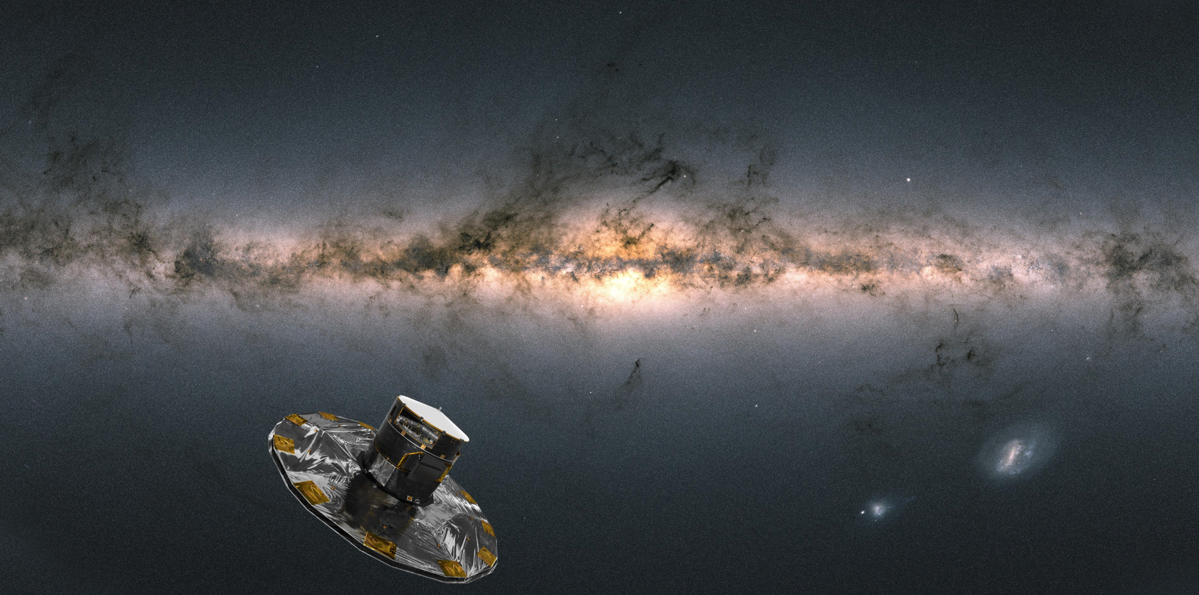 An artist's impression of ESA's Gaia satellite observing the Milky Way. The background image of the sky is compiled from data from more than 1.8 billion stars. Image credit: European Space Agency
Vasily Belokurov used the datasets and mapped out the positions and motions of old halo stars and realised that they are distributed as several streams which are likely to be remains of small galaxies that merged with Milky Way. In 2018, the precision data from Gaia allowed Belokurov to identify the remains of the last major merger between a large dwarf galaxy and Milky Way galaxy. This stream/dwarf galaxy is named the “Gaia-Enceladus Sausage”.
Amina Helmi, independently from Vasily Belokurov, used chemical composition of stars from the SDSS’ APOGEE spectroscopic survey, to distinguish between Milky Way old halo stars and young stars from merging dwarf galaxies. She also discovered, from the 2nd dataset release, the “Gaia-Enceladus Sausage” and deduced that the event occurred roughly 10 billion years ago and the event heated the disk of Milky Way galaxy.
Rodrigo Ibata, in 1994, discovered that the Sagittarius dwarf galaxy is still being merged into Milky Way galaxy in the present day which means that Milky Way galaxy is still merging with its satellite galaxies. Furthermore, through SDSS data, he discovered that the Sagittarius stream of carbon-rich stars wraps around the polar trajectory of Milky Way galaxy. This allows researchers to deduce the dark matter distribution around our galaxy. He has also mapped the halo of Andromeda galaxy which helps to further our understanding of galactic structure formation.
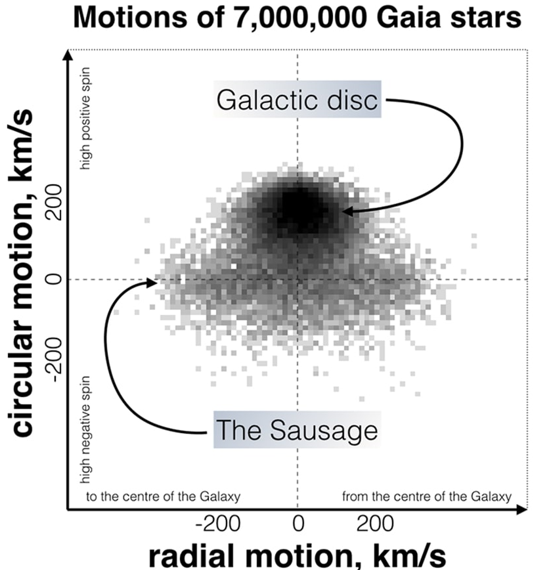
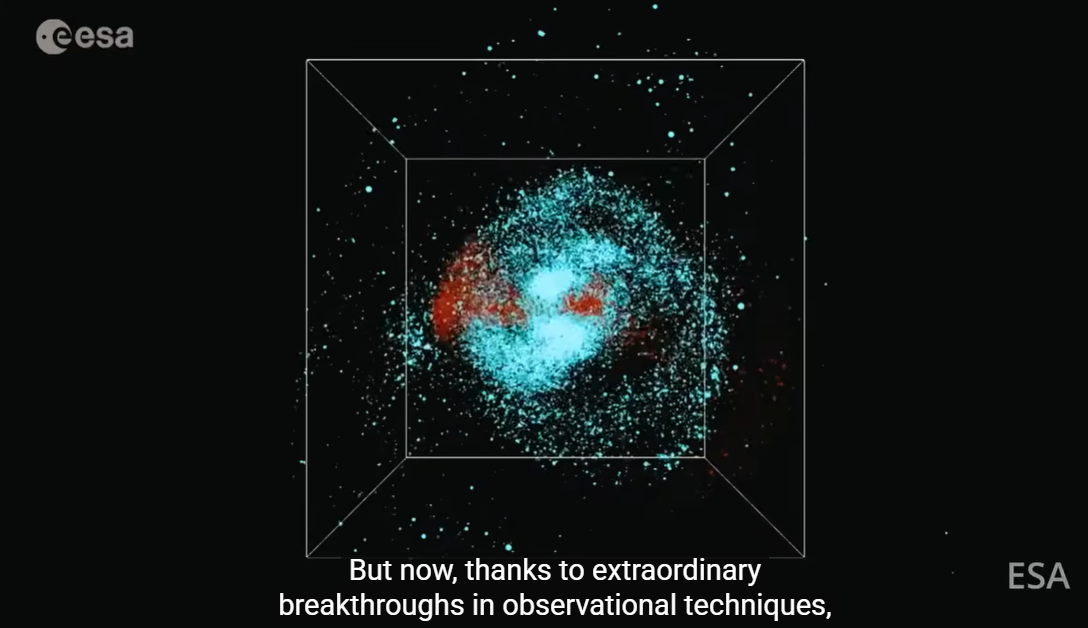
When looking at the distribution of star velocities in the Milky Way, the stars of the Sausage galaxy form a characteristic sausage-like shape. This unique shape is caused by the strong radial motions of the stars.
At NTU Physics, students also get to work with renowned researchers from prestigious institutes such as NASA to access datasets and analyse phenomena such as solar weather, planetary geophysics as well as uncovering properties of exoplanetary systems.
For more information, watch the video on The 2026 Kavli Prize in Astrophysics here.
-(9).tmb-listing.jpg?sfvrsn=22fb3ee8_1)
.tmb-listing.jpg?sfvrsn=c45c3c7e_2)