Route to Experimental Demonstrations of Altermagnetism by Prof Tomas Jungwirth
IAS Frontiers Seminars: Quantum Horizons, Seminar #3 (AY26/27)
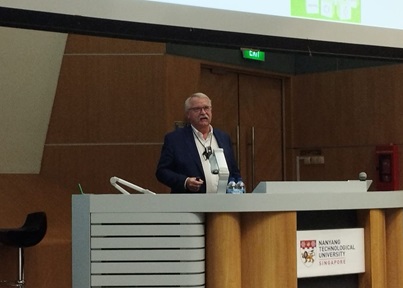
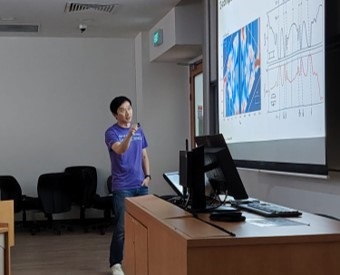
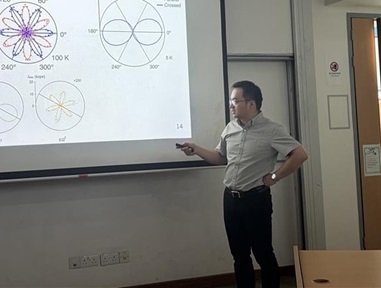
The IAS Frontiers Seminar on Quantum Horizons on 2nd November 2026, featured Prof Tomas Jungwirth (Institute of Physics, Czech Academy of Sciences). Prof Jungwirth presented the development of spintronics from conventional magnetic memory to antiferromagnetic devices and altermagnets. He emphasised the role of crystal and magnetic symmetries in determining spin splitting and spintronics functionality. He also highlighted how recent experiments establish routes to spin-dependent electronic responses without net magnetisation.
Prof Jungwirth introduced magnetic relays used in early digital computers in the 1940s, in which an electromagnet opens or closes a mechanical switch to represent the binary states zero and one. He highlighted both the mechanical moving parts and the difficulty of isolating the magnetic fields generated by the relay coils. He then discussed semiconductor transistors, which control electrical conduction without mechanical moving parts or an applied magnetic field. Finally, he introduced spintronic memory, which stores information in magnetic configurations and combines fast operation with retention of information when the power is switched off.
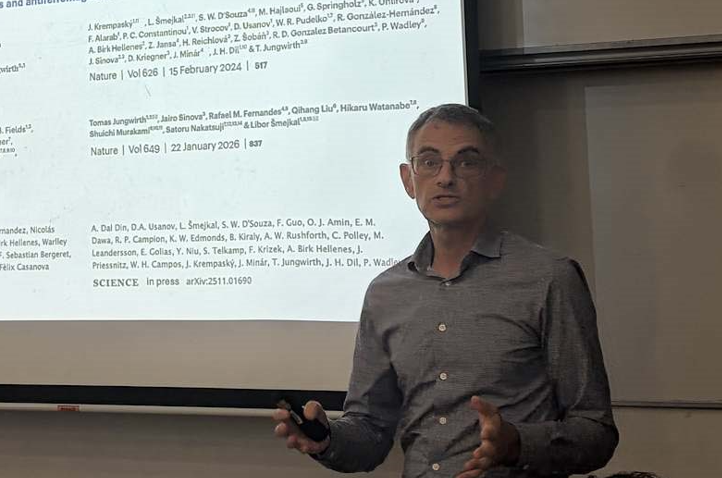 Prof Jungwirth began by tracing the development of devices used to process and store digital information.
Prof Jungwirth then explained the operating principle of ferromagnetic memory. In a device containing two ferromagnetic layers, the electrical resistance depends on whether their magnetisations point in the same or opposite directions. The two-terminal device uses a small current to read the resistance and a larger current to switch the magnetic state. He connected its operation to broken time-reversal symmetry and spin splitting in ferromagnets. However, their net magnetisation generates magnetic fields, limiting dense integration and motivating the search for spintronic materials without net magnetisation.
Prof Jungwirth explained that in conventional antiferromagnets, opposing magnetic moments cancel to give no net magnetisation. With spin–orbit coupling, some antiferromagnets can have electronic structures that break time-reversal symmetry while remaining spin-degeneracy. This enables electrical switching and readout, although the absence of spin splitting makes their operation more complicated than in ferromagnetic devices.
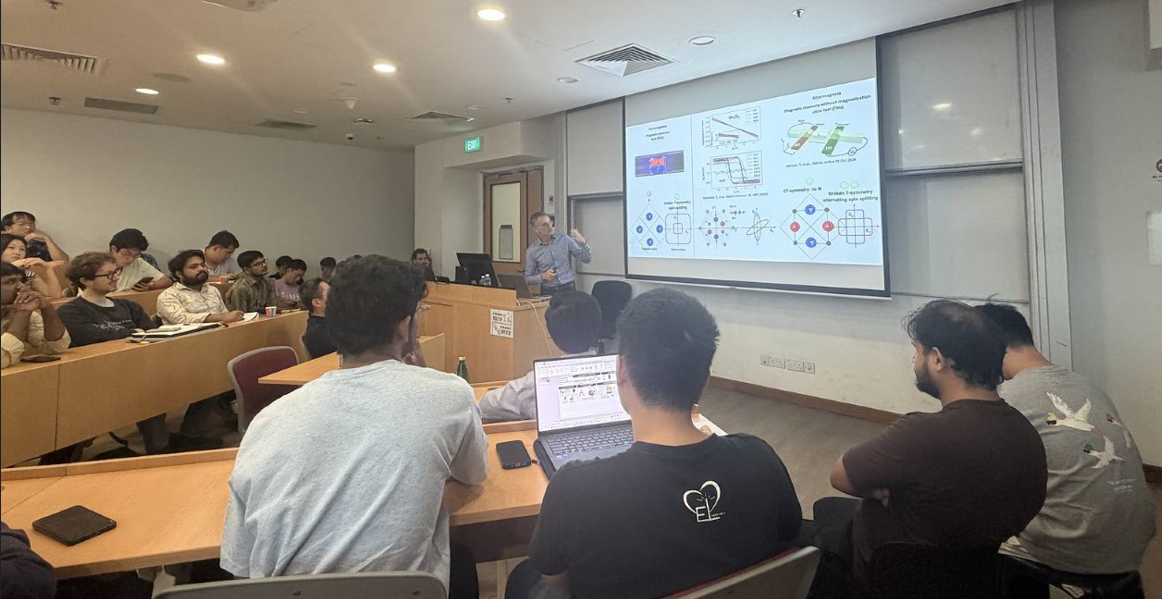 The seminar explored conventional antiferromagnets, materials offering magnetic memory without stray fields.
Prof Jungwirth illustrated this progress using CuMnAs, presenting electrical switching and readout, proof-of-concept memory bits connected to a computer, and terahertz-speed switching experiments. He also discussed a superconducting diode formed by interfacing an antiferromagnet with aluminium. He explained that reversing the antiferromagnetic order by 180-degrees reverses the diode response, changing the preferred direction of supercurrent flow. He subsequently introduced altermagnets, which combine compensated collinear magnetic order with a distinctive electronic structure. In his illustrated example, the arrangement of non-magnetic atoms removes the translation and inversion relations between opposite-spin sublattices, while retaining a 90-degree rotational relation. This allows exchange-driven spin splitting without spin–orbit coupling. Crucially, the splitting alternates with direction in momentum space: the relative energies of opposite-spin states reverse along different directions.
He then presented spin-injection experiments using Mn5Si3 as an injector in a lateral spin-valve device. Spins enter a copper channel and are detected by a separate ferromagnetic electrode. He emphasised that obtaining a signal required allowing lateral injection rather than relying only on vertical injection. Simultaneous anomalous Hall measurements on the same injector independently confirmed reversal of its magnetic order. A further biasing arrangement demonstrated a transverse component of spin injection.
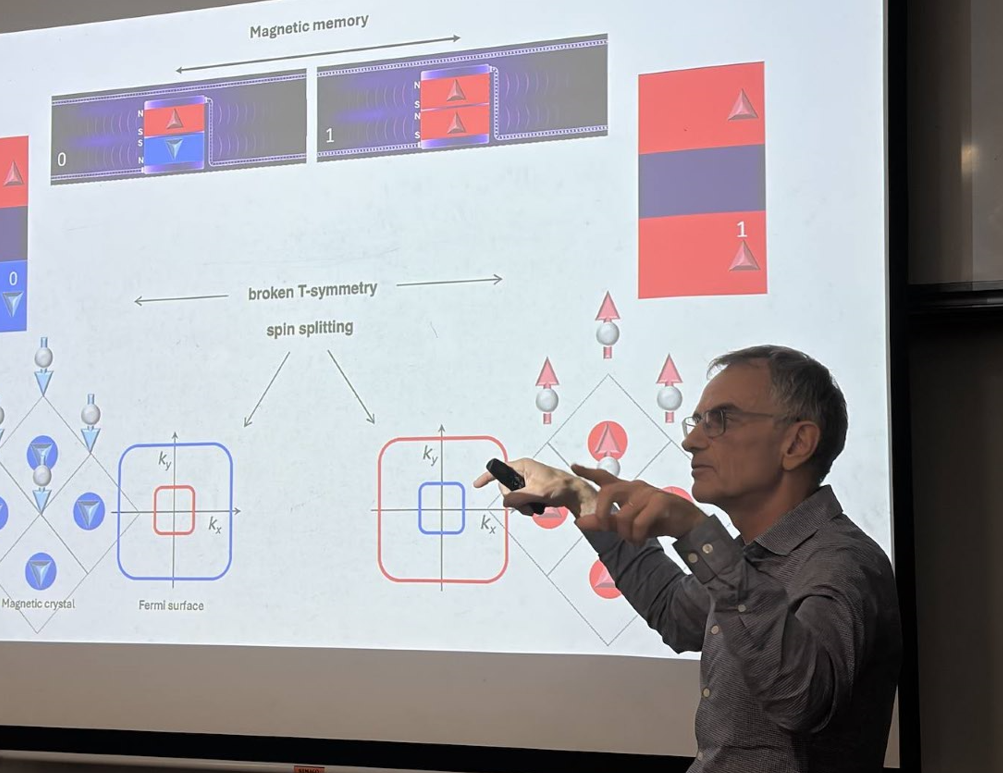 Prof Jungwirth presents band splitting and spin-resolved measures as evidence of alternating spin polarisation.
The final part of his presentation examined microscopy and spectroscopy of MnTe. Electron and X-ray microscopy resolved magnetic order from atomic arrangements to extended domain patterns. Patterned microbars and field cooling enabled preparation of single-domain regions for spectroscopy. Prof Jungwirth then presented angle-resolved photoemission measurements showing band splitting and spin-resolved measurements demonstrating that the spin polarisation reverses with magnetic order and with changes in momentum direction. Together, these measurements provided direct evidence of the alternating spin polarisation.
Prof Jungwirth’s seminar highlighted how altermagnetism addresses a central challenge in spintronics: accessing spin-split electronic states without net magnetisation. The anomalous Hall and spin-injection experiments demonstrated how compensated magnets can support functionality analogous to ferromagnetic spintronics. Together with spectroscopy and magnetic imaging, these results connected the symmetry of magnetic order to measurable electronic behaviour and possibilities for information storage and transport.
This seminar is part of the IAS Frontiers Seminars: Quantum Horizons series. Find out more about the AY26/27 seminars here.
Written by Tan Fei| NTU School of Physical and Mathematical Sciences
"Prof Jungwirth's explanations of the model of altermagnetism was very clear" - Ryan Lim (PhD Student, SPMS)
"I enjoyed learning about the exciting potential applications of these materials " - Borando Francesco (PhD Student, SPMS)
"Very clear and informative presentation!" - Jogi Paul Erinjeri (PhD Student, IGP-ERI@N)