

Organic Catalysis That Makes Life Better: 2021 Nobel Prize In Chemistry
Prof Robin Chi | President’s Chair in Chemistry; School of Physical & Mathematical Sciences, NTU
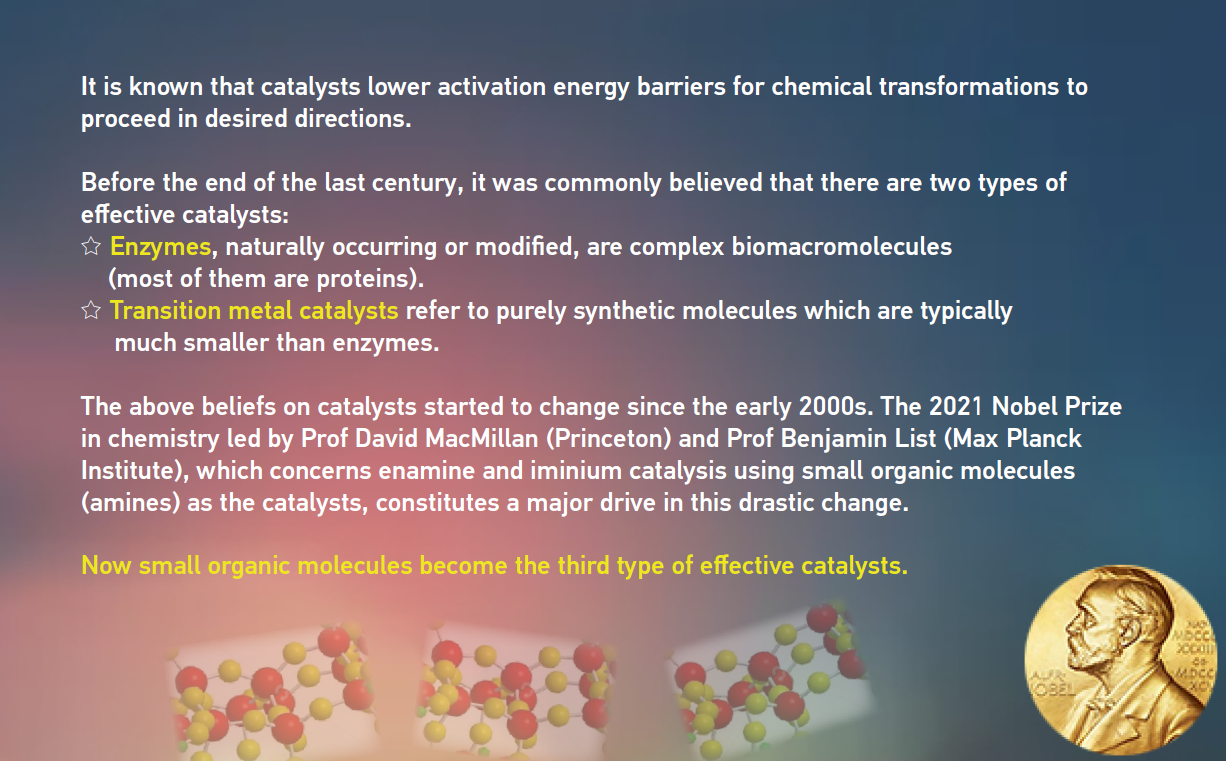
In addition to amines explored in the 2021 Nobel Prize in chemistry, multiple other classes of small organic molecules have also been developed to catalyze a diverse set of reactions. These organic catalysts mediate reactions through covalent activations and/or non-covalent interactions. The most-studied organic catalysts include phosphines, thioureas, phosphoric acids, chiral bases, phase transfer catalysts, and N-heterocyclic carbenes. Several research laboratories in Singapore have pioneered and led multiple of these directions at the global stage.
Each of the three types of catalysts (enzymes, transition metal compounds, and small organic molecules) has its own merits and limitations.
Enzymes have made life possible, transition metal catalysts make living affordable, and organic catalysts shall make our lives better and healthier for a future sustainable world.
Organic catalysts are non-toxic molecules. They are made from abundant resources (mostly carbon, nitrogen, and oxygen elements). The chemical process mediated by organic catalysts use mild conditions and clean operations. Therefore, organic catalysis has become an attractive choice in manufacturing pharmaceuticals, agrochemicals, polymer materials, and other functional molecules. In particular, pharmaceuticals made from organic catalytic process are free of toxic transition metal contaminants. This is relevant to most of us because toxic transition metal contaminants can cause health problems, especially for long-time users in an aging society.
On an important educational note, any advancement in science is built upon contributions from earlier pioneers. Breakthroughs do not come from nowhere. The field of organic catalysis is of no exception. Students and young players, with a deep understanding of the past, a visionary mind that can penetrate the future, and a bit of luck, can all make ground-breaking discoveries that benefit humankind.
In short, organic catalysis is the third catalytic strategy for chemical transformations. It shall help to make our lives better.
For more information, watch the video here on 2021 Nobel Prize In Chemistry: Organic Catalysis


