Programme Overview
Build a career at the intersection of finance, risk, and sustainability with the MSc Actuarial and Risk Analytics programme. Blending actuarial science, risk management, and sustainability insights, this interdisciplinary programme equips you to succeed in a world defined by rapid change and complex challenges.
You will gain the analytical expertise and strategic mindset needed to manage emerging risks, respond to environmental shifts, and drive responsible decision-making across industries.
Our practical, hands-on approach ensures you apply what you learn to real business scenarios, giving you the skills and experience to launch a career in actuarial science, risk consulting, insurance, finance, and beyond.

Programme Calendar
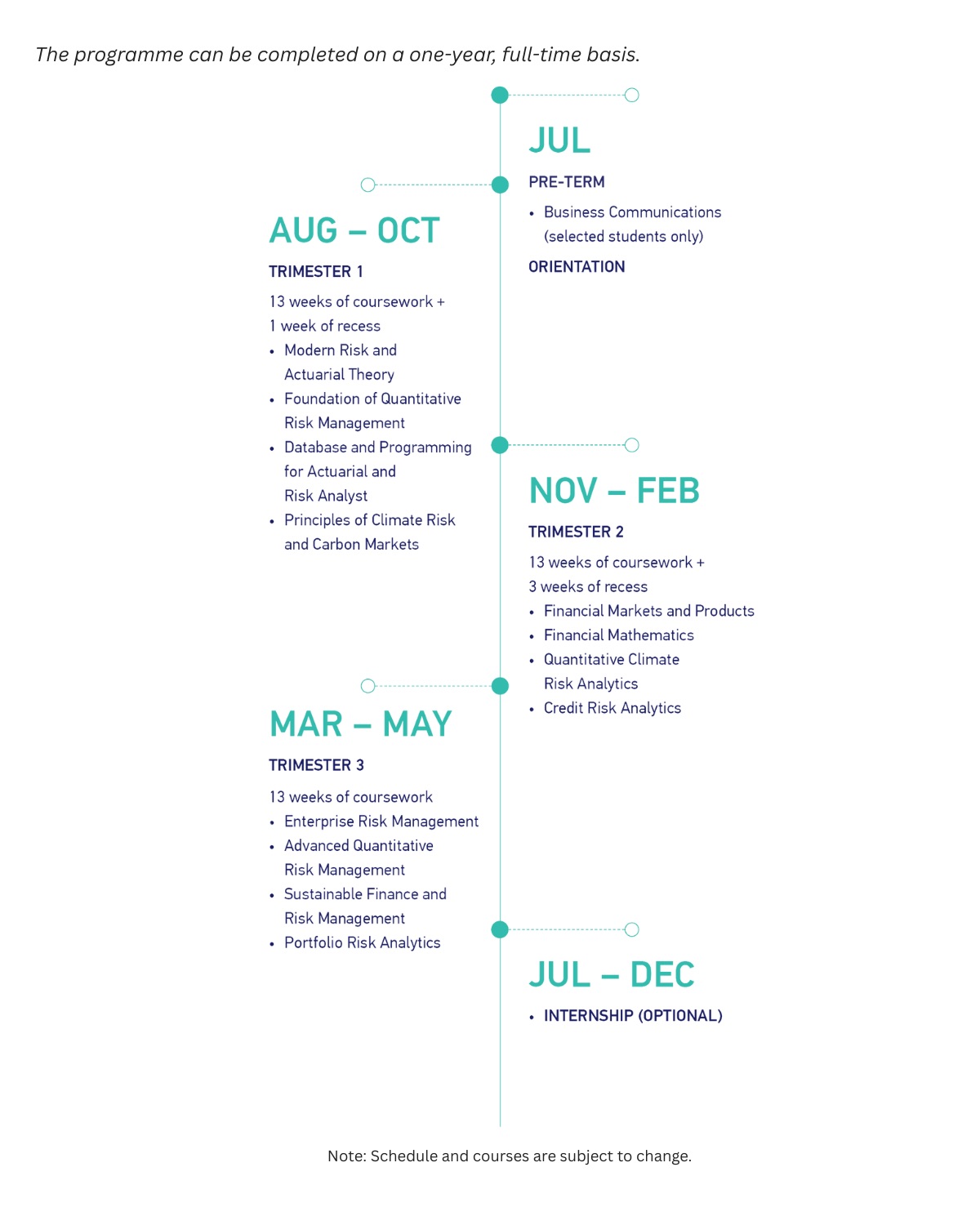
MARA is offered as a full-time, one-year programme. The programme is delivered entirely in English on the vibrant main campus at Nanyang Technological University in Singapore.
Module Information
Core Modules
This module aims to equip students with a comprehensive understanding of database management and programming concepts relevant to actuarial science and risk management.
Students will gain a comprehensive understanding of database management and computing skills necessary in actuarial and risk applications.
This module offers a comprehensive introduction to enterprise risk management, harmonizing quantitative and qualitative approaches.
Students will learn key mathematical and statistical methods for ERM through numerous real-world cases, encompassing both successful implementations and failures.
This module presents a coherent guidance from risk governance to identification, modeling, and mitigation, as well as regulation, behavioral biases, and crisis management, shaping the framework of ERM as a whole.
This module introduces the financial markets as well as basic financial products with a focus on derivatives.
Students will gain knowledge about different types of financial products, as well as basic pricing ideas of derivatives.
This module introduces necessary analytical tools for risk management. Statistics, probability, and mathematics are integrated into the real risk modelling examples.
Students will gain a strong quantitative foundation to process and analyse risk-related data.
This module introduces fundamental principles of risk management and actuarial theory.
Students will understand how these principles will be used to meet the needs of different stakeholders, including individuals, corporations, and governments.
This module brings a general introduction to Climate Risk and Carbon markets.
Students will gain knowledge of the basic climate science, international climate policies as well as climate risk management and regulations.
Elective Modules
This module introduces diverse quantitative disciplines essential for market, credit, and operational risk modeling.
Students will learn how to measure risk with different risk measures and understand a spectrum of quantitative techniques specifically tailored for risk modelling.
A specific emphasis will be on addressing extreme scenarios, analysing the interdependency among key risk drivers, and applying these techniques to real-world data.
This module provides introduction to credit risk, the reasons it arises, and describes quantitative measurements and factors of credit risk.
Students will learn to assess the quality of various sources of information and evaluate a bank’s financial condition.
Students will also learn to perform credit stress testing for a financial institution.
This module covers the basics of financial valuation, including the most important financial concept, the time value of money.
Participants will learn how to perform stock and bond valuation. It also covers key discussions of financial operations in a corporation, including how firms make financing and investing decisions with the goal of maximizing shareholder wealth.
This module covers topics of different analytical methods for portfolio management.
This module will introduce modern portfolio theory (MPT), factor theory, and portfolio VaR measures, and explain the advantages and challenges associated with VaR measurements for portfolio management.
This module will introduce state-of-the-art analytical tools for measuring and modelling climate-related risks.
Students will learn how to utilize data to analysing climate-related risks.
Students will also understand climate scenario analysis and climate stress testing for the insurance portfolios.
This module introduces how to incorporate general risk management techniques into sustainable risk management.
It will also introduce climate and sustainability disclosure and regulation requirements and different sustainable and green finance instruments and products, such as green bonds, green loans, sustainability bonds and sustainability loans.
Leading People Globally
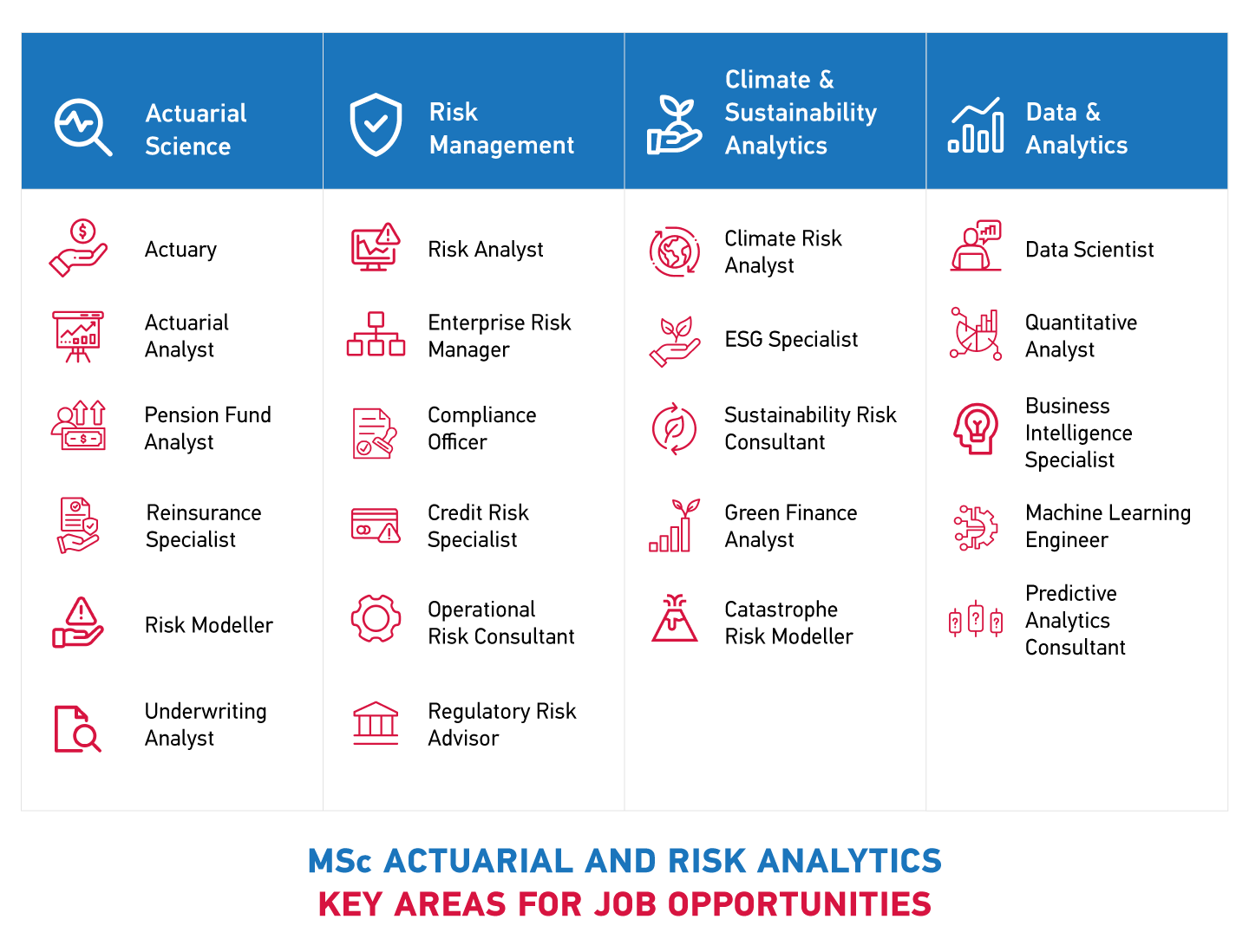
The demand for actuarial and risk analytics professionals continues to grow, as organisations seek experts who can assess uncertainty, manage financial risks, and support data-driven decision-making. Employers value graduates who are proficient in statistical modelling, risk assessment, and the application of quantitative insights across sectors such as insurance, finance, consulting and beyond.
The programme also offers an optional six-month internship, which can be undertaken as part of the curriculum. This provides participants with valuable, hands-on exposure to real-world risk challenges, strengthening their career prospects as actuaries, risk analysts, and consultants, while preparing them for professional actuarial accreditation.