
Language as a Living System: Cognition, Data, Discourse, and Large Language Models
Registration: https://event.ntu.edu.sg/2026-03-02-chin-language-living-system
----
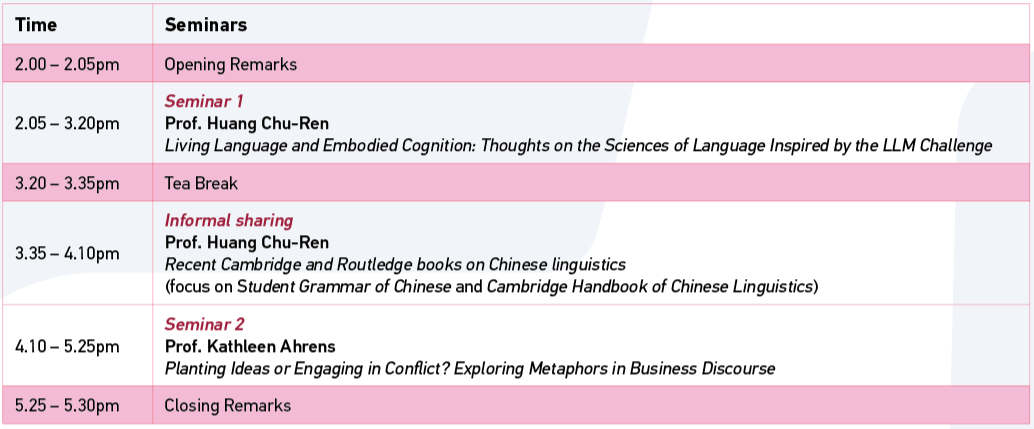
Seminar 1
Living Language and Embodied Cognition: Thoughts on the Sciences of Language Inspired by the LLM Challenge
Prof. Huang Chu-Ren
A linguistic act, in its simplest and most essential form, is the exchange of information between two people (i.e., two intelligent agents), with two design characteristics: first, the shared access to the expressed linguistic content and second, the lack of access to each other’s internal cognitive processes. I argue in this talk that current linguistic theories are not designed to account for these two design characteristics of language. I further demonstrate that, by accounting for these two design features, language sciences can leverage large language models (LLMs) to advance our understanding of language, cognition, and how humans interact with the environment.
In order to set the stage for this argument, I first introduce the Russian doll (or nested self-hypernym) metaphor for the lexical conceptualization of ‘language’ shared by most (if not all) languages in the world. We use the lexical concept of ‘language’ to refer to a full range of different conceptually related entities, e.g. Chinese as both the modern language we speak and the inherited language that defines our culture, and language as the universal ability to acquire the system (the capitalized Language) to the choices of specific words (e.g., ‘watch your language’). Second, I observe that sensory impairments do not preclude full development of linguistic and cognitive competence. These two observations, along with evidence that LLMs can learn shared sensorimotor understandings from collective data, suggest we need to take a closer look at the role of language data and how it is structured in cognition.
I then argue that, contrary to commonly held assumptions, the dynamic collection of language data is a constant in human cognition, anchoring the diversity of individual experiences and the variations of human brains. The power of language lies in how it enables the effective learning of knowledge grounded on shared language data. LLMs function by applying massive computing power to an unprecedented collection of language big data. Humans thrive by leveraging our embodied experiences and the embodied architecture of our cognition to learn from a smaller set of shared data. This data-centered view provides a straightforward account of language as a self-adoptive complex system, resulting from the dynamic growth of shared data/experience. In addition, the nested self-hypernyms conceptualization of ‘language’ captures the essence of language as a complex system while allowing the foregrounding of different levels of its sub-systems in daily human life.
This new perspective points to a different approach to the multi-brain alignment dilemma. That is, we understand each other not by accessing or guessing at each other’s brain activities but by deriving shared information from our shared linguistic data. Thus, I suggest that the most unique characteristic of human language is its embodied architecture and its instantiation as an ever-evolving collection of shared language data. The information from this shared data architecture has paved a path from LLMs to AI, but it is its embodied architecture that remains a key distinction between human intelligence and machine intelligence.
Prof. Huang Chu-Ren Professor Chu-Ren Huang was named a Stanford/Elsevier Top 2% Scientist (Career-long impact) in Artificial Intelligence and Image Processing in 2024–2025. He holds a Ph.D. from Cornell University and an honorary doctorate from Aix–Marseille University. He is Chair Professor in the Department of Chinese and Bilingual Studies at The Hong Kong Polytechnic University, where he built his academic career after earlier work at Academia Sinica.
Prof. Huang’s research is driven by a long-standing interest in what language can tell us about human cognition and our collective responses to natural and social environments. His work spans Chinese linguistics, corpus linguistics, digital humanities, and natural language processing, and bridges theoretical, empirical, and computational approaches.
His recent books include Cambridge Handbook of Chinese Linguistics, Reference Grammar of Chinese, Student Grammar of Chinese (Cambridge), Chinese Language Resources, and Language and Ontology. To date, he has published 26 monographs or edited volumes and special journal issues, 160 journal articles, 150 book chapters, and over 600 conference papers. His research appears in leading journals across linguistics, cognitive science, and artificial intelligence, including Behavior Research Methods, Computational Linguistics, Cognitive Linguistics, Corpus Linguistics and Linguistic Theory, Digital Scholarship in the Humanities, Humanities and Social Sciences Communications, IEEE Transactions on Affective Computing, Intercultural Pragmatics, Journal of Chinese Linguistics, Knowledge-Based Systems, Language, Cognition and Neuroscience, Language Resources and Evaluation, Language Sciences, Lingua, Linguistics, Linguistics Vanguard, Natural Language Processing, Perspectives, PLoS One, Sage Open, and Scientific Reports.
Prof. Huang has led the development of major language infrastructures, including balanced Chinese corpora, historical corpora, treebanks, wordnets, and bilingual knowledge ontologies, which have been widely used in linguistic research and language technology.
---
Seminar 2
Planting Ideas or Engaging in Conflict? Exploring Metaphors in Business Discourse
Prof. Kathleen Ahrens
While metaphors such as “glass ceiling” and “glass cliff” have drawn attention to gendered barriers in professional life, gendered associations of more conventional metaphorical source domains, such as WAR and PLANT, remain underexplored. This talk addresses this gap by outlining robust criteria for identifying metaphor source domains.
It then examines how these domains are perceived in terms of gender and how they are deployed in venture capital pitches by men and women. The findings show that metaphor choice plays a strategic role in shaping communicative effectiveness and navigating gendered expectations in professional and leadership contexts.
Prof. Kathleen Ahrens Professor Kathleen Ahrens is a Professor in the Department of English and Communication and a member of the Research Centre for Professional Communication in English at The Hong Kong Polytechnic University. She has served as the Chair of the Executive Board for the Association for Researching and Applying Metaphor (’18-’22) and was President of the Hong Kong Academy of the Humanities (’18-’19). Professor Ahrens has recent papers in Language, Cognition and Neuroscience, Intercultural Pragmatics, PLoS One, Journal of Pragmatics, Metaphor & Symbol, and Applied Linguistics. She takes an inter-disciplinary approach to the study of metaphor, running behavioural crowd-sourcing, neuro-imaging, and reaction times studies, as well as analysing metaphor use through corpus-based and ontological-based approaches.