Eye contact helps babies key into language
Eye contact is a powerful social cue that helps infants learn language, a study by NTU and the University of Cambridge finds.
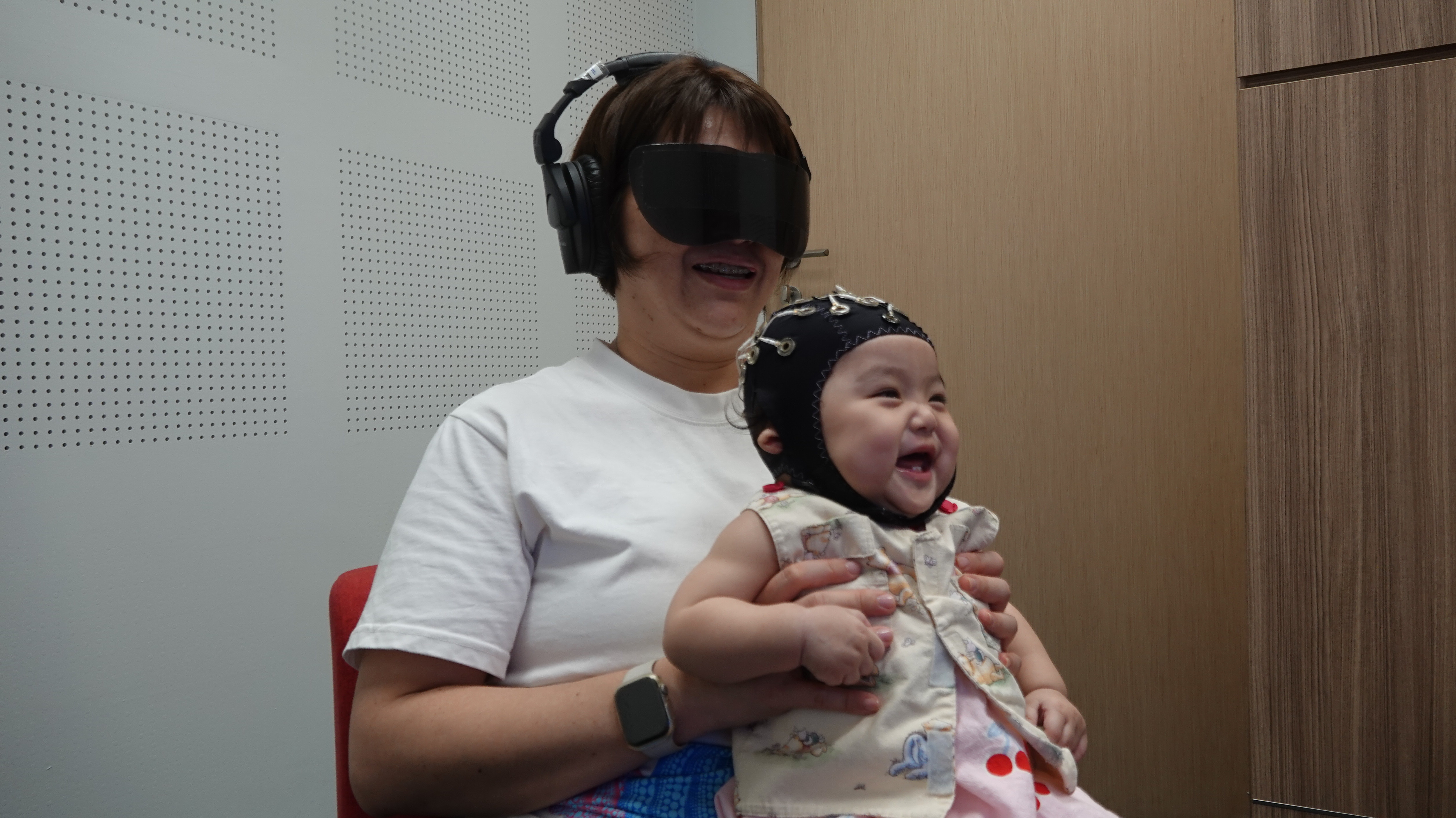
Researchers led by Nanyang Technological University, Singapore (NTU Singapore) and the University of Cambridge have shown that babies use eye contact to learn language, offering new insights into how social cues guide learning in infants.
Published in Nature Communications in July, the study led by Prof Victoria Leong from NTU’s School of Social Sciences and the Department of Paediatrics at the University of Cambridge found that eye contact acts as a signal to synchronise infants’ brainwaves with those of the speaker and help them learn.
Learning language by looking
Infants are surrounded by sights and sounds competing for their attention. Social cues such as eye contact can signal that something is important and worth learning.
To investigate how this works in the brain, the researchers studied 42 infants aged eight to 10 months from Singapore and the UK. The infants watched videos of an adult speaking three artificial languages. The speaker’s eyes were either fully visible, partially obscured or completely hidden behind different types of glasses.
The researchers measured the infants’ brain activity using electroencephalography (EEG) that records the natural electrical currents created by the brain while they were watching the videos and becoming familiar with the languages. They also recorded the brainwave patterns of the speaker while she was speaking the three languages beforehand.
To test whether the infants had learned each language, they were presented with either familiar words drawn from that language, or unfamiliar words that did not belong to the language. If the infants had learned the language, they were expected to differentiate between the familiar and unfamiliar words, typically by looking longer at the novel unfamiliar examples.
The results showed that infants only learned a language when the speaker maintained full eye contact. Although the infants tended to spend an equal amount of time looking at the screen, regardless of whether the speaker’s eyes were visible, no significant learning was detected when the speaker’s gaze was partially or fully obscured.
The researchers also found that when a baby was learning the language, their brainwaves were more likely to align with those of the speaker. This synchrony was a stronger predictor of learning than the brain activity of the infants. Most importantly, brain activity was only synchronised when the baby had a clear view of the speaker’s eyes.
“Our findings offer a glimpse into the remarkable ways young minds learn through interaction and could help create optimal conditions for children to learn, connect and thrive”, said Research Fellow Dr Zhang Wei, who was the first author of the study.
The same learning effects were observed in infants from both Singapore and the UK, despite differences in their linguistic and cultural environments.
“Our study provides evidence that learning is not simply driven by what an infant sees or hears. Instead, the social context surrounding information can influence what the infant’s brain considers important,” says Prof Leong, who is also Director of the Early Mental Potential & Wellbeing Research Centre at NTU.
The researchers say the findings could help deepen understanding of how the brain uses social cues to guide learning during early life. These social mechanisms are powerful strategies that all learners – even young children – can use, and help to explain why humans are able to learn with less information and higher efficiency than artificial intelligence models.
Read more in “Adult-to-infant unidirectional neural coupling mediates selective social learning in infants from the United Kingdom and Singapore” in Nature Communications, DOI: 10.1038/s41467-026-75831-x.
.tmb-listing.jpg?sfvrsn=6ddb47de_2)
.tmb-listing.jpg?sfvrsn=f43836b1_2)
.tmb-listing.jpg?sfvrsn=fba51b63_2)
.tmb-listing.jpg?sfvrsn=ba129532_2)