Three ways to explore materials science: How undergraduate research shaped three NTU MSE students
NTU Materials Science and Engineering undergraduates Wang Tzu-Wei, Jeslyn Chan Xuan Lin and Zhai Yiwei placed first, second and third, respectively, in the Engineering category of the 2026 URECA Poster Competition. Through projects spanning battery materials, food and health, and carbon dioxide conversion, they discovered different ways to apply materials science — and what it takes to develop as a researcher.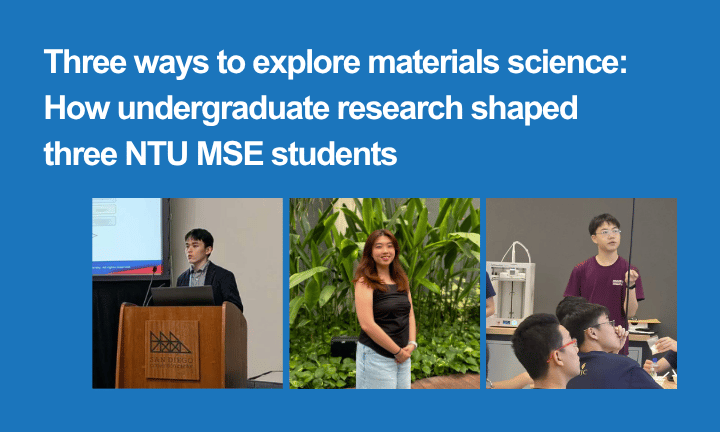
What can studying materials science enable a student to explore?
For three NTU Materials Science and Engineering undergraduates, the answer included using data to investigate battery performance, examining how a plant-derived material could affect nutrient absorption, and studying catalysts for carbon dioxide conversion.
Wang Tzu-Wei, Jeslyn Chan Xuan Lin and Zhai Yiwei pursued these questions through NTU’s Undergraduate Research Experience on Campus programme, or URECA. The university-wide programme gives eligible NTU undergraduates opportunities to undertake research with faculty and research staff.
The three NTU MSE students subsequently placed first, second and third respectively in the Engineering category of the 2026 URECA Poster Competition.
The recognition brought their work together on one stage. Their projects, however, reveal three different ways of applying the foundations of materials science: connecting scientific principles with data, investigating materials in familiar areas such as food and health, and examining how a material’s structure influences its performance.
Behind each poster were also the less visible parts of research — reading, repeated experiments, analysis, troubleshooting, conversations with mentors and the gradual confidence to make more independent decisions.
Connecting materials science with data
Wang Tzu-Wei, whose poster received first place, is pursuing a Bachelor of Engineering in Materials Engineering with a Second Major in Data Analytics.
His research project used machine learning and explainable artificial intelligence to study battery materials. In simple terms, he investigated how a material’s composition relates to its electrochemical performance, particularly its initial capacity, and how data-driven methods could help identify promising candidate materials.
The aim was not only to predict performance. Tzu-Wei also wanted to understand which characteristics of a material might be significant.
The project brought together two areas of his undergraduate education: understanding the relationships among a material’s structure, properties and performance, and using data to investigate those relationships. Across his NTU and URECA research experiences, Tzu-Wei developed experience in materials characterisation, microscopy, machine learning, simulation, experimental design, data analysis and scientific plotting. The deeper lesson was learning to see these methods as connected parts of one research process.
"The most important thing I learned was not simply how to perform each step," he said. "It was learning how to design a research workflow, connect different techniques together, and gradually develop the mindset of an independent researcher."
Tzu-Wei learnt about URECA during his first semester at NTU. He participated because he wanted to understand whether research suited him and what kind of research direction he might enjoy.
Individual tasks could initially appear confusing or disconnected. By working through them patiently, he gradually understood how each detail contributed to the larger research question.
"You do not need to know everything at the beginning, and you do not need to be perfect before joining research,” he said. “Give yourself room to make mistakes, because that is often where real growth happens."
His development later extended beyond Singapore. Tzu-Wei conducted summer research in Germany in 2025 and presented at TMS 2026 in the United States.
The experiences exposed him to different research environments while prompting more personal reflection. Living and working independently overseas led him to consider what he valued and what kind of future he wanted to build.
Preparing his competition poster presented another challenge: deciding what to leave out. Tzu-Wei revised the poster repeatedly, studied effective scientific figures and considered how someone outside his immediate research area would encounter the project.
“Good scientific communication requires both technical understanding and a sense of visual design,” he said.
From undertaking summer research in Germany to presenting at TMS 2026 in the United States, Wang Tzu-Wei’s journey has been shaped by different research environments and communities. He credits his project supervisor Prof Eason Chen, Prof Wu Dongshuang and the wider research group for the guidance and confidence to grow as a researcher and share his work more widely. |
Finding materials science in everyday life
Jeslyn Chan’s project, supervised by Prof Ng Kee Woei, began with something familiar: food.
She examined nanocellulose, a natural material derived from plant fibres, and whether introducing it into food could affect how nutrients are absorbed during simulated digestion. Her findings indicated potential for nanocellulose to reduce calorie absorption or contribute to glycaemic regulation. Further research would be required before any practical health application could be established.
For Jeslyn, the project broadened her understanding of where materials science could be applied.
"It showed how materials science thinking, usually associated with things like semiconductors or structural materials, could be applied to something as personal as food and health," she said.
The experience helped her recognise an interest in research at the intersection of materials, health and biology. She has continued exploring this interest through an internship as an Intern Scientist with Roquette’s Health & Pharma Solutions Technical Services & Development team.
Jeslyn had chosen MSE because she wanted to understand why products are made from particular materials and how that understanding could help address practical problems. She describes materials science as the study of the "stuff" from which other products and technologies are made — whether a phone screen, wound dressing or food ingredient. The discipline appealed to her because it combined scientific understanding with practical application while allowing her to explore different fields.
Her research experience reinforced that breadth. It also showed her that genuine interest does not remove uncertainty from the process.
Jeslyn began without previous research experience. After identifying a subject that interested her, she sought a supervisor with relevant expertise and worked closely with a PhD mentor who trained her in the laboratory and remained open to questions.
Experiments did not always proceed as expected. The work involved literature reviews, troubleshooting, analysis of nutrient-bioavailability data and repeated decisions about what to try next.
"Progress often comes from troubleshooting and learning from things that don’t go as planned," she said.
Jeslyn also learnt to sustain research alongside classes, community service and student activities. After initially spending too much time in the laboratory, she began planning her research by month and completing more experimental work during university vacations.
Preparing her first academic poster required her to translate the project for people without her technical background. Feedback from her mentor helped her identify details that could prevent an audience from following the research, while presenting trained her to answer questions in real time.
Her advice to students considering research is direct:
"Don’t let your uncertainty prevent you from taking the first step."
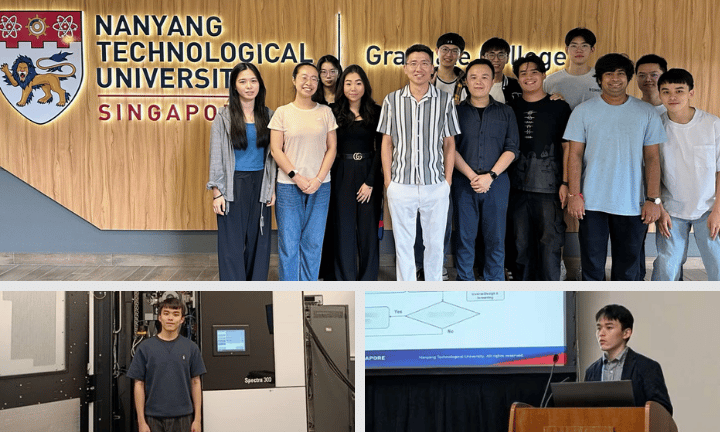
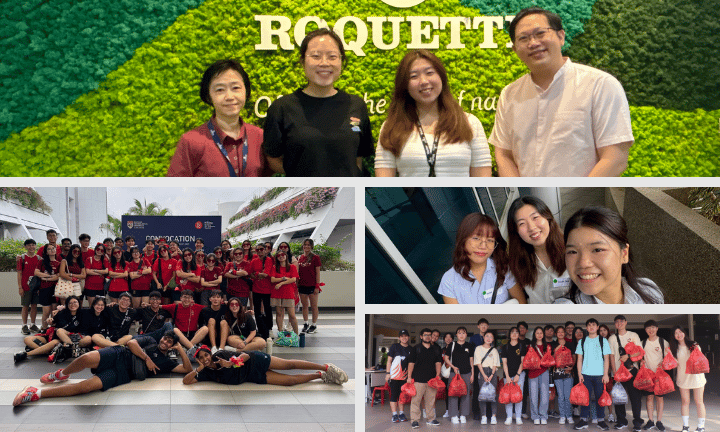
Alongside her URECA research, Jeslyn Chan remained active in the wider university community — beginning her first professional research internship at Roquette, serving as a senior at Orientation Camp and through a Hall 13 charity initiative, and connecting with industry partners at MSE Talent and Industry Connect. These experiences helped her balance research with service, professional exposure and a broader understanding of where an MSE education can lead. |
Experiencing the work behind the evidence
Zhai Yiwei was drawn to materials science by his interest in energy-related challenges.
He joined the research project because he wanted to compare his idea of a research career with the practical experience of working in a laboratory.
His project examined the relationship between the crystal structure of a metallic catalyst and its performance in a reaction that reduces carbon dioxide. It connected a fundamental materials science question — how structure influences properties — with research on carbon dioxide conversion and greener energy technologies.
His development was also shaped by his project supervisor, Prof Wu Dongshuang and members of her research team. Under his mentor’s supervision, Yiwei synthesised catalyst materials and learnt about X-ray diffraction, gas chromatography and high-angle annular dark-field scanning transmission electron microscopy.
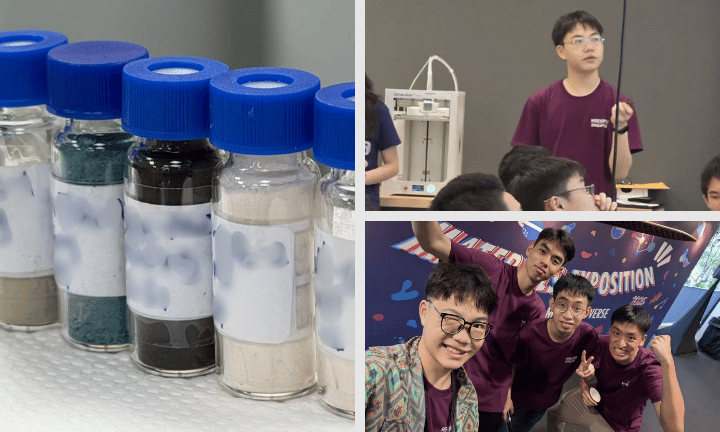
Five catalyst samples became visible milestones from a year of research. To an outside observer, they might appear modest. To Yiwei, they represented repeated synthesis work and the sustained effort required before experimental evidence can be interpreted and communicated.
Yiwei said members of the research team encouraged him to enter the poster competition and pursue other academic opportunities, while sharing insights that extended beyond the project's immediate requirements.
This reflected his wider experience in NTU MSE. He found faculty approachable after lectures and willing to discuss academic questions and possible laboratory opportunities with students who took the initiative to ask.
Preparing the poster required Yiwei to adopt what he called an "audience mindset". A researcher may know every stage of a project, but someone encountering it for the first time needs a clear explanation of the question, evidence and significance.
He has also applied this skill as an MSE student ambassador while introducing scientific demonstrations to younger students.
Five catalyst samples offer a glimpse into the wider story of Zhai Yiwei’s year-long URECA project — from sustained laboratory work and synthesis to learning how research takes shape over time. Beyond the lab, he also developed his ability to communicate scientific ideas through an MSE outreach session for visiting junior college students and the 2025 Materials Exposition. |
Different questions, a shared foundation
Tzu-Wei, Jeslyn and Yiwei's projects demonstrate how widely materials science can be applied.
Tzu-Wei combined materials knowledge with data analytics to investigate battery performance. Jeslyn applied materials thinking to food, health and biology. Yiwei examined how a catalyst’s structure affects its behaviour in an energy-related reaction.
What distinguishes these stories is how the students used that wider NTU opportunity from within Materials Engineering.
Their research questions grew from materials science. Their development was shaped by interactions with MSE supervisors, PhD mentors and research groups. Their experiences built upon a discipline concerned with the relationships among materials’ composition, structure, processing, properties and performance.
The projects also complemented their broader undergraduate development.
Tzu-Wei combined Materials Engineering with Data Analytics and worked in research settings overseas. Jeslyn connected her research with growing interests in pharmaceutical and health-related applications while remaining active in student life. Yiwei applied his developing knowledge in the laboratory and as a student ambassador speaking with younger students.
The competition recognised the work they presented. Their longer journeys show what studying MSE enabled them to explore: different applications, research environments and possible directions.
Prospective students need not begin university already knowing which field they want to enter.
A more useful starting point may be:
What are the materials behind the technologies, products and challenges that interest me — and how could I learn to make them work better?
Explore Materials Engineering at NTU
As these projects demonstrate, the study of materials can lead into fields as different as battery technologies, data-driven research, food and health, catalysis and carbon dioxide conversion.
At NTU MSE, students can build foundations in materials science and engineering, explore different applications through their studies and pursue wider NTU opportunities — including URECA where eligible — as their interests develop.
Explore the NTU Bachelor of Engineering in Materials Engineering and discover where the study of materials could take you.
https://www.ntu.edu.sg/mse/admissions/undergraduates/prospective-students