
Undergraduate Student Research Highlights
Our students contribute meaningfully to advancing materials science through research spanning sustainability, energy, healthcare, and more. From Final Year Projects to postgraduate research, they tackle real-world challenges with innovation and rigour. Below is a selection of their work that reflects the depth and diversity of research at MSE.
Employers or alumni with opportunities to share?
The Industry-Sponsored Final Year Project (IS-FYP) invites companies to collaborate with our final-year students on projects that address real-world industry challenges.
Connect with usNTU MSE Undergraduates Final Year Projects

AI, Data Science, and Computational Materials Science

Battery Technologies and Energy Storage
Biomedical Materials and Biotechnologies

Nanomaterials and Advanced Coatings
Smart Manufacturing and 3D Printing
Sustainability and Green Technology
Key Highlights of FYP Posters:
Automated Identification of Unit Cell Defects in Porous MOFs and Zeolites
Presented by Chua Li Yang
Supervised by Asst Prof Prashant Kumar
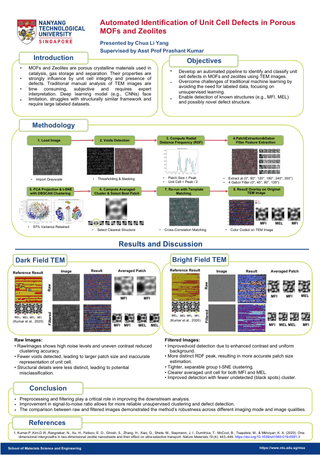
Metal-organic frameworks (MOFs) and zeolites are porous crystalline materials widely used in catalysis, gas storage, and separation. Their performance depends heavily on unit cell integrity — even minor defects can significantly alter properties. Traditional TEM imaging methods to analyse defects are labor-intensive, subjective, and require expert interpretation.
This final-year project developed an automated, unsupervised learning pipeline to overcome these limitations and identify unit cell defects in MOFs and zeolites. Preprocessing and filtering techniques proved critical in enhancing the signal-to-noise ratio of TEM images, enabling more reliable clustering and defect detection. Comparing raw and filtered images demonstrated the robustness of this approach across imaging modes and qualities, laying the groundwork for more efficient defect analysis.
The work shows how combining materials science and AI can accelerate discovery and design — opening possibilities for advanced materials with greater precision and efficiency.
Block Copolymer Templated Halide Perovskite Memristors
Presented by Leonardo Marco Edilynn
Supervised by Prof Nripan Mathews & Divyam Sharma
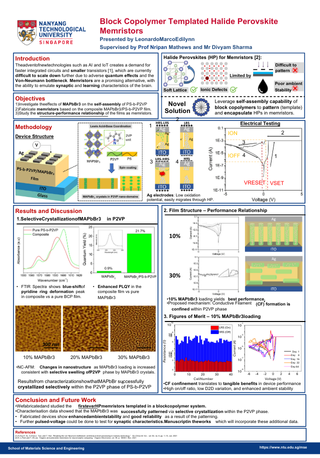
As AI and the IoT advance, the need for faster, smaller, and more efficient circuits is greater than ever. Traditional transistors are reaching their physical limits, but memristors — devices that mimic the way the human brain learns and remembers — could offer a breakthrough alternative.
This final-year project investigated how block copolymer templating could be used to design halide perovskite-based memristors. By studying the self-assembly of composite films and their structure–performance relationship, the project explored new approaches to fabricate nanoscale devices with potential to overcome the Von Neumann bottleneck.
This research shows how materials science can drive next-generation electronics, bridging the gap between biology and technology to power future computing.
Development of Probiotic Nanovesicles for Oral Delivery in Inflammatory Bowel Disease Treatment
Presented by Lin Xiang
Supervised by Asst Prof Czarny Bertrand, Mentored by Lim Yun Wei
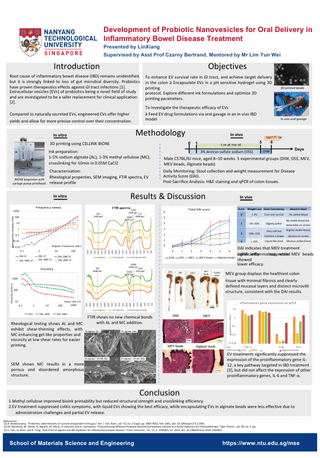
How can engineered probiotics help treat inflammatory bowel disease (IBD)? In this final-year project, our student explored the potential of probiotic nanovesicles — tiny, engineered particles that may deliver targeted therapies more effectively to the colon.
By encapsulating probiotic extraceullular vesicles in pH-sensitive hydrogels via 3D-printing, the project investigated how to improve survival rates of these therapeutic carriers in the gastrointestinal tract, achieve target delivery and and test their therapeutic efficacy.
This work demonstrates how materials science and bioengineering can converge to address urgent medical challenges.
Novel 3D Printing Inks with Non-Toxic Photoinitiators
Presented by Teoh Wee Yong, Darren
Supervised by Assoc Prof Terry Steele & Muhammad Naziruddin Bin Mohd Ali
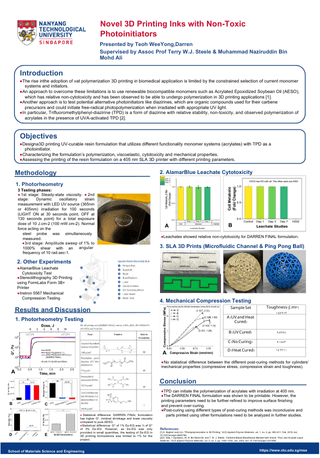
3D printing is revolutionising biomedical applications, but its growth is limited by the lack of safe, versatile materials. Many current resins and photoinitiators pose toxicity concerns, restricting their use in healthcare. This final-year project set out to explore non-toxic, biocompatible alternatives that could unlock new frontiers for biomedical 3D printing.
Using acrylated epoxidized soybean oil (AESO) as a renewable monomer and Trifluoromethylphenyl-diazirine (TPD) as a novel photoinitiator, the project developed and tested new UV-curable resin formulations. Their polymerisation, viscoelastic, mechanical, and cytotoxicity properties were characterised, alongside formulation printing on a 405 nm SLA 3D printer.
The work explores how materials research can create safer, sustainable pathways for additive manufacturing—paving the way for next-generation biomedical devices and implants.
Strategic Non-fullerene Blending Of Ternary Organic Photovoltaics For Morphological And Device Performance Enhancement
Presented by Chia Wei Min. Luke
Supervised by Asst Prof Ng Wei Tat, Leonard & Li Yu Jia
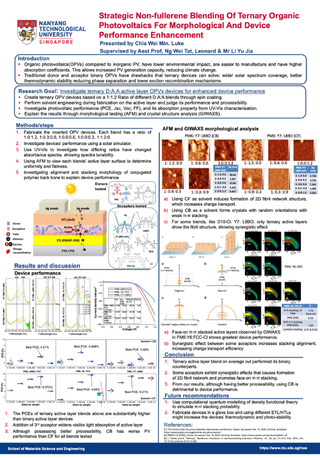
Organic photovoltaics (OPVs) are a promising alternative to traditional solar cells — lightweight, easier to manufacture, and with a lower environmental footprint. But how can their performance be pushed further? This final-year project explored ternary organic photovoltaic devices, which combine multiple donor and acceptor materials to capture more of the solar spectrum while improving stability and reducing energy losses.
Using spin-coating and solvent engineering techniques, the project created ternary blends and assessed their photovoltaic efficiency, absorption properties, and structural behaviour through advanced morphological and crystallographic analyses.
This work demonstrates how materials design at the nanoscale can unlock cleaner, more efficient renewable energy solutions.
Surface Modified Silica Nanoparticles for Nickel Adsorption and Phytoremediation
Presented by Bethany Chong Yu Lin
Supervised by Prof Lam Yeng Ming
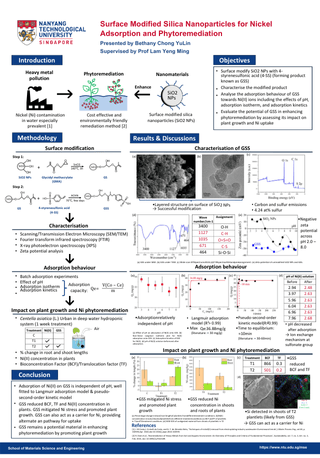
Nickel pollution in water is a growing environmental concern. Phytoremediation is a sustainable, low-cost method of using plants to absorb and detoxify pollutants. This final-year project explored how nanomaterials like surface-modified silica nanoparticles may enhance the process.
By engineering silica nanoparticles with 4-styrenesulfonic acid (GSS), the project studied their ability to adsorb nickel ions and improve plant growth and nickel uptake. Through detailed characterisation and adsorption studies, the work highlights how materials innovation can play a key role in advancing green technologies for environmental clean-up.
This project shows the power of materials science in tackling sustainability challenges — where nanotechnology and nature work hand-in-hand to protect our environment.
Removal of Pigments from Human Hair to Obtain Purer Keratin Fractions for Downstream Biofabrication
Presented by Ng Chu Wen
Supervised by Prof Ng Kee Woei
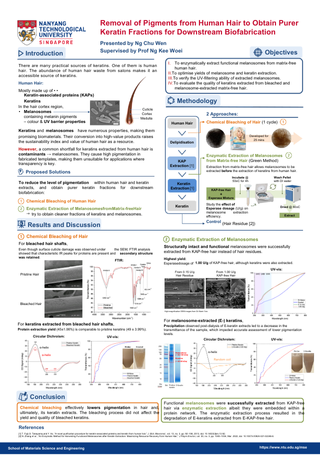
Human hair is an abundant yet underutilise source of keratins and melanosomes — biomaterials with valuable structural and UV-protective properties. Converting this common salon waste into high-value products could raise its sustainability potential, but current extraction methods often leave behind melanosome contaminants that cause pigmentation, limiting their use in applications where transparency is essential.
This final-year project explored methods to separate and purify keratins and melanosomes from human hair by combining chemical bleaching and enzymatic extraction. The work focused on improving the quality of keratin fractions and assessing the UV-filtering ability of isolated melanosomes, laying the groundwork for more sustainable and effective use of human hair as a bio-derived material.