From First Steps to Global Recognition: NTU’s School of Materials Science and Engineering at 35
Every major technological breakthrough — from longer-lasting batteries to life-saving medical devices — often begins with materials advancements. At Nanyang Technological University (NTU), the School of Materials Science and Engineering (MSE) has built on this foundation of innovation, translating scientific discovery into real-world impact for over three decades.
As the school marks its 35th anniversary in 2026, it reflects not only on its origins, but on the role it continues to play in shaping industries, research, and talent in Singapore and beyond.
Building a discipline from the ground up
Materials Science in Singapore began taking shape in the early 1980s, with the installation of the country’s first Scanning Electron Microscope at SISIR (now A*STAR). It marked the start of national capabilities in understanding materials at the microscopic level — capabilities that would go on to underpin industries such as semiconductors and advanced manufacturing.
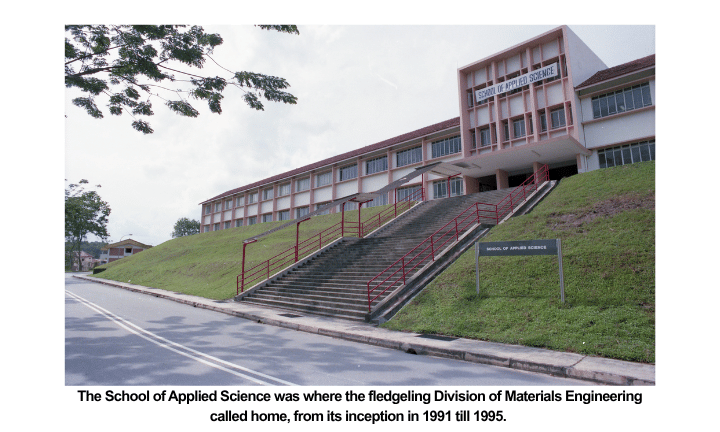
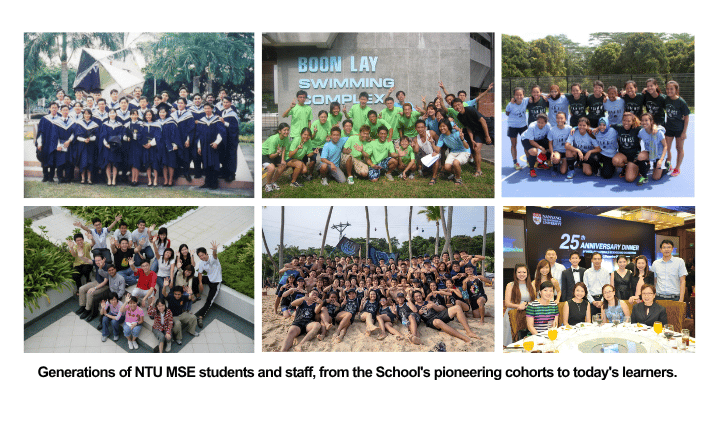
In 1991, NTU established the Division of Materials Engineering within the School of Applied Science — Singapore’s first materials engineering degree programme. In its early years, the school operated with a small team and an inaugural cohort of just 49 students, building laboratories and curriculum from the ground up.
 |
By 2000, the Division of Materials Engineering evolved into a full-fledged engineering school, the School of Materials Engineering — a reflection of both the discipline’s growing importance and Singapore’s ambitions in science and technology.
|
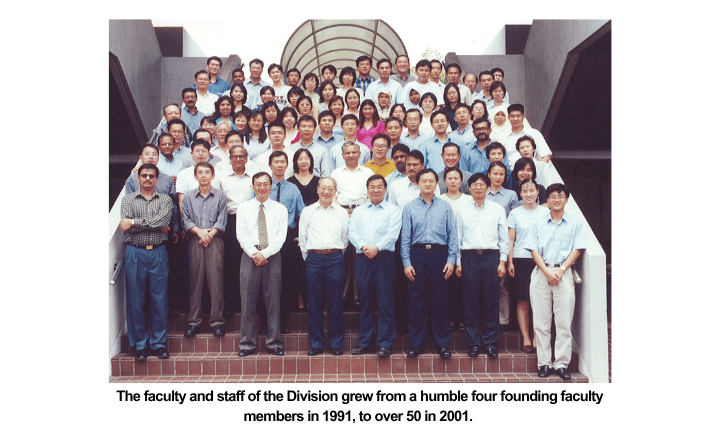
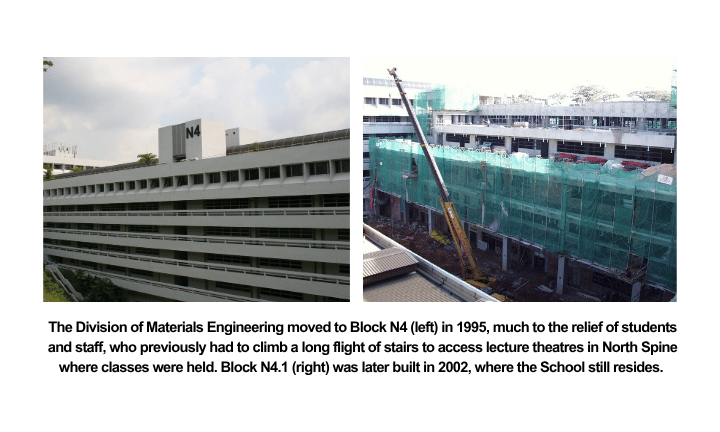
Today, the school has grown to be home to 49 world-class faculty, and hosts a vibrant ecosystem of undergraduate, postgraduate, and research programmes.
Explore our programmes:
- Undergraduate: https://www.ntu.edu.sg/mse/admissions/undergraduates
- Postgraduate: https://www.ntu.edu.sg/mse/admissions/postgraduates
A school defined by practice and purpose
Materials science and engineering sits at the intersection of physics, chemistry, and engineering, enabling innovations across a range of sectors, including clean energy, semiconductors, biomedical devices, and sustainability.
 |
From the outset, NTU MSE has been grounded in a clear philosophy — to put science into practice.
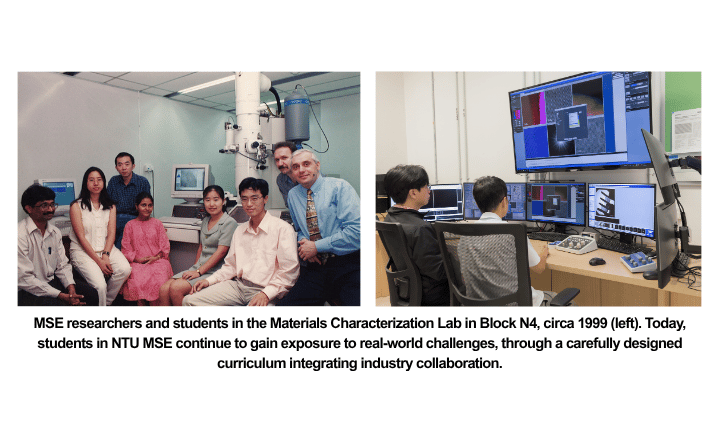
At NTU, this philosophy is reflected in both teaching and research. Students are trained not only in theory but also in application — working with advanced instrumentation, simulation tools, and problem statements developed in collaboration with industry partners.
Across these domains, NTU MSE contributes to areas such as:
- AI for Accelerated Materials Discovery & Computational Materials Science
- Future Energy Resilience
- Resource Circularity, Food & Water Security
- Future Computing
- Advanced Manufacturing & Materials Innovation
- Biointegrated Materials, Interfaces & Technologies
Read more about NTU MSE’s research efforts: https://www.ntu.edu.sg/mse/research
Growth alongside Singapore’s innovation economy
Over the past three decades, NTU MSE has grown alongside Singapore’s transformation into a global hub for advanced manufacturing and semiconductor technologies.
The semiconductor sector contributed approximately 6% of Singapore’s GDP in 2025 (EDB), with materials science and engineering playing a critical role in enabling chip fabrication, packaging, and performance.
Within this landscape, NTU MSE has established itself as a globally recognised centre of excellence. NTU is consistently ranked among the top 10 universities worldwide for Materials Science (QS World University Rankings by Subject) since 2000.
Faculty and researchers also work closely with industry and national research agencies, contributing to both fundamental science and applied innovation.
Beyond the classroom: shaping careers and industries
For students, the NTU MSE journey extends beyond academic training.
Through internships, industry-sponsored projects, and collaborations, students gain exposure to real-world challenges early on. These experiences develop not only technical capabilities, but also leadership, communication, and problem-solving skills.
Graduates go on to careers across sectors that are central to Singapore's economy, including organisations such as Applied Materials, AMD, Micron, Roche, GSK, ExxonMobil, Schneider Electric, IBM, A*STAR and DBS. The latest Graduate Employment Survey for the class of 2025 reflects strong local performance in full-time employment within the discipline, with a high proportion of graduates securing full-time roles within six months of graduation.
 |
Explore how to engage our student talent: https://www.ntu.edu.sg/mse/industry-partners/engage-ntu-mse-student-talent
A community with a shared ethos
Beyond its academic and research achievements, NTU MSE is also defined by its community.
From its early years as a degree programme under the Division of Materials Engineering in 1991 till the present day as one of the world’s largest Materials Science and Engineering institutions, the school has maintained its ethos of collaboration and "can-do" spirit.
As Prof Ng Kee Woei, Chair of the School of Materials Science and Engineering, reflects:
"Materials Science and Engineering sits at the heart of many of today’s most pressing challenges — from sustainability to advanced manufacturing. At NTU MSE, we focus not only on advancing knowledge, but on translating that knowledge into solutions that make a real difference."
Reflecting on MSE's 35-year milestone, one of the School's pioneering PhD graduates and former faculty members, Associate Prof Oh Joo Tien, shared:
"It has been an amazing journey. MSE became a world-class teaching and research school because of the dedication and sacrifices of leaders who dared to believe in what the School could become. The commitment of the entire MSE community — faculty members, administrative and technical staff — has been extraordinary. Most of all, the impact of our undergraduate and postgraduate students made to the industry and the society nationally and globally is remarkable. Congratulations to MSE on its 35th anniversary!"
A legacy of impact — and a future of possibilities
As NTU’s School of Materials Science and Engineering marks its 35th anniversary, it does so with a clear sense of both legacy and momentum.
From a small cohort of 49 students to a globally recognised institution, the school’s journey reflects the evolution of materials science itself — from a foundational discipline to a critical enabler of modern technologies.
 |
Yet its mission remains unchanged: to apply materials science in meaningful ways.
As the world confronts complex challenges — from climate change to resource sustainability — materials science and engineering will continue to play a defining role. At NTU, MSE remains committed to developing the materials, technologies, and talent that will shape the future.