MSE Welcomes Two NTU-AI4X Postdoctoral Fellows
What if scientists could design entirely new materials not through trial and error, but by navigating vast, unseen possibilities with artificial intelligence?
At Nanyang Technological University’s School of Materials Science and Engineering (NTU MSE), these questions are shaping a new wave of research at the intersection of AI and materials science.
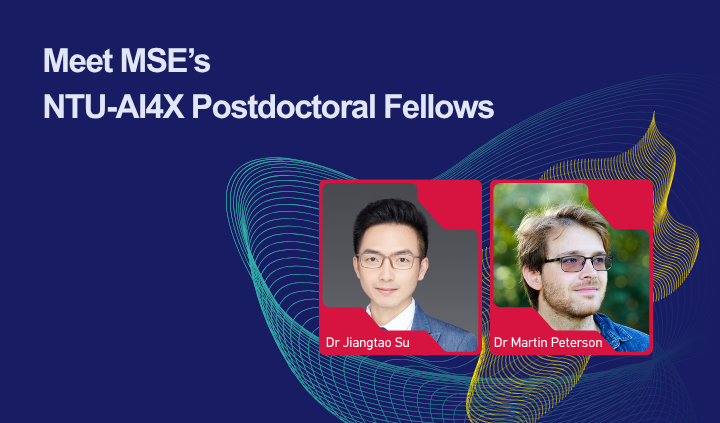
Two newly awarded NTU AI4X Postdoctoral Fellows — Dr Jiangtao Su, who completed his PhD at NTU MSE, and Dr Martin Hoffmann Petersen — are advancing these frontiers, where AI is evolving from a tool for analysis into a driver of discovery and design.
Together, their work reflects a broader shift at NTU MSE — from studying materials as static systems to designing them as part of adaptive, data-driven ecosystems.
Despite rapid advances in artificial intelligence, today’s robots still struggle with something humans do effortlessly: touch.
“Robots today are still largely ‘blind’ to physical interaction,” said Dr Jiangtao Su.
“By contrast, humans use touch effortlessly — from holding something fragile to
adapting to unexpected contact. Replicating that capability is key to building
AI systems that can function reliably in the real world.”
Dr Su’s project, “AI-Enabled Tactile Intelligence for Robotic Systems,” will focus on developing new approaches to enable robots to perceive and respond to physical contact in real time. His approach combines flexible electronic skin systems with machine learning algorithms that interpret complex tactile signals.
What sets this approach apart is how artificial intelligence is used not only to interpret data, but to shape the system itself. By applying generative models to optimise the materials, structures, and layouts of electronic skin, Dr Su aims to develop sensing systems designed with intelligence in mind from the outset. The work is expected to explore a closed-loop framework in which sensing, perception, and control continuously inform one another.
Distinguished University Professor Chen Xiaodong, who mentors Dr Su, noted that such advances point toward a new class of intelligent systems:
“The next generation of materials systems will not just be functional, but responsive — capable of sensing, adapting, and interacting with their environment in real time.”
“The goal is not just to collect tactile data, but to translate it into meaningful, generalisable representations that allow robots to act intelligently in uncertain environments,”
Dr Su added.
Building on his PhD at NTU MSE — where he developed high-performance electronic skin systems and published in journals such as Science Advances, Advanced Materials, and PNAS — Dr Su aims to enable dexterous, adaptive robotic manipulation, with applications in healthcare, rehabilitation, and intelligent manufacturing.
Turning Disorder into Opportunity in Materials Design
While Dr Su’s work focuses on how machines interact with the physical world, Dr Martin Hoffmann Petersen is asking a different question: what if the imperfections in materials are where the real opportunities lie?
Crystalline materials underpin a wide range of modern technologies, from batteries to catalysts. Yet the assumption that these materials exist in perfectly ordered structures often breaks down in practice. Many exhibit atomic disorder, in which atoms occupy positions that are difficult to predict — a complexity that has historically been treated as a limitation.
Dr Petersen’s project, “ML4DisCrystal: Bridging Machine Learning and Material Science for Disordered Crystals”, will explore new ways of treating atomic disorder as a design variable, opening potential pathways for discovering advanced functional materials.
Professor Kedar Hippalgaonkar, who mentors Dr Petersen, highlighted how AI is reshaping this space:
“We are moving towards a paradigm where AI can navigate complex materials spaces far more efficiently than traditional approaches — not just predicting properties, but guiding the discovery of entirely new classes of materials.”
At the core of his research is a unified framework that integrates generative AI, thermodynamics, and crystallographic symmetry—an approach that seeks to move beyond conventional discovery pipelines, which largely focus on ideal, ordered structures. By integrating machine-learning interatomic potentials with symmetry-aware representations and thermodynamic principles, the project aims to enable the generation of candidate structures, the exploration of energy landscapes, and the prediction of viable synthesis pathways.
“Disordered structures often show enhanced functional properties,
but we lack scalable ways to model and design them,” he noted.
With a background spanning computational materials science and machine learning, Dr Petersen has developed ML potentials, worked extensively with density functional theory simulations, and led the development of Dis-GEN, among the first generative models for disordered crystals.
The project is anticipated to contribute to a closed-loop, AI-driven discovery pipeline that links prediction, generation, and experimental validation, with potential applications in energy storage, catalysis, and thermoelectrics.
AI as a Scientific Engine
Across both projects, a common theme emerges: AI is no longer just accelerating existing workflows — it is reshaping how science is conducted.
For Dr Su, this means co-designing materials and intelligent systems to enable machines that can sense and respond to the physical world.
For Dr Petersen, it means using AI to navigate complexity beyond the reach of traditional computational methods, which are often computationally expensive and system-specific, limiting their scalability and hindering large-scale materials discovery.
Building the Next Generation of Interdisciplinary Research
The NTU AI-for-X Postdoctoral Fellowship (AI4X-PDF), jointly supported by NTU and Singapore’s National Research Foundation, is a highly competitive programme designed to attract outstanding early-career researchers applying artificial intelligence to accelerate breakthroughs across science and engineering.
For both fellows, NTU’s interdisciplinary and globally connected research environment was a key draw.
Dr Su described his PhD experience at NTU as “highly formative,” shaped by its interdisciplinary strengths spanning materials science, robotics, and artificial intelligence. Working across these domains and through collaborations with partners including ETH Zurich, MIT, and Harvard, he developed an integrated research approach in which materials design, sensing, and intelligent control are co-developed as part of a unified system.
Dr Petersen similarly highlighted NTU’s collaborative research ecosystem, where close integration between computational modelling and experimental validation enables stronger translation from theory to application. He noted that NTU MSE’s strength lies in bringing together expertise across AI, materials science, and characterisation — a combination he sees as critical for tackling complex challenges such as disorder in crystalline systems.
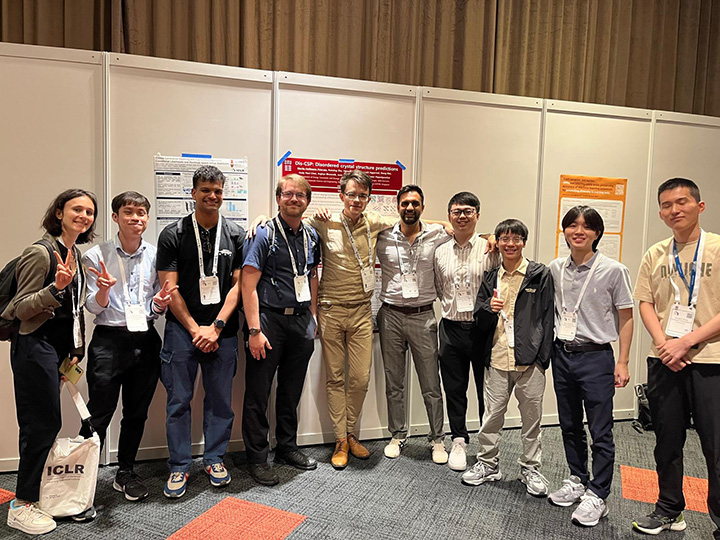
Dr Petersen with Prof. Hippalgaonkar and members of the computational and experimental research group |
Building on this foundation, both fellows are now looking to deepen collaborations across NTU MSE and beyond — working with researchers, students, and industry partners to translate AI-driven ideas into real-world impact.
Looking Ahead
As artificial intelligence continues to move beyond the digital into the physical world, the boundaries between materials, machines, and intelligence are beginning to blur.
From enabling robots to sense touch, to uncovering new classes of materials hidden within disorder, the work of Dr Su and Dr Petersen points to a future where AI is deeply embedded in both how systems are designed — and how they interact with the world.