Singapore-China workshop advances smart technologies for resilient aquaculture
Researchers from Singapore and China gathered at NTU Singapore to exchange progress on intelligence-based aquaculture solutions, from materials-enabled oral delivery systems to AI-driven monitoring, water management and circular farming systems.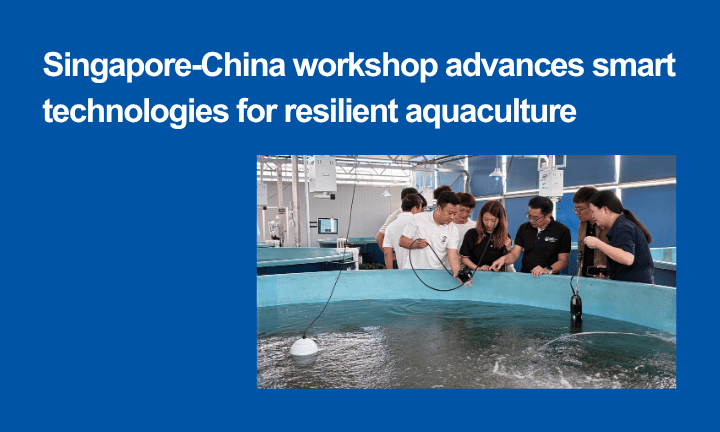
In aquaculture, what fish consume — and how that nutrition is delivered — can be just as important as how fish are farmed.
As climate change, disease risk and resource constraints place growing pressure on food production, aquaculture is becoming increasingly important to global food security. Yet high-density farming systems remain vulnerable to rising temperatures, shifting water conditions, disease outbreaks and environmental stress, all of which can affect fish health, immunity and productivity.
Building more resilient aquaculture systems will require new approaches that bring together materials engineering, biology, nutrition, water quality management, artificial intelligence and automation.
This was the focus of the Singapore-China Joint Flagship Project Workshop, titled "Intelligence-based Technological Innovations to Enhance Resilience in Aquaculture", held on 2 June 2026 at Nanyang Technological University, Singapore.
Led by Prof Loo Say Chye Joachim, Associate Dean (Undergraduate), College of Engineering, NTU, the workshop brought together researchers and students from NTU, A*STAR’s Institute of Molecular and Cell Biology (IMCB), the National University of Singapore (NUS) and the Aquaculture Innovation Centre (AIC), alongside collaborators from Huazhong Agricultural University (HZAU) and Wuhan University (WHU).
The bilateral project is funded under the cooperative framework between the National Research Foundation, Singapore (NRF) and the Ministry of Science and Technology, China (MOST). At the workshop, the teams reviewed first-year progress, exchanged technical insights and strengthened collaboration towards more climate-ready and sustainable aquaculture systems.
Materials science for food and water security
Opening the workshop, Prof Ng Kee Woei, Chair of NTU’s School of Materials Science and Engineering (MSE), welcomed the Chinese delegation and highlighted how advanced materials engineering can contribute to innovation in aquaculture.
In his address, Prof Ng shared how materials science can support targeted drug and nutrient delivery systems that improve fish health, farming productivity and sustainability. He also noted the value of combining complementary expertise from Singapore and China to accelerate the translation of research into aquaculture innovation and practice.
The workshop reflects NTU MSE’s research frontier in Resource Circularity, Food & Water Security, where the School develops sustainable materials solutions for food production, water purification, resource recovery and circular material systems in a resource-constrained world.
In aquaculture, this includes materials-enabled approaches that can improve nutrient delivery, support animal health, reduce waste and enable more efficient management of water and farming resources.
|
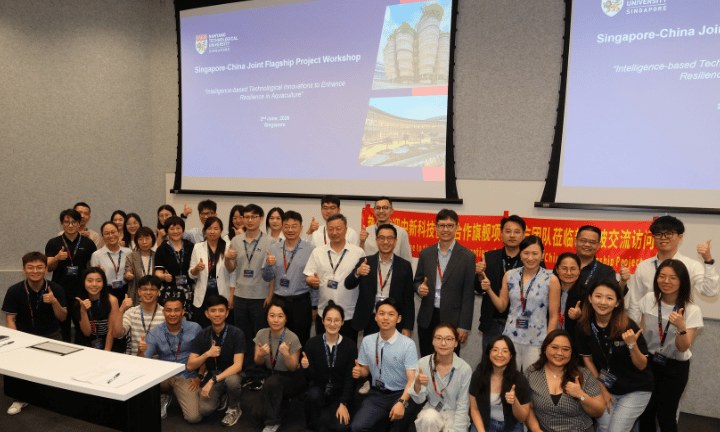 Researchers and student delegates from Singapore and China gathered at NTU for
 Engineering oral delivery systems for aquaculture
Prof Loo, Principal Investigator from the Singapore team, delivered a keynote presentation titled "Where Engineering Meets Aquaculture: Designing Encapsulation Systems for Targeted Oral Delivery".
His presentation showcased NTU’s work in microencapsulation technologies designed to protect sensitive bioactive compounds and beneficial microbes from acidic degradation in the fish stomach. This enables more precise release within the gastrointestinal tract.
In growth trials with local Asian seabass, co-supplementation of probiotics and curcumin improved feed conversion and immunity. The team also explored encapsulated oral hormone delivery as a lower-stress alternative to conventional spawning injections.
The work demonstrates how materials engineering can open new pathways for fish health, reproduction and productivity. It also connects to NTU MSE’s frontier in Biointegrated Materials, Interfaces & Technologies, where researchers design materials that interact with biological systems through areas such as drug delivery, biointerfaces, biosensors and biomedical platforms.
Smart aquaculture through AI and automation
Prof Ma Xufa, the Chinese project lead and Vice Dean of the College of Fisheries at HZAU, shared the China team’s progress in smart aquaculture technologies.
His presentation covered advances in behaviour profiling, digital twin frameworks, AI-enabled disease early-warning systems and intelligent water quality management. He also shared examples of how these technologies have been commercially applied to support automated and visualised aquaculture management.
These developments point to the growing role of data-driven systems in aquaculture. Predictive modelling, digital frameworks and AI-enabled monitoring can help researchers and industry partners move from reactive farming towards more proactive, closed-loop management.
Interdisciplinary solutions for resilient farming
The workshop continued with research updates from project co-investigators across Singapore and China.
From the China team, Prof Li Dapeng of HZAU and Prof Sha Zongyao of WHU shared work on automated systems using multimodal sensor fusion and AI models for real-time physiological monitoring and dynamic feeding strategies. Assoc Prof Hou Jie of HZAU presented a chemical approach to prevent biofilm clogging in wastewater systems.
Representing the Singapore team, Dr Caroline Wee from A*STAR IMCB, Asst Prof Lei Jiarui from NUS, and Dr Diana Chan from AIC shared insights on fish responses to high-temperature and stocking-density stress, the hydrodynamics of marine cages, and approaches to closing resource loops in hyper-intensive farming systems.
Together, the presentations showed how resilient aquaculture depends on multiple layers of innovation: healthier fish, smarter monitoring, cleaner water systems, better resource use and more sustainable farm operations.
Building climate-ready aquaculture systems
The afternoon session featured an academic exchange among postgraduate and postdoctoral researchers from Singapore and China. Presentations covered the scale-up of oral microencapsulation vectors, fish stress responses under high stocking density, and sonar techniques for estimating biomass in turbid pond environments.
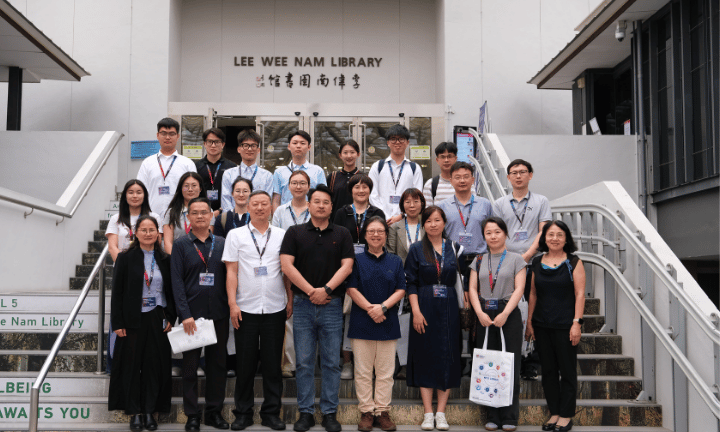 Joint project members and student delegates from Singapore and China during a campus tour at NTU, Joint project members and student delegates from Singapore and China during a campus tour at NTU, which rounded off a day of research exchange on smart aquaculture technologies. |
As the project completes its first year, the Singapore and China teams will continue to advance smart, technology-driven aquaculture solutions that support healthier fish, more efficient farming systems, and more sustainable use of resources.
For NTU MSE, the workshop reflects how materials science can contribute to food resilience and sustainability beyond traditional engineering sectors. By bringing together materials-enabled delivery systems, biological insights, AI-driven monitoring and circular farming approaches, the collaboration aims to support more resilient aquaculture systems for the future.
A collaborative feature with Wo Kheng Pak Kevin, Postgraduate Student, and Dr Li Wenrui, Research Fellow, at the School of Materials Science and Engineering, NTU