Rethinking how batteries lose lithium a potential key to unlocking more efficient energy storage
Before a lithium-ion battery can ever power any of the devices in our everyday lives, it already loses part of the active lithium that gives the battery its energy-storing capacity.
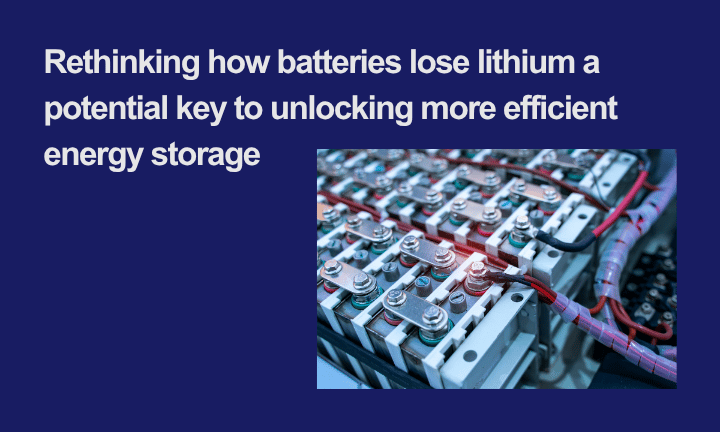
For industries developing electric vehicles and large-scale renewable energy storage systems, reducing lithium loss in batteries has become an increasingly significant challenge.
This loss happens during the battery’s very first charge cycle, when chemical reactions form a thin protective layer known as the solid electrolyte interphase (SEI). This layer is essential for battery stability and safety — but forming it also permanently consumes active lithium ions, reducing the amount of energy the battery can ultimately store.
Now, researchers from Nanyang Technological University (NTU) have proposed a different way to think about the problem: instead of focusing only on how this SEI layer forms, the team looked to the processes that govern when this layer stops forming.
Their findings, published in Advance Materials: Early Terminating Solid Electrolyte Interphase Formation via Nucleophilic Fluorination to Achieve High Initial Coulombic Efficiency, introduce a new direction for engineering battery interfaces that could help reduce irreversible lithium loss in future high-energy-density batteries.
A hidden trade-off in battery design
Whenever a rechargeable lithium-ion battery is used, the lithium ions in the electrolyte act as charge carriers, travelling between the cathode and anode. This movement of charge is what allows the battery to both store and release energy.
However, for this to happen, chemical reactions inside the battery first form a solid electrolyte interphase, consuming precious lithium in the electrolyte.
This interphase layer helps to prevent further decomposition and stabilises the electrolyte, which in turn helps improve the power density, lifespan and safety of these batteries. This inevitable trade-off then poses a challenge for researchers, where there is a need to balance the consumption of lithium ions to create this necessary layer as well as the charge capacity of the battery electrolyte.
"Most existing strategies focus on regulating SEI formation through electrolyte design or additive engineering," said Distinguished University Prof Chen Xiaodong from NTU’s School of Materials Science and Engineering (MSE). “However, these approaches still require significant lithium consumption to build a stable interphase."
These current strategies predominantly rely on compensating for irreversible capacity loss by introducing external lithium sources. Unfortunately, these methods do not completely address the issue of limited lithium utilisation and can be hazardous due to the highly reactive nature of lithium reagents.
"Furthermore, these approaches introduce complexities in cell manufacturing and potential safety hazards, underscoring the need for alternative strategies that improve ICE without relying on additional lithium sources," said Prof Chen.
Shifting the focus from formation to termination
Instead of looking to regulating the process, Prof Chen and his team focused their efforts on the processes that governed the formation of the SEI in the first place.
"SEI formation is inherently a self-terminating process, where initial reactants are replaced by more stable constituents, leading to the cessation of further reactions,” says Dr Cao Shengkai, a research fellow in the team. “Instead of letting this process continue uncontrolled, can we make it stop earlier and save more lithium?"
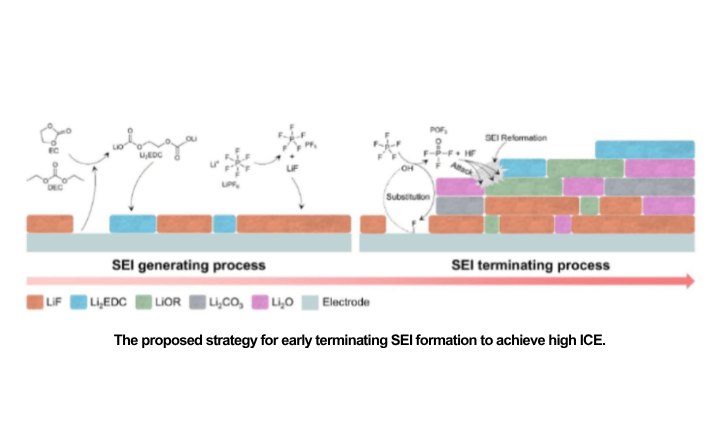 |
That shift in perspective led the researchers to investigate parasitic reactions occurring at the battery interface. These unwanted reactions continuously damage and reform the SEI, consuming additional lithium in the process.
The team identified one key contributor: reactions involving PF5, a decomposition product commonly generated in lithium-ion battery electrolytes. These reactions attack hydroxyl groups on the electrode surface, producing corrosive compounds that destabilise the SEI and drive repeated lithium consumption.
"Building on this insight, we hypothesised that pre-emptively introducing equivalent chemical fluorination can effectively suppress interfacial parasitic reactions and reduce lithium-ion loss, allowing us to terminate SEI formation early," said Prof Chen. "Such a process would then be a new interfacial regulation route that reduces lithium-ion loss without requiring additional lithium sources."
Engineering a thinner, more stable interface
Using hydroxyl-rich titanium dioxide (TiO2) as a model system, the researchers applied a surface chemistry strategy known as nucleophilic fluorination. The process converted surface hydroxyl groups into fluorinated groups before extensive side reactions could occur.
Interfacial analysis showed that the approach dramatically reduced organic SEI formation, producing a thinner and more stable interphase layer while maintaining the beneficial lithium fluoride-rich inner SEI structure needed for battery stability.
The fluorinated TiO2 anodes achieved an average initial Coulombic efficiency (ICE) of 92.1 per cent, compared to 74.1 per cent for untreated anodes. In pouch-cell testing, ICE improved from 67.5 per cent to 83.7 per cent.
A higher ICE means more lithium remains available for actual energy storage, rather than being lost to these irreversible reactions.
The team also observed that some conventional electrolyte additives, despite improving certain interfacial properties, could still reduce ICE because they continued consuming lithium during SEI formation. The finding reinforced the researchers’ broader conclusion: controlling when SEI formation stops may be just as important as controlling what the SEI is made of.
Why this matters
Even incremental improvements in lithium utilisation can have significant implications for battery manufacturing, particularly as industries push toward higher energy density systems for electric mobility and renewable energy infrastructure.
Rather than replacing existing electrolyte or electrode design strategies, the researchers believe their approach could complement them by providing a more efficient route to reducing irreversible lithium loss.
Because this discovery can potentially extend to many forms of lithium-ion battery formulations, potential collaborators include battery researchers, electrolyte and electrode designers, as well as industries working on high-energy-density lithium-ion batteries.
Future Possibilities
Future research will explore extending the fluorination strategy to other electrode materials and electrolyte systems to achieve both high initial efficiency and long-term stability.
In a field where small efficiency gains can translate into major industrial impact, the study highlights how revisiting overlooked chemical processes — including knowing when reactions should end — may help shape the next generation of battery technologies.