NTU MSE takes next step in translating sustainable growing media platform to farm-ready technology
Supported by the Singapore Food Agency, under the Food Story R&D Programme 2.0 Research Translation Grant, the project will optimise formulations of NutriCube, a patented biodegradable growing media platform, for specific crops, validate performance in farm settings and explore industrial-scale manufacturing.
 |
In urban farming, what plants grow in can be just as important as how they are grown.
Growing media — the soil substitutes used to support seed germination, seedling growth and crop maturation — are a critical but often overlooked part of the farming system. Many conventional growing media used in urban farms are passive materials. They support the plant physically but do not provide targeted nutrients. Some also generate solid waste after harvest, adding to the environmental footprint of food production.
For Singapore, this issue is especially relevant. The country imports more than 90 per cent of its food, making food supply vulnerable to external shocks and supply chain disruptions. Under Singapore Food Story 2, the "Grow Local" pillar aims to strengthen local farms’ capability and capacity, including supplying 20 per cent of local fibre consumption — such as fresh leafy and fruited vegetables, beansprouts and mushrooms — by 2035.
That places pressure on local farms to grow more with limited land and resources, while keeping production sustainable and commercially viable. Improving seeds, lighting and climate control are important, but the materials that hold and feed crops also matter.
An NTU School of Materials Science and Engineering (MSE) team is addressing this gap through NutriCube, a growing medium made from waste-derived keratin and cellulose. Keratin can be obtained from biological waste such as chicken feathers, while cellulose can be derived from plant waste.
The team has secured support under the Singapore Food Story R&D Programme 2.0 Research Translation Grant to take NutriCube into its next stage: from a promising platform towards crop-specific, farm-tested and scalable use.
"Urban farming is often discussed in terms of automation, lighting or crop genetics, but the material that plants grow in is just as important," said Professor Ng Kee Woei, Chair of NTU’s School of Materials Science and Engineering and Principal Investigator of the project. “If we can engineer growing media to support the plant, deliver nutrients more efficiently and reduce waste after harvest, we can address a hidden but significant part of sustainable food production.”
From platform to practical use
NutriCube has already been demonstrated as a sustainable growing media platform. The new project is about translating the technology for real agricultural use.
The team will develop optimised NutriCube formulations for specific crops, including leafy greens such as lettuce, pak choy, kailan and bayam. By varying material composition, nutrient concentrations, and crosslinking densities, the researchers aim to tune nutrient release and the growing medium's performance under different crop and farming conditions. The tech can also be applied to other food crops, including fruiting vegetables and ornamental plants, in the future.
This matters because farms do not operate on one-size-fits-all solutions. Different leafy greens, growing environments and production systems may require different nutrient profiles, water retention properties and degradation rates. A formulation that works well for one crop may need to be adjusted for another.
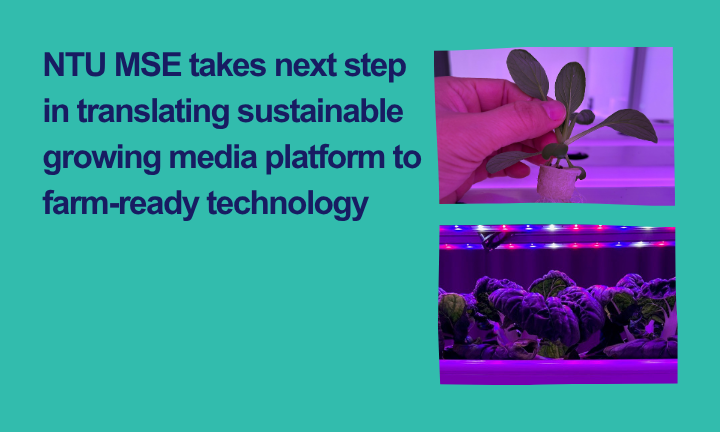
NutriCube being leveraged in controlled growing environments helping researchers evaluate how different formulations affect plant growth, nutrient delivery and farm-readiness. |
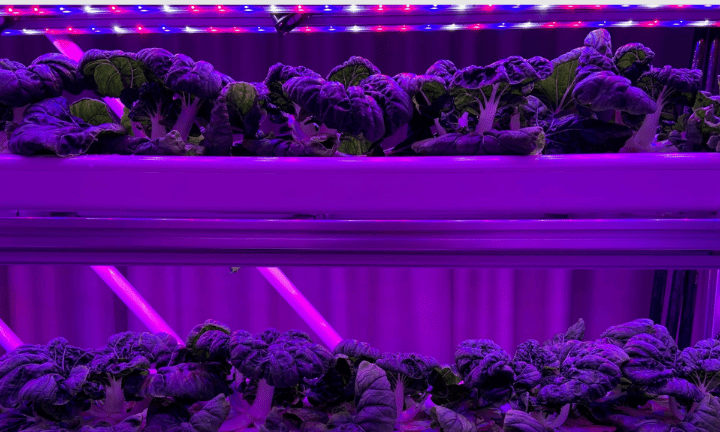
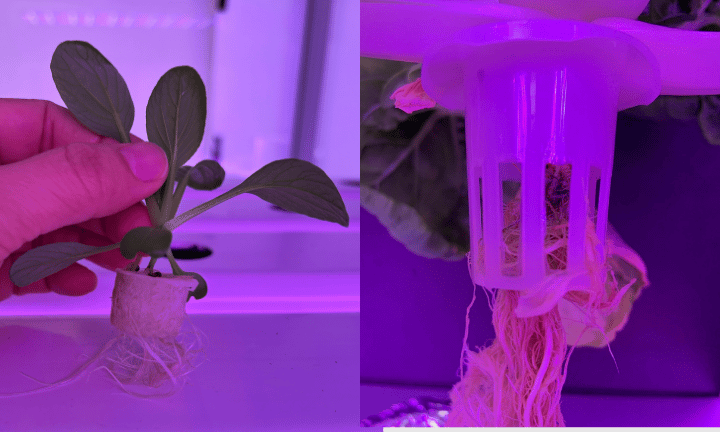
Unlike conventional growing media, NutriCube is designed to be bioactive. As it biodegrades, it can release macronutrients such as nitrogen and sulphur. It can also be engineered to carry micronutrients such as iron, zinc, magnesium and copper, with compositions and release profiles customised to suit different cultivated varieties and environments.
This means the growing medium can do more than hold the plant in place. It could support growth, deliver nutrients more efficiently and reduce waste after harvest. Once validated at farm scale, crop-specific NutriCube formulations could help farms improve yield while reducing fertiliser wastage, pollution and residual solid waste. It could also create a higher-value use for waste streams such as chicken feathers and plant residues.
Testing what works beyond the lab
A key emphasis of the grant is validation. The project will include field tests to evaluate how NutriCube performs in real farm settings and generate data on crop outcomes, cost-benefit and market-relevant use cases.
The team will also conduct a Life-Cycle Assessment to evaluate the environmental impact of the optimised growing media, including its performance in terms of cost, carbon emissions, resource efficiency, and plant growth metrics.
Manufacturing is another important part of the work. The project will explore approaches to produce NutriCubes at an industrial scale, with attention to efficiency, consistency and scalability.
Together, these efforts will help answer the questions that matter to potential adopters: Can the material be made reliably? Does it improve crop outcomes? Does it reduce waste and environmental impact? Can it be produced at a scale and cost that makes sense for farms?
Why NTU MSE
NutriCube is fundamentally addressing a materials science challenge in food resilience.
Its performance depends on how keratin and cellulose are processed, how the porous structure absorbs and retains water, how nutrients are incorporated, and how the material degrades over time. By controlling formulation and crosslinking, the research team can tune the growing medium for different crops and environments.
This builds on NTU MSE’s strengths in sustainable materials, biomaterials, materials processing and translational research. It also reflects the school’s ability to apply materials innovation to national and industry challenges beyond traditional engineering sectors.
The broader significance of this work has also been recognised regionally. Professor Ng has been selected as the recipient of the SEARCA Regional Professorial Chair for Academic Year 2026–2027 in Materials Science and Engineering, in recognition of his contributions to improving sustainability in agriculture through innovations in growing media technology.
For NTU MSE, the work shows how waste-derived materials can be redesigned into functional platforms that support more sustainable food production. It also demonstrates how materials science can contribute to Singapore’s food resilience goals while addressing wider regional priorities in sustainable agriculture, resource circularity and climate resilience.
By optimising NutriCube for selected crops, validating it under farm conditions and exploring industrial-scale production, the project aims to build the materials, field evidence and scale-up pathways needed for next-generation growing media technologies.
A collaborative feature with Dr Zhao Zhitong, Senior Research Fellow at NTU School of Materials Science and Engineering
| This project contributes to NTU MSE’s Resource Circularity, Food &
Water Security research frontier, which creates sustainable materials
solutions for food production, water purification, resource recovery and
circular material systems in a resource-constrained world. By turning biological waste streams such as chicken feathers and plant residues into functional growing media, NutriCube shows how materials science can support more sustainable food production while advancing circular materials use. |
More about Prof Ng Kee Woei
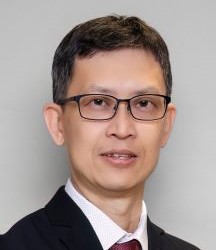 | Chair, School of Materials Science & Engineering Professor, School of Materials Science & Engineering Research Domains: Biomedical Engineering | Biotechnology | Circular Economy | Food Science and Technology | Green Production and Sustainable Urban Farming | Nanomaterials and Nanotechnology | Skin Diseases and Wound Repair |