Reinforced Chitosan polymer electrolytes bring low-cost, sustainable and high-performance energy storage closer to reality
Collaborative feature with Prof Madhavi Srinivasan and Dr Gwendolyn Lim at NTU School of Materials Science and Engineering
Published in Advanced Functional Materials, March 2025
Rethinking the (lithium) batteries we have today
Imagine no longer having the concept of a “battery compartment” in your devices, and just having a lighter, smaller device instead.
This is the future that structural batteries, also known as “massless” energy storage, are promising. Structural batteries store energy while also carrying mechanical loads, forming the basis of the device itself. This translates into an overall weight reduction and an increase in efficiency. This opens the door to lighter, more efficient systems across a variety of applications — from electric vehicles to self-powered architectural components.
Among the most promising candidates are aqueous zinc batteries. The water-based zinc electrolyte is safer, more environmentally friendly, and more widely available than conventional lithium-ion alternatives. Water plays a key role in these batteries, making them much less flammable, while also reducing cost.
However, such batteries have yet to be commercially developed as there are a variety of challenges present. In the presence of water, zinc metal forms needle-like structures called dendrites, which can short-circuit the battery. The water in the electrolyte can also cause corrosion and unwanted chemical reactions.
At the same time, existing gel-like electrolytes lack the mechanical load-bearing capabilities to be able to be integrated into structural designs.
"In most battery systems today, energy storage and structural function are completely separate,” said Prof Madhavi Srinivasan. “That separation adds weight and limits how efficiently we can design next-generation technologies."
A multifunctional material that balances electrochemical stability and strength
NTU MSE researchers sought to find a workaround to these problems by using a hydratable plastic as the battery electrolyte. This plastic is made with a biopolymer called chitosan, as well as a nanoscale reinforcement material made from cellulose, known as cellulose nanofibrils (CNF), and infused with aqueous Li+/Zn2+ electrolyte solution.
Chitosan is derived from chitin, which itself is largely available in nature, such as crustacean shells, the cell walls of fungi, and the exoskeletons of insects.
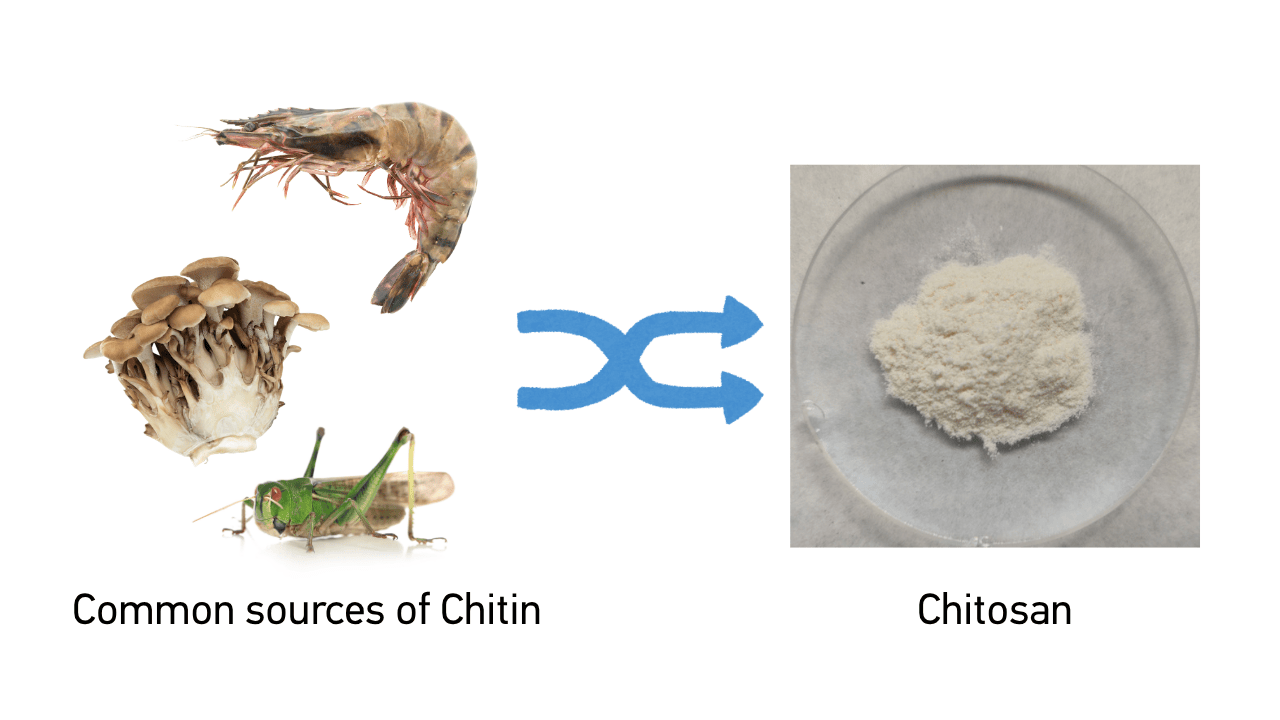
Common sources of Chitin include shells of crustaceans, fungi cell walls and insect exoskeletons. This Chitin is then refined into Chitosan, which can then be used in a variety of applications.
|
On the other hand, CNF is typically derived from waste plant matter, such as wood pulp and seed fibres, where cellulose is processed into nanometre-scale widths.
By combining the two in different layers, the researchers created a composite electrolyte that was both mechanically robust and electrochemically stable.
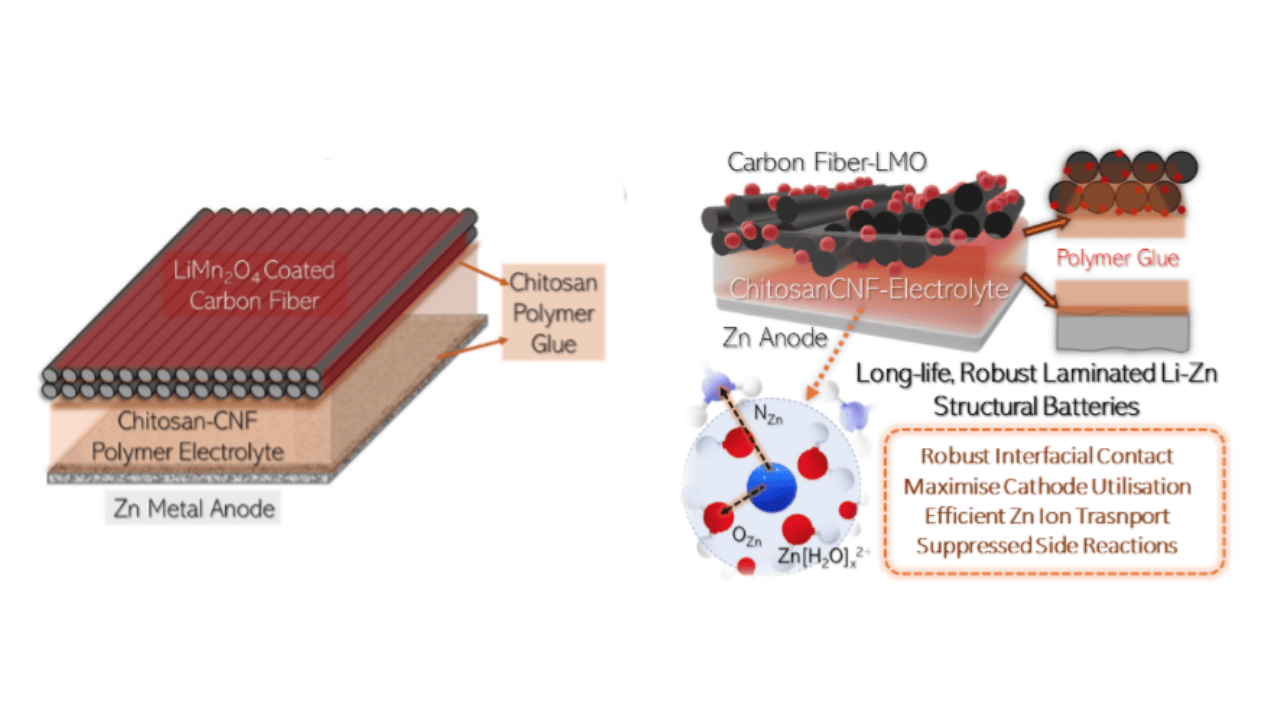
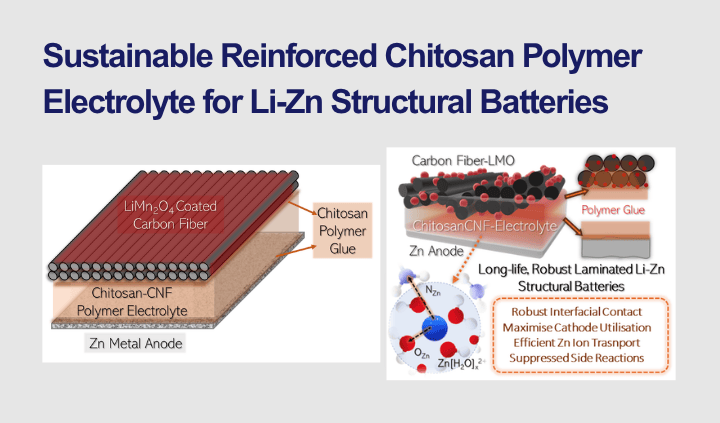
The Chitosan-CNF polymer electrolyte is sandwiched between 2 layers of Chitosan polymer glue, which integrates the seamless electrolyte-electrode interface (left). The laminated structure behaved as a single continuous composite, improving both mechanical integrity and electrochemical performance.
|
In most aqueous Zn systems, improving electrochemical stability means sacrificing mechanical strength, and vice versa.
“The challenge has not been a lack of materials, but the inability to align their functions across scales — from ion-level chemistry to device-level performance,” said Prof Madhavi.
At the microscopic level, chitosan reshapes the local chemical environment of Zn²⁺ ions, reducing free water activity and stabilising electrochemical reactions.
"We observed that the chitosan matrix directly alters how zinc ions are solvated,” said Dr Gwendolyn Lim, a research fellow on the team. “By reducing the amount of free water around Zn²⁺, we were able to suppress unwanted reactions and achieve much more stable cycling."
At the same time, the cellulose nanofibrils helped to reinforce the material, giving the electrolyte the necessary stiffness and strength required to carry loads.
The resulting battery, utilising a combination of naturally derived materials, achieved a high electrochemical performance with a cycling stability of over 4500h, with over 90% capacity retention.
"What was interesting was how seamlessly the layers integrated," Dr Gwendolyn added. "After assembly, the system behaved as one continuous material rather than separate components."
It was also able to withstand deformation and abuse without losing its ability to hold a charge, making it extremely adaptable to complex configurations without any additional structural supports.
Why this matters for science and collaborators
The matrix versatility and sustainability of this battery design open the potential for future mechanically robust and high electrochemically performing energy storage designs.
"If your battery can also carry load, you’re no longer designing around it — you’re designing with it," said Prof Madhavi.
Both discoveries point to the importance of interface engineering and polymer chemistry in battery design, and a step toward making structural batteries a reality in everyday devices.
Future Possibilities
"This is about enabling a new design paradigm," said Prof Madhavi. "Where energy storage is no longer a separate component, but part of the structure itself."
Such innovations can see an immediate benefit in virtually every industry that utilises batteries. Just like how electric vehicles now have a “frunk”, or forward trunk, where the engine would typically sit in a conventional vehicle, we could potentially see similar space-saving gains in the electronics around us.
Furthermore, because the batteries are water-based, we could also see the elimination of protective casings and cooling systems usually reserved for conventional batteries.
The discoveries from this paper mark a significant step toward real-world implementation of sustainable structural energy storage systems, combining long cycling stability, high tensile modulus, deformation resistance, and practical laminate integration.
The use of bio-derived, recyclable polymers, such as chitosan and cellulose, could potentially open pathways toward carbon-neutral or biodegradable energy storage systems. These systems could then see deployment in temporary structures, disaster-relief deployments, or space-constrained environments.
Future work will focus on:
- Scaling and manufacturability studies to assess process compatibility with industrial battery fabrication;
- The optimisation of chitosan chemistry;
- Interface engineering to enhance adhesion and reduce interfacial resistance in multilayer structural batteries.
More about the publication
This research is supported by A*STAR’s Advanced Manufacturing and Engineering programmatic fund and Singapore’s RIE2025 Young Individual Research Grant, alongside international collaboration through the Wallenberg Initiative Materials Science for Sustainability (WISE), reinforcing the work’s relevance to advanced manufacturing and sustainable materials innovation.
More about Prof Srinivasan Madhavi

| Appointments: Executive Director, Energy Research Institute @NTU (ERI@N) President's Chair in Sustainability Professor, School of Materials Science & Engineering
Research Domains: Chemistry and Chemical Engineering | Circular Economy | Civil and Environmental Engineering Energy | Climate and Environment | Energy | Materials Science & Engineering | Nanotechnology & Nano-Science | Renewable Energy and Sustainability
madhavi@ntu.edu.sg |