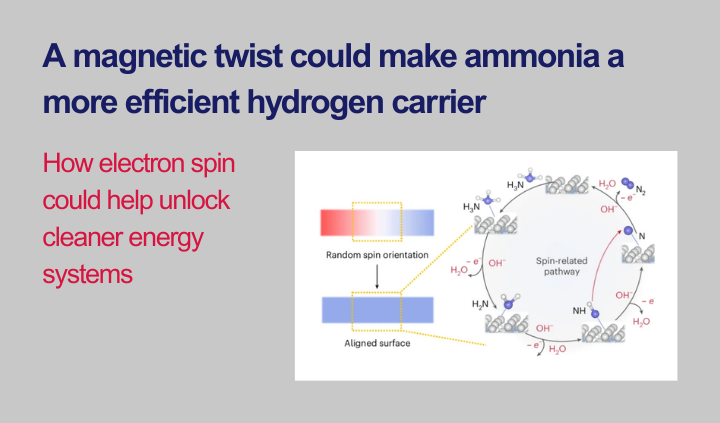
A magnetic twist could make ammonia a more efficient hydrogen carrier
How electron spin could help unlock cleaner energy systems
Collaborative feature with Prof Jason Xu, Dr Zhu Siyuan, and Dr Wu Qian, NTU School of Materials Science and Engineering
Published in Nature Chemistry, August 2025
A stubborn bottleneck in clean energy
Extracting hydrogen from ammonia — a promising carrier for clean energy — has long been limited by a stubborn chemical bottleneck. NTU researchers have now shown that the key may lie in an unexpected place: the alignment of electron spins on a magnetic catalyst surface.
Hydrogen is widely viewed as a clean fuel of the future. When used, it produces only water. But hydrogen is difficult to store and transport efficiently.
Ammonia (NH₃), already produced and transported globally as a fertiliser, offers a possible solution. It stores hydrogen in a dense liquid form and can be shipped using existing infrastructure.
The challenge lies in releasing that hydrogen efficiently.
A reaction scientists have struggled to speed up
To extract hydrogen from ammonia, the molecules must first break apart on the surface of a catalyst. During this process, nitrogen-based intermediates form and must combine before the reaction can proceed.
For decades, researchers have tried to accelerate this step by modifying catalysts — changing their chemical composition, reshaping surfaces, or engineering new nanostructures.
Yet a key stage of the reaction has remained stubbornly inefficient.
A magnetic clue
In a study published in Nature Chemistry, Prof Jason Xu and his team discovered that the answer may lie in an often-overlooked property of electrons: spin.
Spin describes the quantum orientation of electrons, similar to tiny magnetic needles. The researchers found that when these spins align with a magnetic catalyst surface, a critical step in the ammonia oxidation reaction becomes significantly easier.
“For decades, reaction improvements were by changing the catalyst itself,” says Prof Xu. “Our work shows that how the electrons spin — not just what the catalyst is made of — can determine how efficiently the reaction proceeds.”
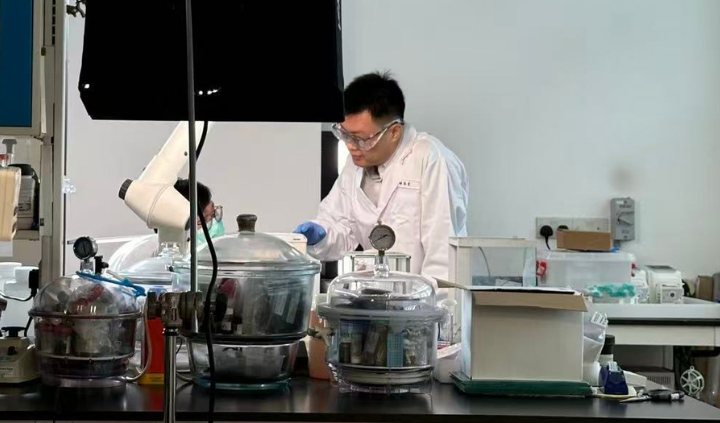
Prof Jason Xu and a member of his research team |
When the spins of nitrogen intermediates align with the magnetised catalyst surface, the energy barrier for a key nitrogen–nitrogen coupling step drops dramatically — allowing the reaction to proceed more efficiently.
Illustration of ammonia oxidation |

Designing catalysts with spin in mind
To investigate this effect, the team engineered cobalt–platinum thin-film catalysts with carefully controlled magnetic properties.
Their experiments revealed that when the catalyst surface was magnetised:
- nitrogen intermediates aligned their spins with the catalyst surface
- the energy barrier for coupling reactions decreased
- the overall ammonia oxidation reaction proceeded more efficiently
Notably, the improvement occurred without increasing temperature or pressure, which are the conventional ways of accelerating chemical reactions.
A new principle for catalyst design
The findings suggest that catalyst performance may depend on more than chemical composition and surface structure of catalysts.
Instead, researchers may also need to consider the spin environment of electrons on catalyst surfaces.
“This work bridges materials science, magnetism and catalytic chemistry,” say Dr Zhu Siyuan and Wu Qian, research fellows and co-first authors of the study. “It shows how quantum spin effects can influence chemical reactions and guide the design of more efficient catalysts.”
By linking magnetic ordering to catalytic performance, the study introduces spin alignment as a new design principle for electrocatalysis. Prof. Xu’s group has pioneered the electron spin effect in catalysis. In their earlier studies, they have revealed the spin-promotion effect and established the spin-aligned intermediates coupling mechanism, demonstrating that magnetic ordering promotes the radical intermediates coupling process, such as O-O, which is a critical barrier in water electrolysis for hydrogen production.
Why it matters for energy systems
Efficient ammonia conversion is becoming increasingly important as ammonia gains attention as a potential hydrogen carrier.
Ammonia-based systems are being explored for:
- hydrogen storage and transport
- clean fuel for shipping and heavy transport
- energy systems that rely on hydrogen supply chains
Improving the efficiency of ammonia conversion reactions could therefore support the development of these emerging energy technologies.
Looking ahead
The researchers are now exploring whether spin-guided catalyst design can be applied to other chemical reactions where intermediate coupling limits efficiency.
Future work will focus on:
- testing similar spin effects in different catalyst materials
- examining other energy-related reactions where spin alignment may play a role
- understanding how magnetic properties can be engineered to improve catalytic performance
Sometimes, solving a long-standing chemical problem requires looking beyond traditional approaches. In this case, the answer may lie in the quantum behaviour of electrons themselves.
__________________
More about the publication:
Cooperative Spin Alignment Enhances Dimerization in the Electrochemical Ammonia Oxidation Reaction
AUGUST 2025 | Nature Chemistry
Authors: Siyuan Zhu, Qian Wu, Chencheng Dai, Anke Yu, Tianze Wu, Xiao Ren, Xiaoning Li, Anton Tadich, Dengfu Deng, Tao Liu, Qiong Wu, Ming Yue, and Zhichuan J. Xu*
This research is supported by competitive national funding from Singapore’s National Research Foundation and A*STAR under strategic hydrogen and low-carbon energy programmes, with international collaboration enabled through the Australian Synchrotron and additional support from the National Natural Science Foundation of China.
More about Prof Jason Xu
| Appointments: Associate Chair (Faculty) President's Chair in Materials Science and Engineering Professor, School of Materials Science & Engineering Director, Centre of Excellence in Maritime Energy & Sustainable Development (MESD) Research Domains: Chemistry and Chemical Engineering | Energy | Materials Science & Engineering | Nanotechnology & Nano-Science | Water & Sustainability xuzc@ntu.edu.sg |