Polymer Nanoparticles for Afterglow Molecular Imaging
Synopsis
Diagnostic imaging is vital for disease diagnosis and treatment. This invention introduces semiconducting nanoparticles tailored for real-time bioimaging. Their unique near-infrared (NIR) afterglow luminescence enables deep tissue imaging with heightened sensitivity and a prolonged storage capability of up to one month, promising enhanced patient outcomes and advancements in medical research.
Opportunity
Diagnostic imaging is essential for detecting medical complications and aiding in disease diagnosis and treatment. It also generates vast datasets that contribute to understanding diseases and developing new therapies and medical technologies, thus improving patient outcomes. The diagnostic imaging market, valued at USD 40 billion in 2022, is poised to grow at a CAGR of 5.5% from 2023 to 2032, driven by an aging population and increasing prevalence of chronic diseases.
Technology
This invention is underpinned by semiconducting nanoparticles characterised by their NIR afterglow luminescence properties, which are specifically designed for in vivo real-time bioimaging applications. These polymer nanoparticles provide an innovative solution for pre-irradiation and extended storage of up to one month before use. The key feature of these semiconducting nanoparticles lies in their ability to emit NIR afterglow luminescence, providing exceptional tissue penetration capabilities to ensure high-quality imaging even in deep-seated tissues. They also demonstrate enhanced in vivo sensitivity, which improves detection precision while maintaining an impressive signal-to-background ratio. Further, the ability to pre-irradiate and store the nanoparticles for up to one month adds practicality and convenience in medical settings.
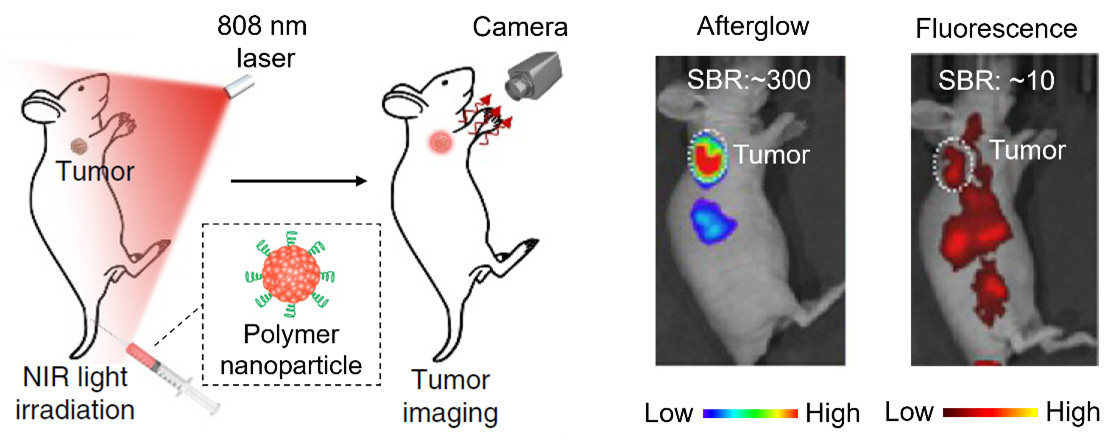
Figure 1: Polymer nanoparticle-based afterglow imaging of tumor. Polymer nanoparticle is injected to tumor-bearing mouse via tail vein, followed by 808 nm laser irradiation. After cessation of irradiation, afterglow signals are recorded in real-time. Afterglow imaging can sensitively detect tumor as soon as 2 h post-injection and offer higher signal-to-background ratio (SBR) than fluorescence imaging
Applications & Advantages
Main application areas include the early detection and monitoring of diseases, medical research and real-time in vivo bioimaging.
Advantages:
- Eliminates the need for real-time laser excitation during imaging procedures, resulting in minimal background interference.
- The semiconducting nanoparticles are organic, preventing metal-ion-induced toxicity.
- NIR afterglow luminescence of the nanoparticles is 100 times more sensitive than fluorescence imaging, allowing for lower dose administration.
- NIR afterglow luminescence surpasses NIR fluorescence in tissue penetration.
- Allows real-time monitoring of pathological processes, enhancing the ability to track disease progression.