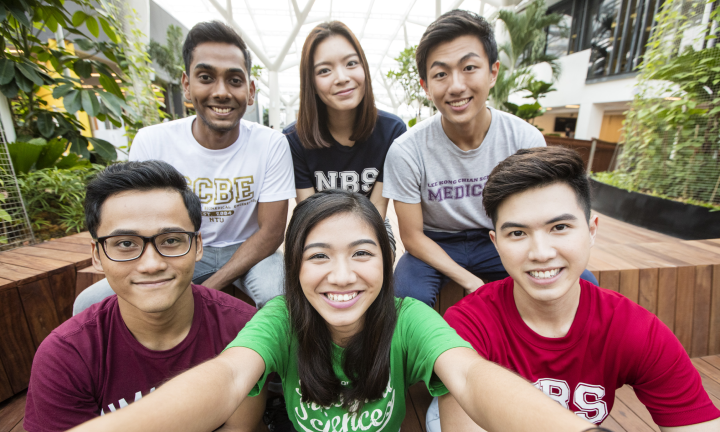

At NTU-CEE, you will be equipped to build a brighter, greener, and more sustainable world as an environmental engineer, understand concepts of food sustainability and apply them to real-world situations.
Food security has become a critical concern both locally and globally, driven by a combination of environmental, economic, and social factors. In response, Singapore has strategically repositioned itself to improve food security, focusing on research and development in urban agribusiness. This includes a wide range of initiatives— from modern farming practices and reducing food waste through advanced processing technologies, to addressing the nutritional needs of an ageing population.
The Bachelor of Environmental Engineering with Second Major in Future Foods is a joint programme between the School of Civil and Environmental Engineering and the School of Chemistry, Chemical Engineering, and Biotechnology (CCEB) in partnership with Wageningen University & Research (WUR). This programme provides students with new insights into food technology and nutrition aimed at creating sustainable future foods.
Minimum Subject Requirements
Applicants are expected to fulfil these minimum subject requirements.
| Institution | Requirements |
|---|---|
| Singapore Cambridge GCE 'A' Level | H2 Level pass in Mathematics, and H2 Level pass in Physics / Chemistry / Biology /Computing |
| International Baccalaureate Diploma | Mathematics at Higher Level, and Physics / Chemistry / Biology / Computer Science at Higher Level |
| NUS High School Diploma | Major CAP of 2.0 in Mathematics, and Major CAP of 2.0 in Physics / Chemistry / Biology |
| International and Other Qualifications | Mathematics at Senior High School Level, and Physics / Chemistry / Biology at Senior High School Level, and Physics at Junior High School Level* * Physics at Junior High School level is only applicable to applicants who have not read Physics at Senior High School Level. |
| Polytechnic Diploma | Applicants with relevant diplomas from one of the local polytechnics may apply for admission. |
Admission Enquiries
Contact Office of Admission
Students with outstanding ‘A’ Level, IB, NUS High School Diploma, or Polytechnic Diploma results may qualify for exemptions from selected first-year courses (up to three for pre-university qualifications).
Interdisciplinary Common Core (ICC) curriculum
- Interdisciplinary Collaborative Core (ICC): approximately 25%
- Major Requirements (Core and Major Prescribed Electives): approximately 60%
- Broadening and Deepening Electives (BDE): approximately 15%
Duration
The Bachelor of Engineering (Environmental Engineering) with Second Major in Future Foods is a four-year, full-time direct honours programme.
Second Major in Future Foods
In addition to the Core Programme Requirements, students need to fulfill a minimum total of 30 AUs of Future Foods (FF) courses (5 compulsory + 5 elective courses).
Students can choose from 2 tracks, to be declared by Year 2 Semester 1.
Track 1: Students will do a 1-semester exchange in Wageningen and complete all 5 FF electives at WUR as part of their FF requirement and one NTU elective course from Track 2.
Track 2: Students will complete all their FF requirements with NTU courses.
More information on Second Major
Minor
Students can acquire multiple skills and broader knowledge beyond what their major discipline may provide through minor programmes. There are more than 45 minors available in NTU.
Specialisation
In Year 3 & 4, students are to gain deeper expertise in their chosen field and enhance the value of their degree.
Curriculum Structure with Professional Internship (PI)
| Academic Unit Requirement | |||
|---|---|---|---|
| Major Requirements (Core + Major PE) | 80 + 3 | ||
| Interdisciplinary Collaborative Core (ICC) – Common Core | 14 | ||
| Interdisciplinary Collaborative Core (ICC) – Professional Series | 16 | ||
Interdisciplinary Collaborative Core (ICC) – Care, Serve, Learn | 3 | ||
| Broadening and Deepening Electives (BDE) (Second Major in Future Foods) | 30 | ||
| Total | 146 | ||
The Second Major in Data Analytics unlocks a wide spectrum of career opportunities in the food industry, including roles such as Product Development R&D, Food Research Scientist / Engineer, Food Quality Assurance/Quality Control, Food Analytical Chemist, Food Process Engineer, and Food Manufacturing Engineer.
Our graduates have gone on to pursue diverse and exciting careers across multiple sectors.
The programme is accredited by the Institution of Engineers Singapore (IES) through its Engineering Accreditation Board (EAB). IES is the Singapore signatory of the Washington Accord - an international agreement that evaluates the degree to which engineering academic programmes equip their graduates with the skills required for practising engineering at the professional level.
Related Programmes
- Double Degree in Bachelor of Engineering in Environmental Engineering and Bachelor of Social Science in Economics
- Bachelor of Engineering in Environmental Engineering with Second Major in Business
- Bachelor of Engineering in Environmental Engineering with Second Major in Entrepreneurship
- Bachelor of Engineering in Environmental Engineering with Second Major in Society & Urban Systems
- Bachelor of Engineering in Environmental Engineering
- Bachelor of Engineering in Environmental Engineering with Second Major in Sustainability
71c552b9-56d0-4df7-a4b1-8ea31da180b9.png?sfvrsn=71e9d4da_3)