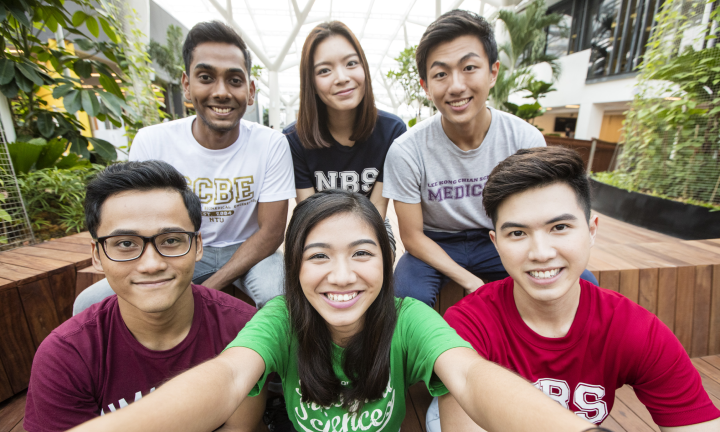
At NTU-CEE, you will develop the knowledge, skills, and networks to create a brighter, greener world — sustainable today and for generations to come.
Environmental Engineers apply science and engineering principles to develop innovative solutions for today’s pressing environmental challenges. Their work contributes to sustainable development, safeguards human health, and protects the delicate balance of our natural ecosystems.
The Environmental Engineering programme offers a distinctive education that prepares students to address complex environmental challenges with solutions that are both sustainable and economically viable. Blending flexibility with academic rigour, the curriculum provides a strong foundation in mathematics, science, and core engineering principles, complemented by a comprehensive range of specialised courses in environmental engineering.
Minimum Subject Requirements
Applicants are expected to fulfil these minimum subject requirements.
| Institution | Requirements |
|---|---|
| Singapore Cambridge GCE 'A' Level | H2 Level pass in Mathematics, and H2 Level pass in Physics / Chemistry / Biology /Computing |
| International Baccalaureate Diploma | Mathematics at Higher Level, and Physics / Chemistry / Biology / Computer Science at Higher Level |
| NUS High School Diploma | Major CAP of 2.0 in Mathematics, and Major CAP of 2.0 in Physics / Chemistry / Biology |
| International and Other Qualifications | Mathematics at Senior High School Level, and Physics / Chemistry / Biology at Senior High School Level, and Physics at Junior High School Level* * Physics at Junior High School level is only applicable to applicants who have not read Physics at Senior High School Level. |
| Polytechnic Diploma | Applicants with relevant diplomas from one of the local polytechnics may apply for admission. |
Admission Enquiries
Contact Office of Admission
Students with outstanding ‘A’ Level, IB, NUS High School Diploma, or Polytechnic Diploma results may qualify for exemptions from selected first-year courses (up to three for pre-university qualifications).
Interdisciplinary Common Core (ICC) curriculum
- Interdisciplinary Collaborative Core (ICC): approximately 25%
- Major Requirements (Core and Major Prescribed Electives): approximately 60%
- Broadening and Deepening Electives (BDE): approximately 15%
The BDE can be used for a Second Major, Minor, Specialization, Work-Study programme, MOOCs, or any electives (including additional Major Prescribed Electives). Students will also have the opportunity to complete a full-semester internship with an industrial firm for practical learning experience.
Duration
The Bachelor of Engineering (Environmental Engineering) is a four year, full-time direct honours programme.
Minor
Students can acquire multiple skills and broader knowledge beyond what their major discipline may provide through minor programmes. There are more than 45 minors available in NTU.
Second Major
A Second Major programme provides students with a breadth of exposure and is also designed to offer greater depth of study in an additional discipline compared to a minor.
More information on Second Major
Specialisation
In Year 3 & 4, students are to gain deeper expertise in their chosen field and enhance the value of their degree.
More information on Specialisation
Curriculum Structure with Professional Internship (PI)
| Academic Unit Requirement | |||
|---|---|---|---|
| Major Requirements (Core + Major PE) | 80 + 3 | ||
| Interdisciplinary Collaborative Core (ICC) – Common Core | 14 | ||
| Interdisciplinary Collaborative Core (ICC) – Professional Series | 16 | ||
Interdisciplinary Collaborative Core (ICC) – Care, Serve, Learn | 3 | ||
| Broadening and Deepening Electives (BDE) | 20 | ||
| Total | 136 | ||
Environmental engineers will be challenged to find the best solutions to the most pressing problems of society and apply sophisticated technologies to meet society’s needs in an environmentally sustainable manner.
Graduates can look forward to a wide range of career prospects in fields such as:
- Integrated Urban Storm-water Management
- Sediment Transport and Coastal Management
- Waste Minimization, Recycling and Resources Recovery
- Membrane Technology
- Biotechnology in Wastewater Treatment
- Environmental Chemistry and Chemical Technology
- Air Quality Management
- Infrastructure Planning and Development
Common roles for fresh graduates:
- Environmental Engineer
- Business Consultant
- Civil Engineer
- Management Executive/ Management Trainee
- Research Officer
- Production Engineer
- Quality Assurance Manager
- Safety Inspector
- Software Developer/Engineer
Our graduates have been in diverse exciting jobs in various sectors.
The programme is accredited by the Institution of Engineers Singapore (IES) through its Engineering Accreditation Board (EAB). IES is the Singapore signatory of the Washington Accord - an international agreement that evaluates the degree to which engineering academic programmes equip their graduates with the skills required for practising engineering at the professional level.
Related Programmes
- Bachelor of Engineering in Environmental Engineering with Second Major in Business
- Bachelor of Engineering in Environmental Engineering with Second Major in Entrepreneurship
- Bachelor of Engineering in Environmental Engineering with Second Major in Society & Urban Systems
- Bachelor of Engineering in Environmental Engineering with Second Major in Data Analytics
- Double Degree in Bachelor of Engineering in Environmental Engineering and Bachelor of Social Science in Economics
- Bachelor of Engineering in Environmental Engineering with Second Major in Sustainability
- Bachelor of Engineering in Environmental Engineering with Second Major in Future Foods
71c552b9-56d0-4df7-a4b1-8ea31da180b9.png?sfvrsn=71e9d4da_3)