Themed Workshop and Panels
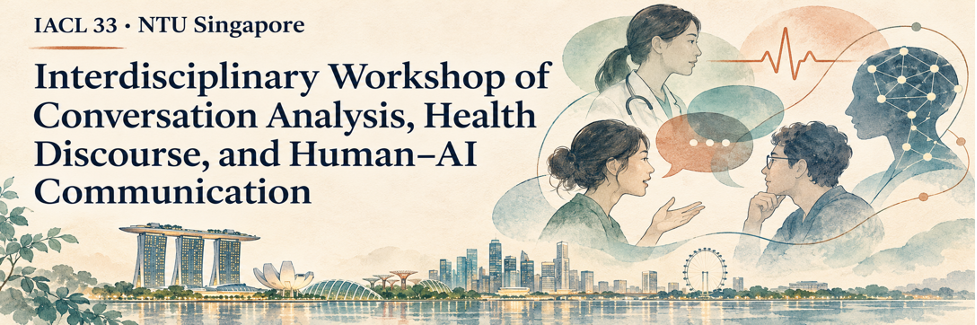
Interdisciplinary Workshop of Conversation Analysis, Health Discourse, and Human-AI Communication
We invite abstracts for an interdisciplinary workshop held in conjunction with IACL 33 at Nanyang Technological University, Singapore. The workshop brings together scholars in Chinese linguistics and communication studies to examine the intersections of Conversation Analysis, health discourse, and human–AI communication in Chinese-speaking communities.
Anchored in Chinese linguistics, the workshop provides a forum for dialogue between researchers in Conversation Analysis and pragmatics, particularly those working on health contexts, and communication scholars studying mental health, digital health, and human–AI interaction. It will feature invited speakers whose research spans Chinese pragmatics, clinical interaction, mental health communication, and AI chatbots.
The workshop aims to identify shared theoretical questions and methodological approaches and to develop collaborative research agendas across linguistics and communication studies. We welcome original, unpublished research that addresses interaction in Chinese-speaking contexts and makes its relevance to this interdisciplinary dialogue explicit. Contributions may be empirical, theoretical, or methodological.
Topics include, but are not limited to:
- Conversation Analysis and pragmatics of clinical encounters, counselling, and other health-related interactions;
- Interactional practices in mental health communication, including help-seeking, disclosure, empathy, and support;
- Digital health discourse in online communities, social media, and mediated consultations;
- Human–AI communication in Chinese, including interaction with conversational agents and health or mental health chatbots;
- Trust, alignment, repair, and the negotiation of understanding in human–human and human–AI interaction;
- Multimodal resources in health communication, including prosody, gaze, gesture, and embodied action;
- Theoretical and methodological connections between Chinese linguistics and communication studies, including qualitative, quantitative, computational, and mixed methods.
We particularly encourage submissions that connect detailed analysis of language and interaction with questions about health, communication, or AI. Comparative and multilingual studies are welcome where Chinese-speaking communities or Chinese-language interaction form a central part of the analysis.
Invited speakers
- LIM Ni Eng, Nanyang Technological University
- LI Yungeng, Shanghai Jiaotong
University Organizers
- LI Haoze, Nanyang Technological University haoze.li@ntu.edu.sg
- ZHANG Renwen, Nanyang Technological University renwen.zhang@ntu.edu.sg
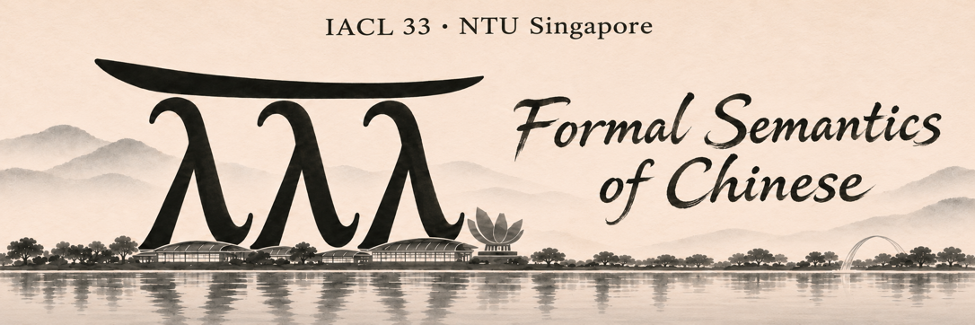
Formal Semantics of Chinese
We invite abstracts for a themed panel on Chinese semantics at IACL 33, hosted by Nanyang Technological University, Singapore. The panel highlights the contribution of logical and mathematical approaches to understanding Chinese grammar and the role of Chinese in advancing semantic theory. It aims to promote dialogue between close empirical investigation and explicit mathmetical models. We welcome original, unpublished contributions from a range of theoretical and methodological perspectives. Studies may draw on formal analysis, fieldwork, corpus research, experiments, or computational methods. Comparative research is welcome where Chinese data play a central role in the argument.
Topics include, but are not limited to:
- Quantification, scope, distributivity, and plurality;
- Reference, definiteness, nominal interpretation, and anaphora;
- Tense, aspect, event structure, and temporal interpretation;
- Modality, conditionals, attitude reports, and evidentiality;
- Questions, alternatives, focus, and information structure;
- Negation, polarity, comparison, and degree constructions;
- Presupposition, implicature, discourse particles, and context dependence;
- Lexical meaning and the syntax–semantics and semantics–pragmatics interfaces;
- Experimental, corpus-based, and computational approaches to Chinese semantics.
Invited Speaker
- TBA
Organizer
- LI Haoze, Nanyang Technological University haoze.li@ntu.edu.sg
- LUO Zhuosi, Beijing Foreign Studies University. zhuosiluo@bfsu.edu.cn
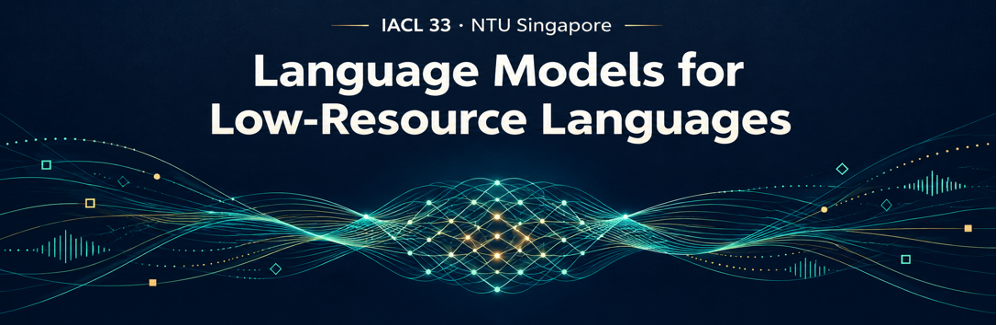
Language Models for Low-Resource Languages
As AI tools become more widely used in education, work, and everyday life, speakers of low-resource languages risk unequal access to these tools in their own languages. Limited support can also reduce opportunities for younger generations to use these languages in digital spaces, making it harder to pass on the languages and the cultural knowledge they carry. Building language models for low languages can help address these inequities, in addition to supporting language documentation and giving researchers new ways to study linguistic diversity.
The challenge extends beyond the amount of training data available. Existing datasets may overrepresent standard written forms while leaving out regional varieties, everyday speech, and code-switching. Limited annotation and a lack of benchmarks designed for individual languages can also make it difficult to assess whether models capture important grammatical distinctions and reflect how speakers use their languages. Linguistic research can guide what data to collect and what distinctions to test, while collaboration with speaker communities can help determine how data should be used and which applications would best serve their needs.
This panel builds on complementary research directions in NTU’s School of Humanities and the SEA-LION initiative: work on Singapore Mandarin and other Chinese varieties, and efforts to build models for Southeast Asian languages. We welcome submissions on the following topics:
- Model development and adaptation: Pre-training, post-training, and adaptation techniques for languages with limited digital or annotated resources.
- Data creation and curation: Corpus building, data annotation, synthetic data generation, and quality control.
- Evaluation and benchmarking: Multilingual performance, cultural understanding, and evaluation of language-specific phenomena.
- Multilingual and multimodal AI: Models that support diverse languages across text, speech, and vision.
- Responsible and inclusive AI: Safety, cultural alignment, and community-led approaches to data and model development.
- Linguistic diversity and variation: Modelling dialects, minority languages, and contact varieties, including code-switching and mixed-language data.
- Language models for linguistic research: Using language models to investigate linguistic structure, meaning, and variation.
Invited Speaker
- LIN Jingxia, Nanyang Technological University
- NGUI Jian Gang, AI Singapore/Nanyang Technological University
Organizer
- Peerat Limkonchotiwat Peerat@aisingapore.org
Experimental Syntax
IACL-33 will feature a one-day panel on Experimental Syntax. The panel brings together researchers who use experimental and other empirical methods to address questions in the syntax of Chinese and other related languages, including Chinese dialects, minority languages, contact varieties such as Singlish, and heritage varieties. Experimental evidence plays a growing role in testing syntactic theories, probing gradient and variable judgments, and examining phenomena where introspective judgments are unclear or contested. We hope the panel will showcase this work and encourage discussion of the methodological challenges of conducting experiments on these languages.
We invite abstracts for talks reporting experimental or other empirical work on syntax and its interfaces, from any theoretical perspective. Relevant methods include:
- acceptability judgment tasks, online processing measures (e.g., self-paced reading, eye-tracking),
- neurolinguistic methods (e.g., ERP, EEG, fMRI),
- acquisition studies,
- and corpus-based, or computational approaches.
Submissions that bear on a theoretical debate are especially encouraged. Please follow the general abstract format and submission guidelines of the main call.
Invited Speakers
- TBA
Organizers
- HUANG Nick, National University of Singapore znhuang@ntu.edu.sg
- SHEN Zheng, National University of Singapore zhengshen@nus.edu.sg