Pushing Frontiers in Chiral Surface Engineering: Prof Prashant Kumar Awarded Prestigious S$3.1M Singapore NRF Fellowship
Prof Prashant Kumar, from NTU’s School of Materials Science and Engineering, has been awarded the Singapore NRF Fellowship grant of S$3.1 million to lead pioneering research in biomolecular detection. The fellowship, one of Singapore’s most competitive research honours, supports early-career scientists with the potential to establish world-class research programmes that address pressing global challenges.
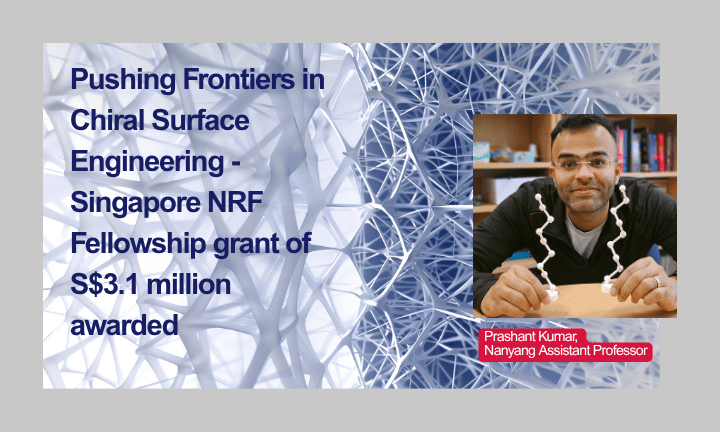
It felt like having a superpower. I could directly see how atoms
arrange themselves and where tiny asymmetries arise,” he recalls.
 |
Prof Prashant’s vision is to engineer surfaces that can selectively detect biomolecules, enabling diagnostic technologies that are faster, more accurate, and more accessible. Such innovations could help democratise healthcare by making point-of-care testing possible even in resource-limited environments.
This ambitious programme will tackle challenges at the edge of materials science and biology:
- Achieving nanoscale control over chirality at interfaces, opening new ways to study molecular interactions.
- Designing chiral surfaces that are stable yet sensitive, able to function in complex environments like blood or tissue.
- Developing advanced electron microscopy methods, allowing researchers to watch chiral interactions unfold at the nanoscale.
By addressing these frontiers, the team hopes to unlock fundamentally new insights into how biology and materials communicate at the molecular level.
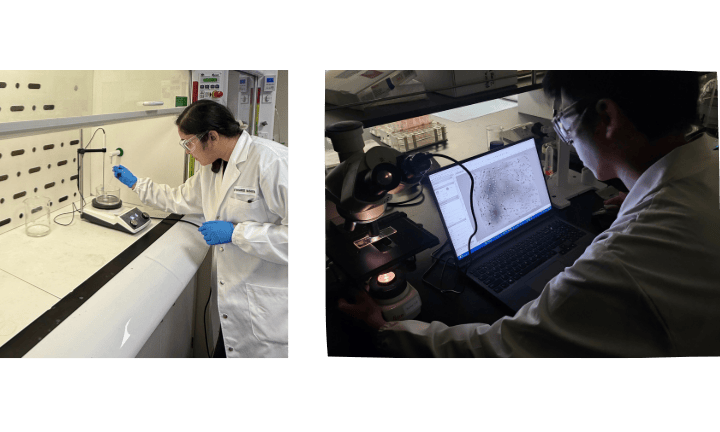
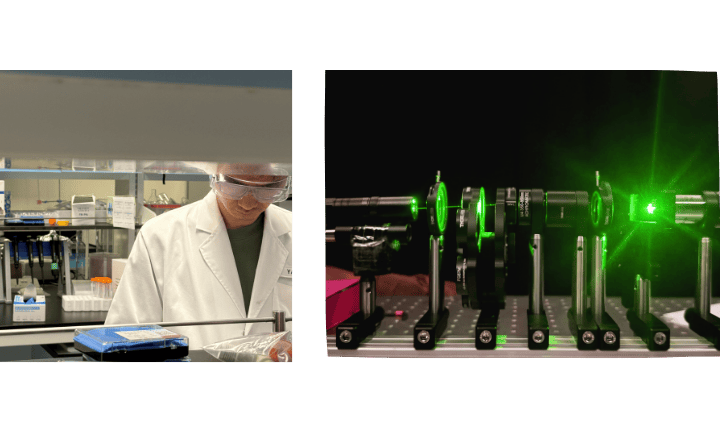
Beyond the science, the NRF Fellowship provides a rare opportunity to shape future talent. Prof Prashant’s lab will be a space where students and early-career researchers can gain hands-on experience in synthesis, characterisation, and device integration.
I want them to cultivate curiosity and resilience,” he explains. “Research isn’t just about metrics, it’s about exploration, where failures can teach as much as successes.
The Fellowship sets the stage for researchers to contribute to a programme built from the ground up, bringing together fundamental science, advanced electron microscopy, and real-world healthcare applications. By working seamlessly across synthesis, characterisation, and device integration, they can develop both breadth and depth of expertise, while learning to think across disciplines, communicate effectively, and approach problem-solving with creativity.
 |
Looking Ahead
With the support of the NRF Fellowship, Prof. Kumar and his team’s exploration of chirality at surfaces demonstrates how materials science and engineering connects atomic-scale phenomena with real-world applications. This work not only advances our understanding of matter, but also contributes to practical solutions in healthcare and other sectors — underscoring the discipline’s enduring relevance in addressing complex challenges.
PhD opportunities: https://www.ntu.edu.sg/mse/admissions/postgraduates/prospective-students/doctor-of-philosophy-master-of-engineering/opportunities