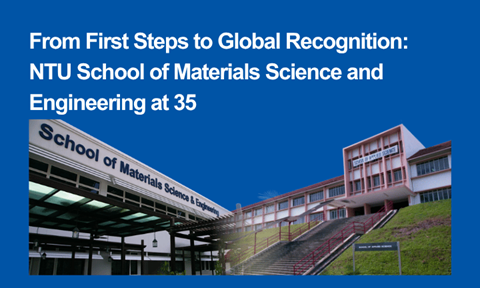
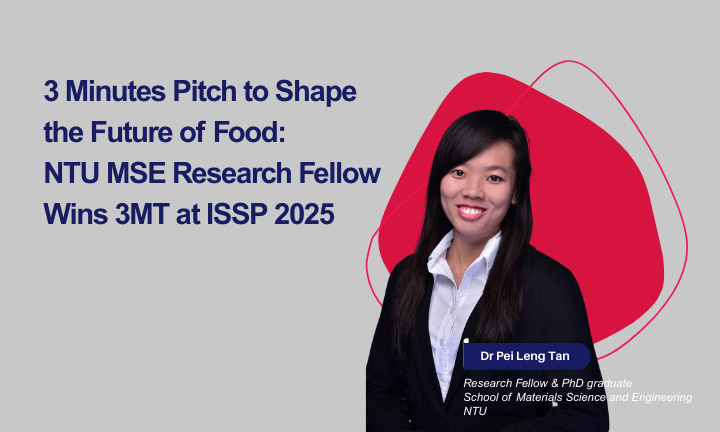
3 Minutes Pitch to Shape the Future of Food: NTU MSE Student Wins 3MT at ISSP 2025
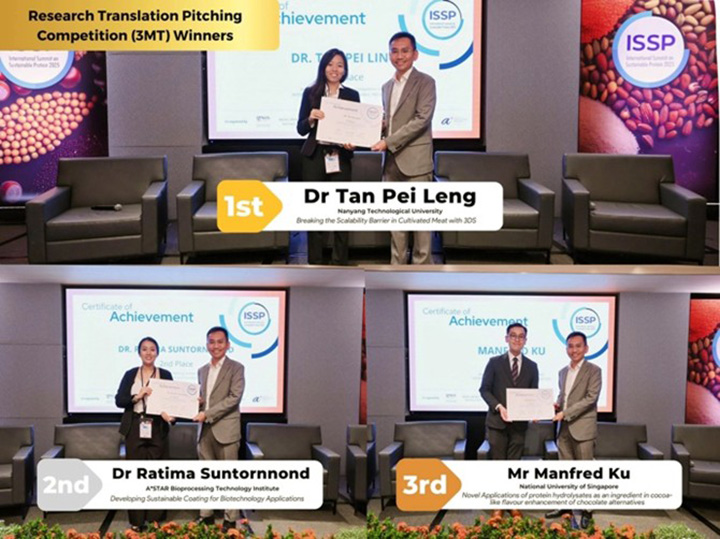
At the International Summit on Sustainable Protein (ISSP) 2025, a gathering of global experts on the future of food, Research Fellow and PhD graduate at NTU School of Materials Science and Engineering, Dr. Pei Leng Tan clinched 1st Place in the highly competitive Research Translation Pitching Competition (3MT). This annual competition challenges early-career postdocs and PhD students to distil years of technical research into a three-minute presentation that is accessible to non-specialists, while still convincing a discerning audience of investors, corporates, and policymakers.
 |  |
Taking the Stage
To make the concept of mechanotransduction intuitive, she drew from human physiology:The most memorable moments from my pitch were the ways I had to translate complex science into everyday experiences,” she recalled. “I began with a relatable image — the temporary shortages on supermarket shelves driven by sudden surges in demand during the pandemic, which underscored how fragile our food supply can be if borders close.
When we exercise, mechanical stress helps us build muscle; when we stop, fat tends to accumulate. This everyday example captured the essence of mechanotransduction, where cells sense mechanical forces and respond by maturing into different tissue types.
By pairing scientific rigour with imagery and relatable experiences that resonated emotionally, she turned an abstract topic into a compelling story — one that stood out to both judges and audience members.
Breaking the Scalability Barrier
Her winning pitch, titled “Breaking the Scalability Barrier in Cultivated Meat with 3DS,” draws directly from her research in MSE. At its core, the project looks at how scaffold design — the materials framework that cells attach to — can influence the way cells grow, differentiate, and mature into tissues. By engineering scaffolds with carefully tuned structure, stiffness, and surface properties, her team aims to reduce reliance on costly growth additives that currently limit large-scale production.
From the perspective of food security, this approach could be transformative. Singapore imports more than 90% of its food (Singapore Food Agency, 2023), making it vulnerable to supply shocks. Cultivated meat, produced locally without traditional livestock, offers a resilient alternative. What excites Pei Leng most is the possibility of creating real animal meat without slaughter, while addressing concerns of cost, texture, and scalability.
Her first brush with this potential came during a lab milestone: constructing a small piece of cultivated fat with her team. It was modest in scale but striking in impact.
It looked and felt familiar — even though the cultivated fat was grown in the lab, it was recognisable as the pork lard we once used for barbecues. This was grown using cells harvested from animal tissue, without the need to slaughter an entire animal. In that moment, I realised this was more than a scientific curiosity; it had the potential to reshape how we think about food. | 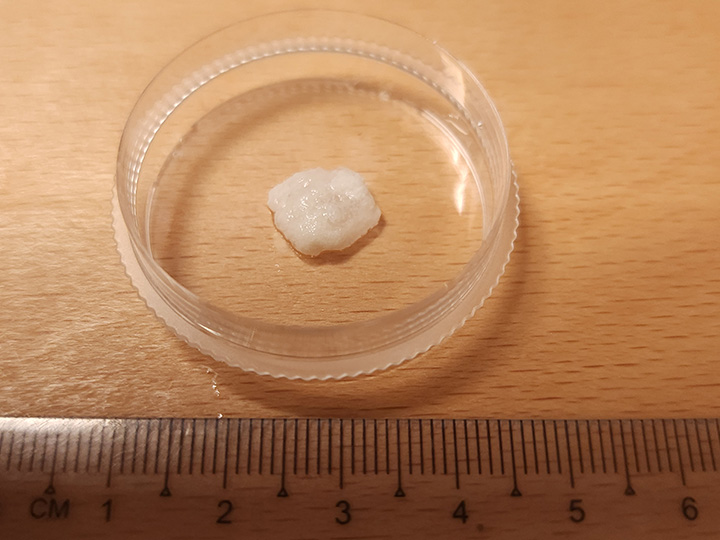 Cultivated fat sample grown from animal cells. Cultivated fat sample grown from animal cells. (Image Courtesy of Dr. Pei Leng Tan) |
Life as a PhD Student at MSE
Pei Leng’s journey at NTU began during her undergraduate studies, and her interest in translational research was first sparked from her biomedical hydrogel final year project under Prof Subbu. Opportunities at MSE — such as an international collaboration in Denmark prototyping microfluidic systems — reinforced that passion and eventually led her to pursue a PhD under Prof Tan’s mentorship.
The PhD, she reflects, has been more than just an academic pursuit. Beyond the technical skills of experimental design and critical thinking, she has grown in resilience and adaptability. Failures and setbacks in the lab taught her resilience and humility; collaborations across NTU, SIT, and A*STAR exposed her to interdisciplinary problem-solving; and conferences like TERMIS and IUFoST sharpened her ability to communicate to both specialist and general audiences.
Research is never a journey you walk alone. I’ve grown to value collaboration
and mentorship more deeply. My supervisor, lab members, collaborators, other
NTU MSE professors and technical staff have all shaped not just the science,
but the way I think, plan and relate as a researcher.
Looking Ahead
Even if we are not the ones to eventually produce cultivated meat, I hope to see our group playing a part in making it a real option one day — especially in light of climate change and the importance of strengthening local food resilience to withstand future global disruptions.
Learn more about PhD opportunities at NTU MSE.