Prof Lee Pooi See awarded prestigious NRF Investigatorship to pioneer nature-inspired artificial muscles for healthcare and robotics
The 11th NRF Investigatorship recognises Singapore’s top research leaders pursuing ground-breaking, high-risk science. At NTU Singapore’s School of Materials Science and Engineering (MSE), Prof Lee Pooi See will advance soft, intelligent actuator systems that mimic the responsiveness of natural muscles, opening new possibilities for healthcare, wearable systems, robotics and immersive virtual environments.
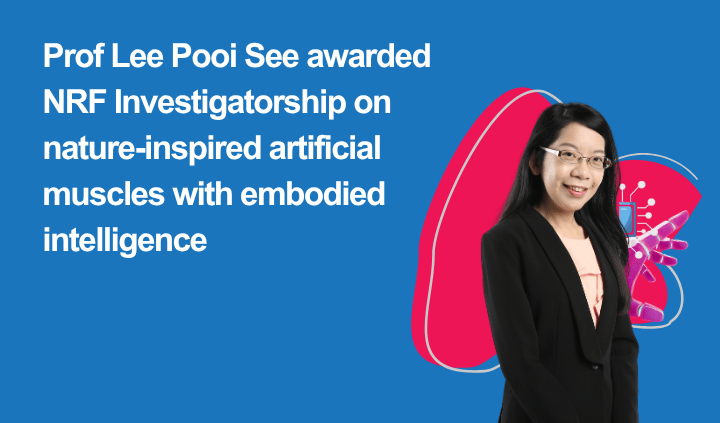
Prof Lee has been awarded the National Research Foundation (NRF) Investigatorship under its 11th call, one of Singapore’s most prestigious and competitive honours for established scientific leaders. The award supports exceptional principal investigators in pursuing bold, high-risk ideas that can redefine the future of science and technology.
Her new research direction focuses on next-generation soft actuators, or artificial muscles, inspired by the agility, efficiency and adaptive intelligence of biological systems. Designed to overcome the rigidity and bulk of conventional actuators, these highly adaptive materials will introduce responsive dexterity, morphing behaviour and life-like tactile feedback.
By integrating sensing across strain, pressure and temperature, the systems aim to introduce embodied intelligence, allowing devices to perceive their environment and respond in real time. This creates transformative opportunities across human-machine interfaces, wearable and nearable devices, exoskeletons, rehabilitation systems, soft robotics and immersive AR/VR environments, where touch, sensation and movement can be rendered with far greater realism.
The research also carries strategic relevance for Singapore’s innovation ecosystem, with potential applications spanning healthcare rehabilitation, assistive technologies, advanced manufacturing simulation, digital twins and remote training environments.
Globally recognised for her leadership in deformable soft electronics, energy storage, soft robotics and human-machine interfaces, Prof Lee is among the world’s leading scientists in intelligent material systems. She has published more than 400 research papers, with 42,000 citations and an H-index of 112, and has been named among Clarivate’s Top 1% Highly Cited Researchers for eight consecutive years (2018–2024).
"We envision a new generation of artificial muscles that go far beyond movement — materials that can sense, self-adapt and generate tactile experiences that make digital environments feel physically real,” said Prof Lee.
"The bold leap is to transform soft materials from passive components into embodied intelligent systems, opening entirely new possibilities for rehabilitation, robotics and immersive human experiences that today’s technologies cannot yet deliver."
NTU MSE’s continued excellence in NRF Investigatorship awards
With Prof Lee’s latest recognition in the 11th NRF Investigatorship call, NTU MSE continues its strong momentum in securing Singapore’s most prestigious competitive research awards.
This builds on the previous NRF Investigatorship awarded to Prof Nripan Mathews for his work on printed logic from mixed ionic-electronic halides for sustainable hybrid electronics, reinforcing the School’s leadership across frontier areas spanning soft intelligent systems, sustainable electronics, energy materials and next-generation human-machine interfaces.
Together, these awards reflect NTU MSE’s continued ability to lead high-risk, high-impact research at the frontiers of materials science, while strengthening Singapore’s innovation ambitions in healthcare, sustainability, advanced manufacturing and immersive technologies.
As materials science increasingly shapes how people interact with intelligent devices, virtual environments and adaptive systems, NTU MSE’s latest NRF successes underscore the School’s growing influence in defining the future of human-centric technologies at the intersection of materials, AI and the physical–digital world.
Related Link: