NTU MSE at the World Expo 2025 in Osaka
Building a Resilient Future Through Materials Innovation
NTU’s School of Materials Science and Engineering (MSE) is honoured to represent the University and Singapore at World Expo 2025 in Osaka, showcasing how materials innovation can help solve the world’s most pressing sustainability challenges. From tackling water scarcity to rethinking plastic and textile waste, MSE’s research is contributing to a more resilient, resource-efficient future.
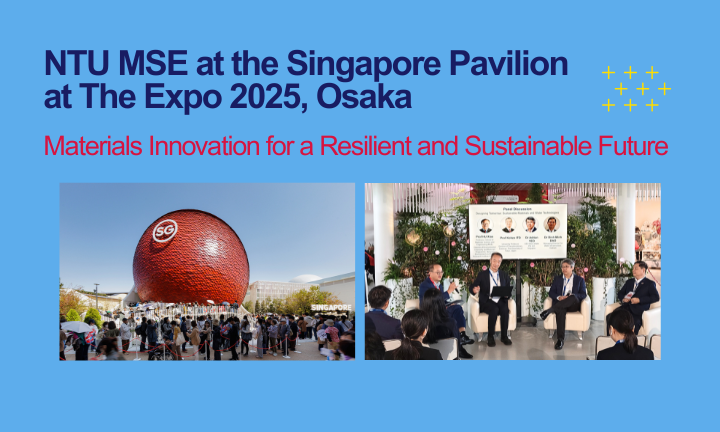
As part of the exclusive programme at Singapore Pavilion, the session titled “Building a Resilient Future: Climate Change, Innovation, and Collaboration” held on 11 June featured NTU’s Vice President (International Engagement) Professor Lee Pooi See and Professor Hu Xiao from NTU MSE, Director of the Environmental Chemistry and Materials Programme at Nanyang Environment and Water Research Institute (NEWRI). Prof Hu delivered a keynote and moderated a panel discussion on how sustainable materials technologies can tackle urgent challenges such as climate-driven food insecurity, textile and plastic waste, and clean water access. The session also underscored the importance of academic-industry partnerships and regional collaboration in scaling these innovations across Asia and beyond.
Innovations Across Three Domains: Agriculture, Plastics, and Water
1. Greener Agriculture and Plant-Based Innovation
As climate change and agrochemical overuse threaten global food security, NTU MSE showcased a materials technology that enhances crop yield while reducing reliance on synthetic fertilisers and also makes the crop more resilient to abiotic stresses resulting from the adverse effects of climate change. A separate technology harnesses plant waste — via a simultaneous extraction of hydrophilic and hydrophobic compounds using food-safe green solvents — to create nutrients suitable for plant-based supplements and cosmetics. The outcome: more resilient crops, less environmental damage, and higher-value reuse of biological waste.
2. Tackling Textile and Plastic Waste
The global impact of plastic and textile waste continues to escalate. In Singapore alone, 245,000 tonnes of textile waste were generated in 2023 — up 38% from the previous year — with only 2% recycled (NEA, 2023).
To address this, MSE spotlighted initiatives to recycle polyurethane foam — a major component of plastic and furniture waste — and other efforts under the RGE-NTU SusTex Research Centre, which develops scalable closed-loop approaches to recycle textile waste into new materials. These innovations are turning waste into high-value, low-carbon products with industrial and consumer applications.
3. Safe and Clean Drinking Water for All
Two key global challenges are the deterioration of surface and groundwater quality and the increasing frequency of extreme weather events and disaster zones. While technologies like membrane filtration are often considered mature, the reality is that billions of people still lack access due to issues of affordability and infrastructure—a fact often overlooked in developed nations. This underscores the urgent need not only to innovate but also to proliferate essential technologies that can benefit underserved communities in developing and underdeveloped regions.
To address these gaps, MSE introduced two enabling technologies:
Nanocomposite Polyolefin Membranes: Designed using green fabrication processes, these membranes are cost-effective, mechanically robust, and suitable for large-scale water reuse.
Cryogel Point-of-Use Disinfection Devices: Capable of rapidly turning contaminated water into drinking water, meeting UNHCR standards — ideal for emergency and rural settings.
These technologies have already been licensed to Atera Water and HyDrGel, two companies actively deploying clean water solutions across Southeast Asia and beyond. This further highlights the critical role of academic-industry partnerships and regional cooperation in scaling impactful innovations where they are needed most.
Collaboration as a Catalyst for Impact
The panel discussion at the event also featured leading experts including Prof Hu Xiao, Prof Kohzo Ito (University of Tokyo), NTU alumnus and Atera Water CEO, Dr Adrian Yeo, and Managing Director of CA Water, Dr Dinh Minh Dao, who examined how policy, technology, and cross-sector partnerships can accelerate water sustainability across Asia. NTU Vice President (International Engagement), Prof Lee Pooi See, also underscored the importance of global collaboration in scaling innovation from lab to market.
Another key highlight was the signing of a Memorandum of Understanding (MOU) between NTU spin-off Atera Water Pte Ltd and Vietnam-based CA Water Infrastructure. The agreement marks a strategic step toward strengthening regional cooperation on water technologies.
Why It Matters
At Expo 2025, NTU MSE showcased how materials innovation extends far beyond the development of new products — it plays a critical role in building sustainable systems. From turning waste into circular resources, to enabling clean water access and supporting more resilient agriculture, our research reflects real-world impact powered by strong academic-industry collaboration. Our participation at the World Expo reaffirms the School’s mission to create intellectual value, inspire need-driven research, and translate deep tech innovation into sustainable solutions that serve society and the marketplace.