Innovation in Action: Student Highlights from Ian Ferguson Innovation Challenge
This year’s IFIC (AY2025/2026) saw 26 teams tackling real-world engineering challenges from sustainable packaging concepts to healthcare applications and functional coatings — reflecting the diverse ways materials science can shape everyday technologies.
Reimagining Everyday Packaging
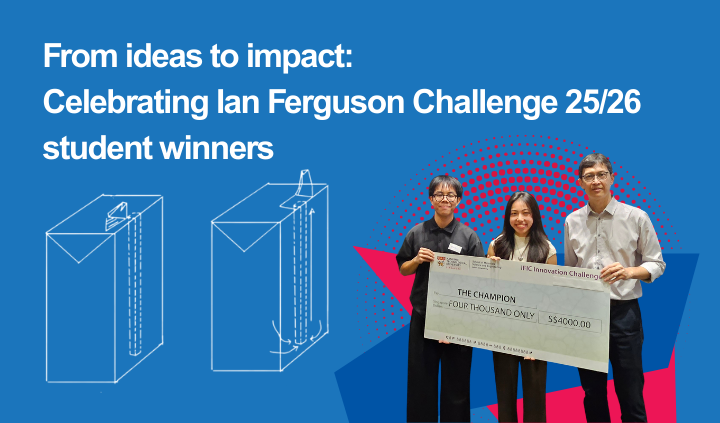
The top prize of $4,000 was awarded to a team comprising Chong Yi Jie (Zhong Yujie), Han Song En, Maximus Toh Jun Fai, Vanille Goh (Wu Minxi), and Wee Shao Lun Dexter, who proposed a user- and environmentally-friendly straw-less drink carton.
Their concept addresses a familiar but persistent sustainability challenge: the continued reliance on single-use plastic straws in beverage packaging. Instead of introducing additional components, the team explored how carton design itself could enable convenient consumption while reducing unnecessary plastic use.
"Initially, we expected the development process to be relatively straightforward — building a prototype and iterating based on feedback. However, even the ideation stage required thoughtful consideration, especially when balancing manufacturing constraints with innovative design."
Learning from Industry Perspectives
"Our mentors helped us understand food safety standards and industrial packaging processes. Their guidance helped us refine the design so it could align more closely with existing manufacturing pipelines."
"The student team demonstrated openness and adaptability, by refining their design in response to real-world constraints. They advanced the work through fluid flow simulations and hands-on prototyping using real materials and 3D-printed components to bring their ideas to life for validation.
Overall, the team showed great creativity and skill, taking their project from concept sketches to smart designs that solved real challenges."
Engineering Solutions in a Broader Context
This year’s challenge also featured projects addressing healthcare applications and materials functionality.
First Runner-Up and Most Popular Project — $2,000
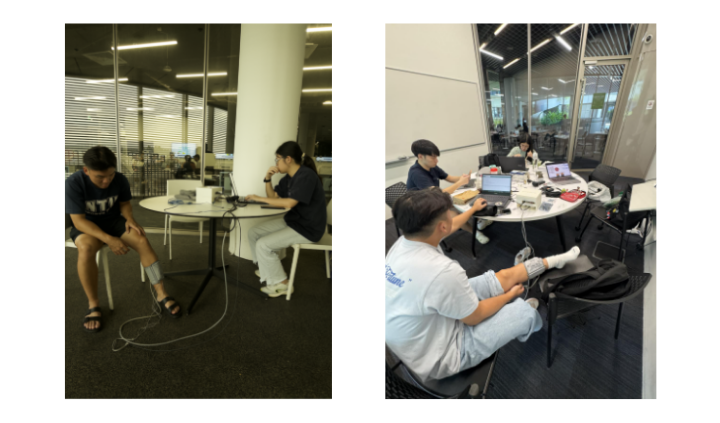 |
Second Runner-Up — $1,000
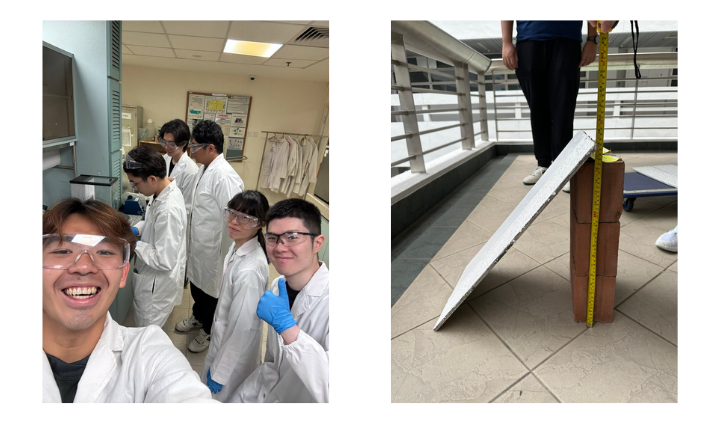 |
Supporting Student Innovation
The Ian Ferguson Innovation Challenge forms part of NTU MSE’s broader efforts to encourage innovation and entrepreneurship among its students. Through mentorship, seed funding, and prototype development, the programme allows students to explore how materials science ideas can evolve into practical applications.
By combining technical knowledge with problem identification, design iteration, prototyping, and industry engagement, students gain early exposure to translating engineering concepts into real-world solutions. Experiences like IFIC expose students to the full innovation cycle — from problem identification and concept development to prototyping, validation, and communication of ideas.
Explore student innovation and entrepreneurship opportunities, and discover how to engage with NTU MSE on industry design projects.