How Should Materials Science Education Evolve for an AI-Enabled and Industry-Driven Future?
NTU MSE faculty contribute research and perspectives to an international special issue on the future of materials science education
As artificial intelligence, sustainability, and advanced manufacturing continue to reshape the scientific and engineering industries, universities worldwide are rethinking how future materials scientists and engineers should be trained.
These questions form part of a recent special issue of the Journal of Chemical Education focused on Teaching Innovation in Materials Science and Engineering Design.
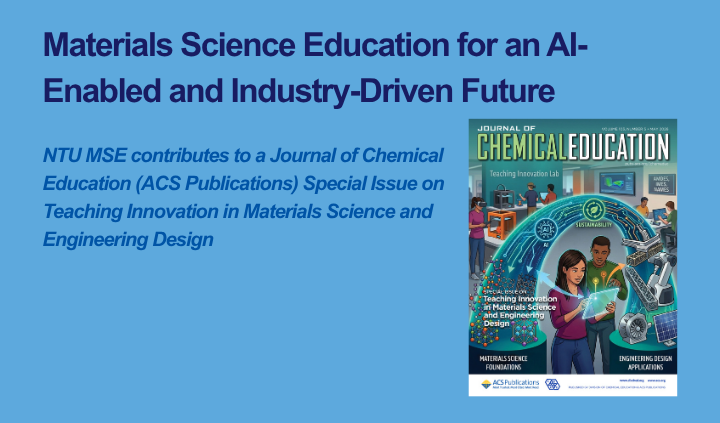
Reprinted (adapted) with permission from J. Chem. Educ. 2026, 103, 5, 2403–2405. Copyright 2026 American Chemical Society.
The issue brings together educational research and perspectives from across the global materials science education community, spanning topics such as sustainability, interdisciplinary learning, design thinking and artificial intelligence in engineering education.
The themed issue was curated by an international group of educators and researchers, including NTU MSE faculty Prof Dong Zhili, Prof Leonard W. T. Ng and Dr Rui A. Gonçalves, alongside collaborators from Singapore University of Technology and Design (SUTD), and Singapore University of Social Sciences (SUSS), reflecting broader international discussions on the future of materials science and engineering education.
In the accompanying editorial, the authors argue that materials science and engineering education is now "at an inflection point", where traditional approaches centred primarily around disciplinary mastery alone may no longer sufficiently prepare students for increasingly interdisciplinary, computational and sustainability-driven engineering environments.
Within the special issue, NTU MSE contributions explored two increasingly important educational questions:
- how engineering students learn within AI-enabled scientific environments
- and how exposure to real-world ambiguity shapes engineering readiness.
Preparing students for increasingly data-driven materials science
In the Journal of Chemical Education paper, Harnessing GenAI for Higher Education: A Study of a Retrieval Augmented Generation Chatbot’s Impact on Learning, NTU researchers examined how students interact with a domain-specific AI learning assistant designed for materials science and engineering education.
The work brought together NTU MSE faculty Prof Leonard W. T. Ng and Prof Kedar Hippalgaonkar with researchers Maung Thway, Jose Recatala-Gomez and Fun Siong Lim.
The study emerged from a growing reality within modern materials science, where students increasingly work with:
- statistical analysis
- machine learning approaches
- computational modelling
- optimisation workflows
- and large experimental datasets.
Rather than treating computational literacy as a specialised skill set, the study shows how data-driven analysis and AI-assisted workflows are becoming increasingly intertwined with experimental science itself.
To support students in this transition, the NTU MSE researchers developed "Professor Leodar", a retrieval-augmented AI chatbot trained specifically around course materials and materials science contexts.
Importantly, students did not simply value the chatbot because it was AI-enabled.
Instead, they responded most strongly to:
- structured explanations
- scaffolded reasoning
- contextual accuracy
- and guided problem-solving tailored specifically to materials science applications.
The findings suggest that educational AI may be most effective not as a replacement for teaching, but as a guided learning companion tailored to specific disciplinary contexts.
More broadly, the work reflects a broader question increasingly facing engineering educators globally: as AI becomes embedded in scientific research and engineering workflows, how should students learn not only to use these systems but also to critically interrogate and interpret their outputs?
The editorial accompanying the special issue similarly notes that the most effective AI-enabled learning environments are those that encourage students to "interrogate, interpret, and critique AI-generated outputs rather than simply consume them."
Engineering students may need more exposure to ambiguity — not less
Another study published in the Journal of Chemical Education, Navigating Industry Collaboration in Capstone Projects: Benefits and Challenges from Student Perspectives, examined how students responded to industry-sponsored capstone projects involving real-world engineering challenges.
The study was conducted by Dr Eileen Fong together with collaborators, including Tania T, Maximus Lim, Xiaohang Gai, Jeanette Choy and Mi Song Kim.
Unlike traditional classroom problems with clearer solution pathways, students were required to navigate:
- competing stakeholder demands
- manufacturability and cost constraints
- sustainability considerations
- evolving project requirements
- and situations with no single "correct" answer.
For many students, this represented a significant shift from conventional academic learning environments.
Rather than applying formulas mechanically, students increasingly needed to:
- negotiate trade-offs
- adapt to changing constraints
- communicate across teams
- justify decisions
- and integrate technical knowledge with practical considerations.
Students also identified growth in broader competencies increasingly valued across engineering industries today, including:
- teamwork
- communication
- adaptability
- and ethical reasoning.
Importantly, the study suggests that exposure to uncertainty and open-ended decision-making may itself play an important role in shaping engineering judgment and professional readiness.
These findings closely reflect broader themes raised in the editorial, which purposes that professional competencies such as teamwork, communication and decision-making under constraint should increasingly be treated not as supplementary outcomes, but as core learning objectives within engineering education itself.
Rethinking what engineering readiness means
Together, the NTU MSE studies reflect broader shifts already emerging across materials science and engineering education internationally.
Future engineering readiness may increasingly depend not only on disciplinary depth, but also on the ability to:
- work across computational and experimental domains
- navigate ambiguity and incomplete information
- critically evaluate AI-assisted outputs
- communicate across disciplines
- and solve problems within real-world constraints.
For industry partners, the work also reflects how engineering education is gradually moving closer to the realities of modern practice — where technical expertise increasingly intersects with sustainability, systems thinking, computation and collaboration.
As artificial intelligence and emerging technologies continue to reshape how science is conducted, future engineers may increasingly be valued not simply for what they know, but for how they reason, adapt, and apply knowledge across unfamiliar contexts.
The special issue reflects one part of a broader international conversation on how engineering education itself may evolve alongside the changing nature of scientific research and industrial practice.
At NTU MSE, some of these conversations are already shaping educational approaches across areas such as AI-assisted learning, computational materials science, industry-integrated capstone experiences, and interdisciplinary problem-solving.
Publications and Related Reading
Special IssueTeaching innovation in materials science and engineering design. Journal of Chemical Education. Advance online publication. https://pubs.acs.org/page/jceda8/vi/materials2026
Editorial
Teaching innovation in materials science and engineering design. Journal of Chemical Education. https://pubs.acs.org/doi/10.1021/acs.jchemed.6c00550
NTU MSE-Contributed Studies
Harnessing GenAI for higher education: A study of a retrieval-augmented generation chatbot's impact on learning. Journal of Chemical Education. https://pubs.acs.org/doi/10.1021/acs.jchemed.5c00113 | The study explored how retrieval-augmented AI systems may support computational and data-driven learning workflows in materials science education |
Navigating industry collaboration in capstone projects: Benefits and challenges from student perspectives. Journal of Chemical Education. https://pubs.acs.org/doi/10.1021/acs.jchemed.5c00763 | The study examined how industry-sponsored capstone projects shape engineering students’ professional readiness, interdisciplinary problem-solving and real-world learning experiences. |