30 NTU MSE faculty named among the World’s Top 2% Scientists in 2026 edition
Twenty-two appear on both single-year and career-long citation impact lists, compared with 17 in the 2025 edition.
Thirty faculty members from NTU’s School of Materials Science and Engineering (MSE), including colleagues with joint appointments, have been included in the 2026 Stanford/Elsevier World’s Top 2% Scientists database, up from 28 in 2025.
The global database identifies researchers with high citation impact across 20 scientific fields and 174 subfields. Inclusion is based on placement among the top 100,000 researchers by a composite citation score, calculated with and without self-citations, or within the top 2% of a researcher’s subfield.
The database provides a standardised view of citation influence across disciplines, highlighting researchers whose published work is extensively cited within the international scholarly literature.
MSE has 26 faculty members on the single-year citation impact list and 26 on the career-long list. Twenty-two appear on both, bringing this year’s total to 30 unique faculty members.
Research influence across disciplines
The faculty recognised span materials, nanoscience and nanotechnology, biomedical engineering, polymers, energy, chemistry, applied physics, and geochemistry and geophysics.
This breadth reflects the connections between materials science and other disciplines across MSE’s research community. The increase from 17 to 22 faculty on both lists highlights the School’s growing representation across both measures of citation impact.
Faculty recognised in the 2026 edition
Our Faculty on the Two Citation Impact Lists
The single-year list reflects citations received during calendar year 2025, including citations to research published in earlier years. The career-long list considers cumulative citation metrics through the end of 2025.
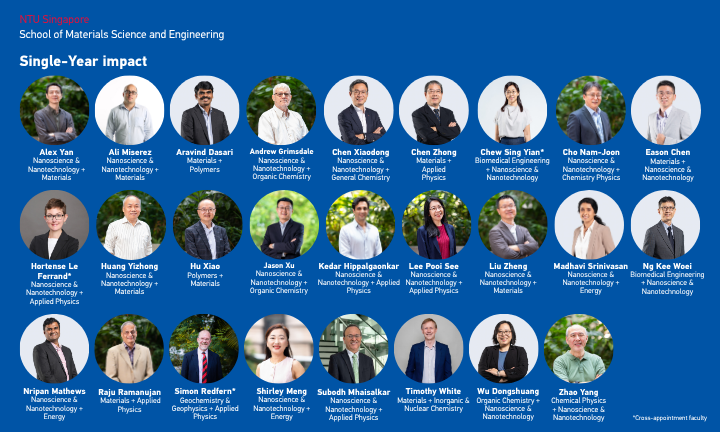
Single-year impact — 26 faculty
| Faculty | Subject Field 1 | Subject Field 2 |
|---|---|---|
| Prof Alex Yan Qingyu | Nanoscience & Nanotechnology | Materials |
| Prof Ali Miserez | Nanoscience & Nanotechnology | Materials |
| Prof Chen Xiaodong | Nanoscience & Nanotechnology | General Chemistry |
| Prof Chen Zhong | Materials | Applied Physics |
| Prof Chew Sing Yian* | Biomedical Engineering | Nanoscience & Nanotechnology |
| Prof Cho Nam-Joon | Nanoscience & Nanotechnology | Chemical Physics |
| Prof Hu Xiao | Polymers | Materials |
| Prof Jason Xu Zhichuan | Nanoscience & Nanotechnology | Organic Chemistry |
| Prof Lee Pooi See | Nanoscience & Nanotechnology | Applied Physics |
| Prof Liu Zheng | Nanoscience & Nanotechnology | Materials |
| Prof Madhavi Srinivasan | Nanoscience & Nanotechnology | Energy |
| Prof Ng Kee Woei | Biomedical Engineering | Nanoscience & Nanotechnology |
| Prof Nripan Mathews | Nanoscience & Nanotechnology | Energy |
| Prof Raju Ramanujan | Materials | Applied Physics |
| Prof Simon Redfern† | Geochemistry & Geophysics | Applied Physics |
| Prof Subodh Mhaisalkar | Nanoscience & Nanotechnology | Applied Physics |
| Prof Timothy White | Materials | Inorganic & Nuclear Chemistry |
| Prof Shirley Meng | Nanoscience & Nanotechnology | Energy |
| Assoc Prof Aravind Dasari | Materials | Polymers |
| Assoc Prof Andrew Grimsdale | Organic Chemistry | Nanoscience & Nanotechnology |
| Assoc Prof Hortense Le Ferrand‡ | Materials | Nanoscience & Nanotechnology |
| Assoc Prof Huang Yizhong | Nanoscience & Nanotechnology | Materials |
| Assoc Prof Kedar Hippalgaonkar | Nanoscience & Nanotechnology | Applied Physics |
| Assoc Prof Zhao Yang | Chemical Physics | Nanoscience & Nanotechnology |
| Nanyang Asst Prof Eason Chen | Materials | Nanoscience & Nanotechnology |
| Nanyang Asst Prof Wu Dongshuang | Organic Chemistry | Nanoscience & Nanotechnology |
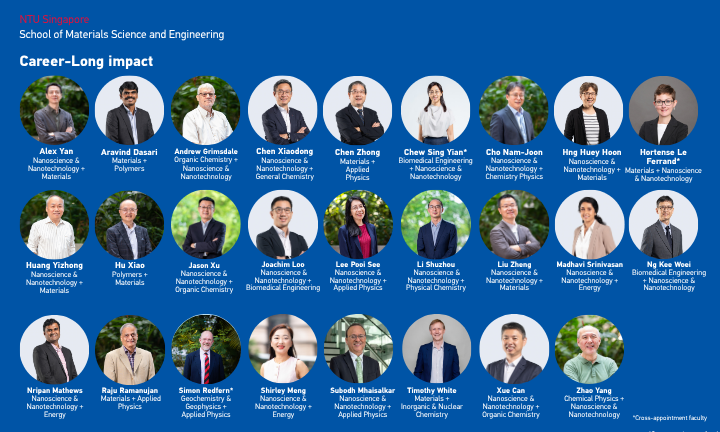
Career-long impact — 26 faculty
| Faculty | Subject Field 1 | Subject Field 2 |
|---|---|---|
| Prof Alex Yan Qingyu | Nanoscience & Nanotechnology | Materials |
| Prof Chen Xiaodong | Nanoscience & Nanotechnology | General Chemistry |
| Prof Chen Zhong | Materials | Applied Physics |
| Prof Chew Sing Yian* | Biomedical Engineering | Nanoscience & Nanotechnology |
| Prof Cho Nam-Joon | Nanoscience & Nanotechnology | Chemical Physics |
| Prof Hng Huey Hoon | Nanoscience & Nanotechnology | Materials |
| Prof Hu Xiao | Polymers | Materials |
| Prof Jason Xu Zhichuan | Nanoscience & Nanotechnology | Organic Chemistry |
| Prof Joachim Loo | Nanoscience & Nanotechnology | Biomedical Engineering |
| Prof Lee Pooi See | Nanoscience & Nanotechnology | Applied Physics |
| Prof Li Shuzhou | Nanoscience & Nanotechnology | Physical Chemistry |
| Prof Liu Zheng | Nanoscience & Nanotechnology | Materials |
| Prof Madhavi Srinivasan | Nanoscience & Nanotechnology | Energy |
| Prof Ng Kee Woei | Biomedical Engineering | Nanoscience & Nanotechnology |
| Prof Nripan Mathews | Nanoscience & Nanotechnology | Energy |
| Prof Raju Ramanujan | Materials | Applied Physics |
| Prof Simon Redfern† | Geochemistry & Geophysics | Applied Physics |
| Prof Subodh Mhaisalkar | Nanoscience & Nanotechnology | Applied Physics |
| Prof Timothy White | Materials | Inorganic & Nuclear Chemistry |
| Prof Shirley Meng | Nanoscience & Nanotechnology | Energy |
| Assoc Prof Aravind Dasari | Materials | Polymers |
| Assoc Prof Andrew Grimsdale | Organic Chemistry | Nanoscience & Nanotechnology |
| Assoc Prof Hortense Le Ferrand‡ | Materials | Nanoscience & Nanotechnology |
| Assoc Prof Huang Yizhong | Nanoscience & Nanotechnology | Materials |
| Assoc Prof Xue Can | Nanoscience & Nanotechnology | Organic Chemistry |
| Assoc Prof Zhao Yang | Chemical Physics | Nanoscience & Nanotechnology |
Joint appointments with MSE:
* School of Chemistry, Chemical Engineering and Biotechnology
† Asian School of the Environment
‡ School of Mechanical and Aerospace Engineering
About the database
The 2026 edition of the Updated science-wide author databases of standardised citation indicators was published on 7 October 2026 in the Elsevier Data Repository, with John P. A. Ioannidis of Stanford University as its contributor.
Drawing on Scopus data, the database uses a composite citation indicator that incorporates citations, co-authorship, and authorship positions. The 2026 edition is based on a Scopus snapshot taken on 1 August 2026, with citation data through the end of 2025.
Citation indicators offer one perspective on research influence and complement other ways to understand scientific contributions.
Learn more about NTU MSE's Research Impact.
View the database and methodology.