Salt holds key to making several new materials - Nanyang Assistant Professor Liu Zheng
We are pleased to share that the research on transition-metal chalcogenides (TMCs) conducted by Nanyang Assistant Professor Liu Zheng and Dr Zhou Jiadong has been featured in The Straits Times.
Using salt, the team discovered a new group of materials which can be applied in smartphones, semiconductors, hydrogen cars, etc. This breakthrough was also published in a study in Nature on 19 April 2018, where the authors demonstrated that a more purified and concentrated version of table salt can expedite the production process of TMCs. They are part of a family of more than 1,000 materials, each with the thickness of a single atom or a few atoms. One of the materials, graphene, has been in the spotlight in recent years as the semi-metal's flexibility and high electrical conductivity allow it to be used in a wide range of applications, from body armour to solar cells. However, TMCs promise to revolutionize the field of electronics due to the varying nature of conductivity.
The team circumvented the challenge of mass production by employing an unconventional solution of introducing salt to lower the melting points of metals. This approach allowed the team to create 35 new TMCs, previously unknown to us. Moving forward, the team is working with industrial partners, such as GlobalFoundries and Aixtron to build prototype semiconductor wafers with these materials.
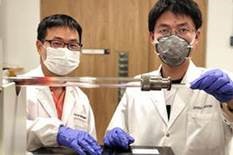
Assistant Professor Liu Zheng (left) and Dr Zhou Jiadong insert a ceramic boat, containing salt mixed with other components used to make transition-metal chalcogenides, into a furnace.
Media Coverage
The Straits Times
Our heartiest congratulations to Prof Liu and his team for their excellent achievement!