
hBP-Fi: Contactless Blood Pressure Monitoring via Deep-Analysed Hemodynamics
Synopsis
hBP-Fi is a contactless blood pressure measurement system driven by hemodynamics acquired via radio-frequency sensing technology and analysed via deep neural models. It innovates in grounding on hemodynamics as the key physical process of heart-pulse activities.
Opportunity
Hypertension is the number one major risk factor for death (over 1.3 billion people globally). It often develops over years without any symptoms and could cause dangerous health conditions such as heart attack. Therefore, it is critical to monitor blood pressure (BP) regularly to achieve timely diagnoses.
Unlike serious hospital settings, regular BP measurements are normally noninvasive, obtained by strapping inflatable cuffs and sensors on body; they all require skin contact (e.g., to block blood flow), causing discomfort and inconvenience to users. Moreover, their performances rely heavily on device-wearing states, leading to uncertainty in achieving the desired accuracy.
Recent progress in radio-frequency (RF) sensing brings new hope to alleviate these limitations and lead to more promising solutions. Existing systems sense chest/arm motions as an externally observable biomarker and map the morphological features of the captured waveforms to BP via deep learning (DL). However, the learned mapping between morphological features and BP may not be causal due to the lack of a physiological basis, making its validity highly questionable. In addition, these systems demand high volumes of training data to cope with variations in morphological features across different subjects and measurement scenarios. Therefore, it is imperative to have a more effective and efficient alternative for timely BP monitoring.
Technology
We propose hBP-Fi to associate, for the first time, advanced RF sensing and DL inference with a sound physiological basis; it leverages motion-sensitive RF signals to capture the BP-encoded hemodynamics of pulses transiting along arm arteries.
As shown in Figure 1, as blood flows through, the arm arteries undergo compliance changes indicating changes in BP, resulting in variable pulse waveforms depending on the blood pressure measurement site. Consequently, the varying pulse waveforms measured at different sites allow for deriving a BP-specific transfer function (BTF); inferring BP becomes possible as the BTF, describing how compliance varies along arteries, is causally related to BP. Given the relation between BP and RF-sensed pulses, hBP-Fi carefully steers RF beams to scan an arm, aiming to capture varying pulse waveforms along it. It then involves a continuous beam-steerable RF sensing scheme to synthesise all signals obtained during the whole scanning process to obtain a series of high-quality pulse waveforms along the arm. Finally, a CycleGAN-based DL pipeline is proposed to process pulse waveforms; it is designed to be physically explainable and robust to cross-domain generalisation.
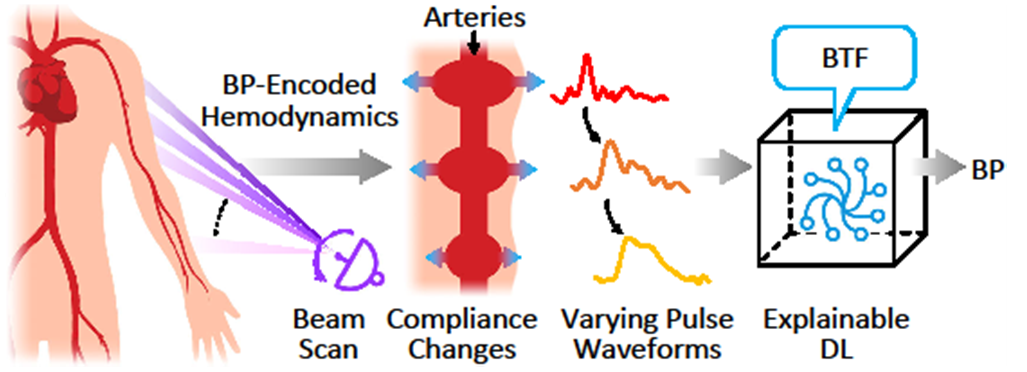
Figure 1: The conceptual construction of hBP-Fi: a path from hemodynamics understanding towards RF (micro-)motion sensing and explainable DL inference.
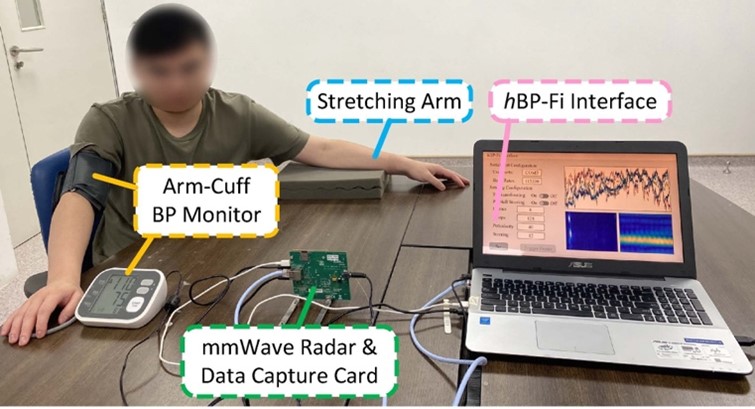
Figure 2: Experiment setup with all devices exhibited. The wearable device is only meant for collecting the ground truth, so as to validate hBP-Fi’s performance.
Applications & Advantages
- First contactless BP monitoring system driven by modern mmWave radar technology.
- Capable of obtaining accurate BP measures without causing discomfort to human users, marking an important step towards timely and regular health monitoring.
- Can be embedded into smartphones equipped with compact radars, further facilitating continuous BP monitoring.
.tmb-listing.jpg?sfvrsn=8d60272d_1)



.tmb-listing.jpg?sfvrsn=43b583b8_2)
.tmb-listing.jpg?sfvrsn=5b527752_2)