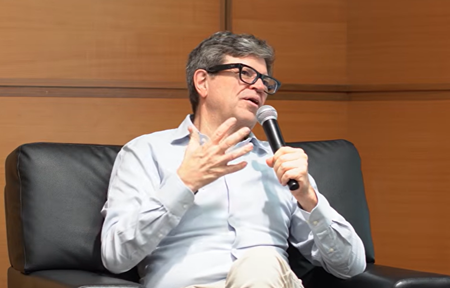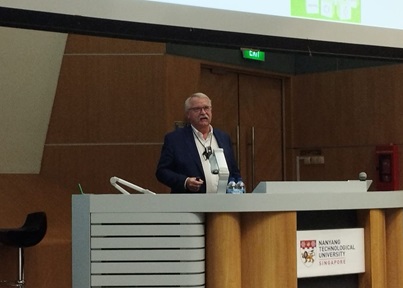
Quantum Geometric Principles for Magnetism and Superconductivity by Prof Youichi Yanase
IAS Frontiers Seminars: Quantum Horizons, Seminar #4 (AY26/27)
The IAS Frontiers Seminar on Quantum Horizons held on 16 November 2026, featured Prof Youichi Yanase (Kyoto University), who presented the role of quantum geometry in magnetism and superconductivity. He explored how the geometry of electronic wavefunctions can help explain which magnetic and superconducting states are favoured by electron-electron interactions, providing a guiding principle for studying ordered phases in correlated materials.
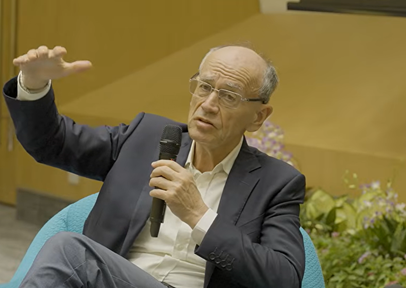
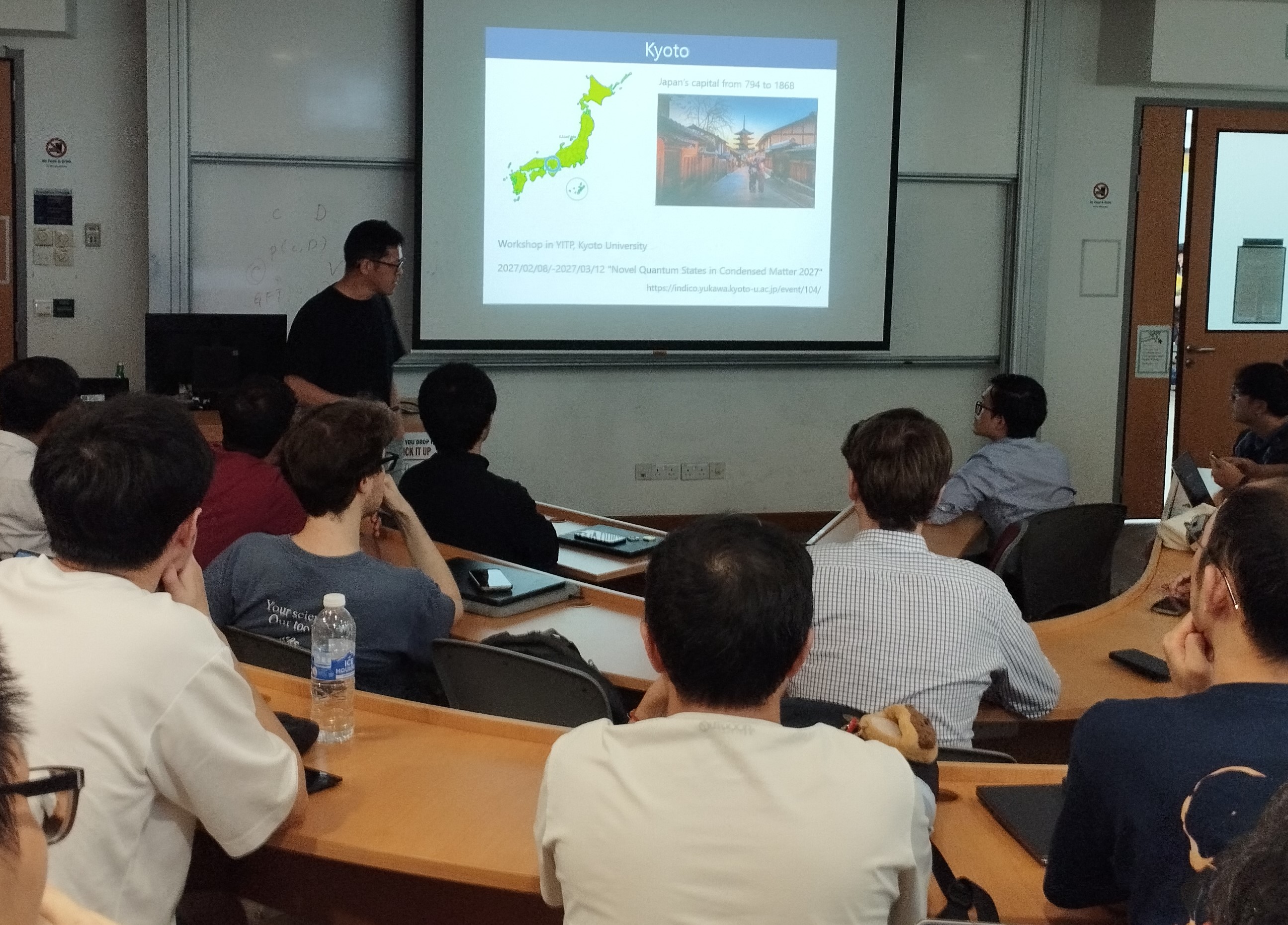 Prof Yanase began with a short introduction to how quantum geometry and magnetic interactions could influence unconventional superconductivity.
Prof Yanase began by distinguishing two aspects of electrons in crystals: their energy dispersion and the geometry of their Bloch wavefunctions. The latter is described mathematically by the quantum geometric tensor, whose real part gives the quantum metric and whose imaginary part is related to Berry curvature. He emphasised that Berry curvature alone does not represent the whole band geometry. The quantum metric, which captures the distance between nearby quantum states, can offers additional information about electronic behaviour, including optical response and nonlinear transport. He then connected this framework to systems in which electron-electron interactions and spin play important roles. He explained that magnetic fluctuations can mediate electron pairing and influence the type of superconductivity that emerges. This connection motivated his investigation of how quantum geometry shapes the momentum structure of magnetic fluctuations, providing a possible route to unconventional superconductivity.
To address this question, Prof Yanase examined the spin susceptibility, which describes the electronic spin response to a magnetic perturbation. He separated its curvature near zero momentum into contribution from energy dispersion and quantum geometry. Within the geometric contribution, the quantum metric favours ferromagnetic fluctuations through a Fermi surface term, while Berry connection polarisability favours antiferromagnetic fluctuations.
He illustrated these ideas through calculations for an extended Lieb lattice with band degeneracy and a singular saddle point, without requiring a flat band. Including quantum geometry produced a susceptibility peak at zero momentum, indicating ferromagnetic fluctuations; neglecting it instead favoured antiferromagnetic fluctuations. Adding Coulomb interactions within the random phase approximation strongly enhanced the ferromagnetic fluctuations. Calculations using the Eliashberg equation then predicted spin-triplet p-wave superconductivity, with a competing extended s-wave state appearing nearby in parameter space.
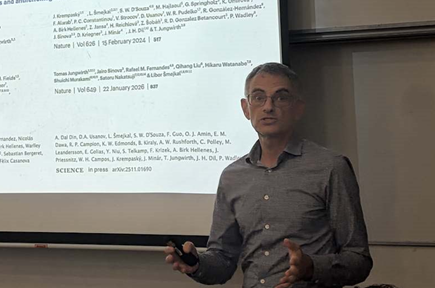
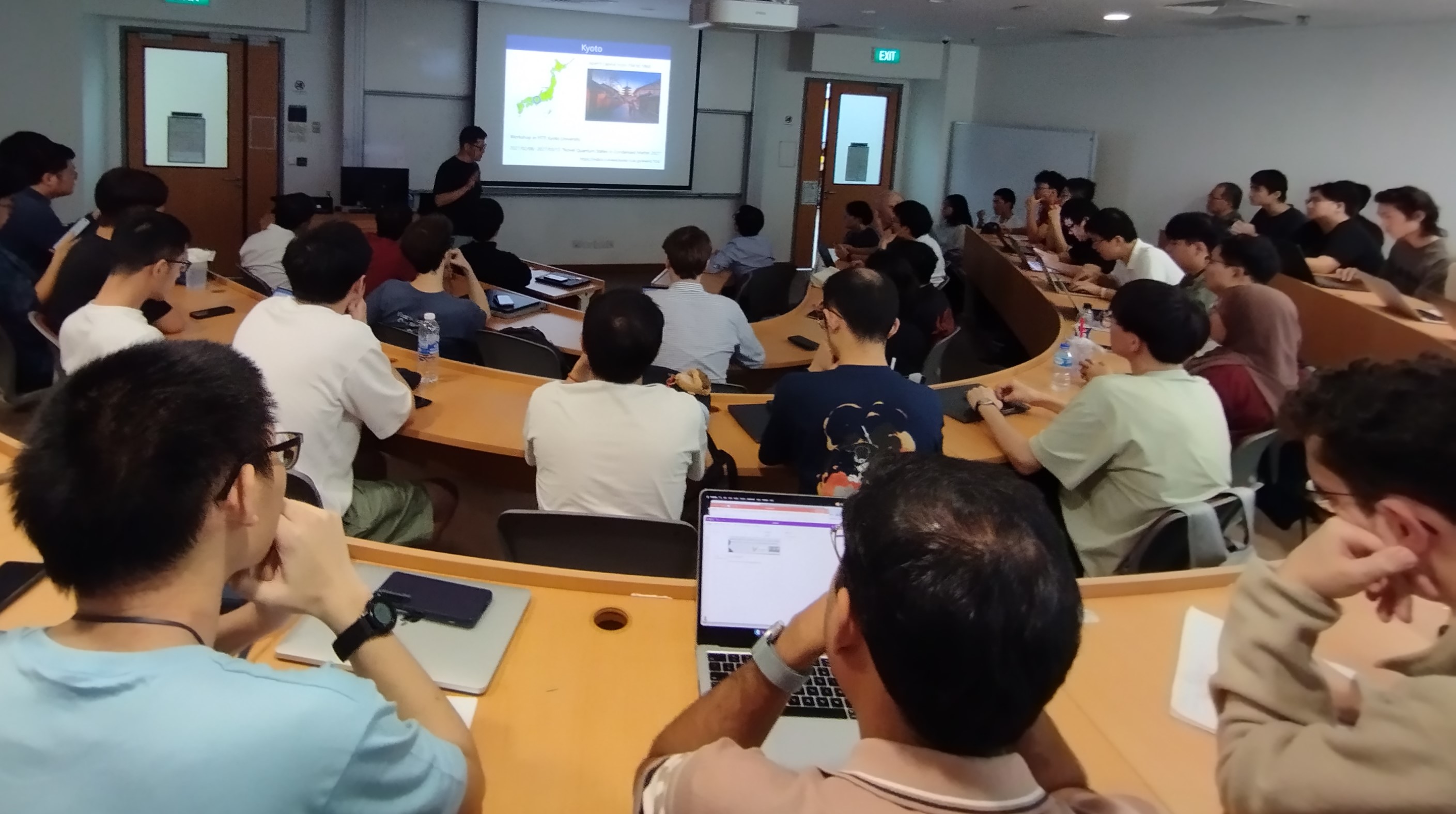 Prof Yanase highlighted new possibilities for discovering rare superconducting materials.
Prof Yanase further examined how divergent quantum geometry at singular saddle points can promote ferromagnetic fluctuations. He connected this mechanism to established results on flat-band ferromagnetism, showing how the geometric viewpoint extends the discussion beyond flat bands. Since candidate materials for spin-triplet superconductors remain rare, he proposed quantum geometric ferromagnetism as a useful principle for guiding the search.
The second part of his seminar extended the framework to odd-parity magnetic multipole order using a bilayer Lieb lattice. He compared ferromagnetic alignment with opposite magnetic alignment between the layers. The latter preserves combined spatial inversion and time-reversal symmetry and can represent odd-parity magnetic multipole order. Using mirror symmetry, he showed that the quantum metric contributes to spin fluctuations through a Fermi surface term and to multipole fluctuations through an interband term. In the bilayer model, the geometric contribution favouring ferromagnetic fluctuations was enhanced when the chemical potential approached either of the two band-crossing energies. The contribution favouring magnetic monopole fluctuations was instead enhanced when the chemical potential lay between these energies. Quantum metric effects consequently favoured odd-parity multipole magnetism over a broad parameter range. Prof Yanase proposed that qualitatively different momentum patterns in spin and multipole correlations could serve as a signature of quantum geometry, and it is testable through neutron scattering.
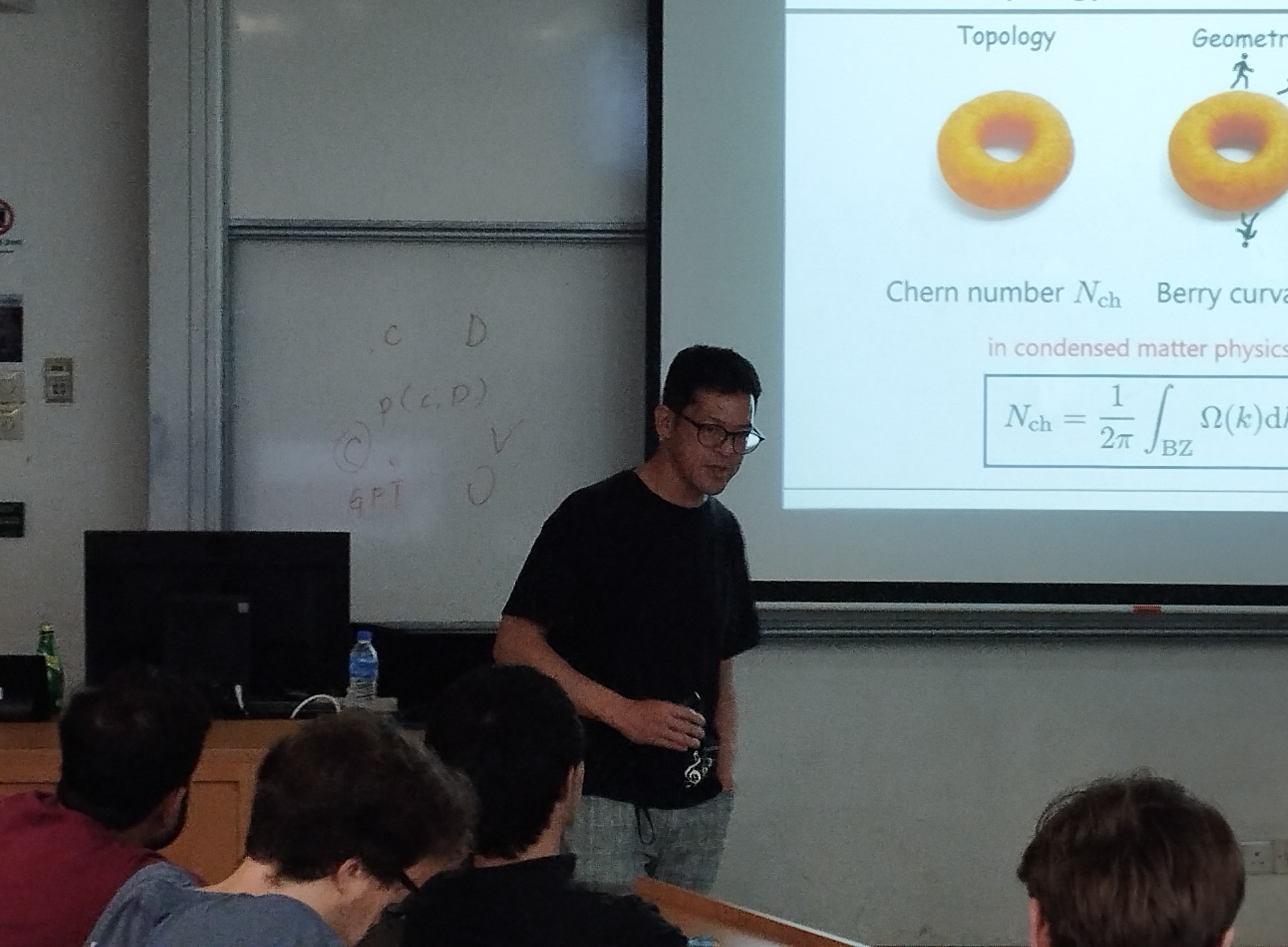 The seminar further explored how different magnetic arrangements influenced fluctuations and unusual magnetic behaviour.
Towards the end of his seminar, he highlighted related applications of quantum geometry to superconductivity, including anomalous temperature scaling of the geometric contribution to superfluid weight. Such behaviour could help identify pairing symmetry in multilayer graphene. He also pointed to nonlinear optical responses as a means of characterising topological superconductors.
Overall, the seminar connected the quantum geometry with interaction-driven ordering. Through model calculations of magnetic fluctuations, superconducting paring and multipole order, Prof Yanase showed how geometric information can guide the search for ordered states and suggest experimental signatures for distinguishing them.
This seminar is part of the IAS Frontiers Seminars: Quantum Horizons series. Find out more about the AY26/27 seminars here.
Written by Tan Fei| NTU School of Physical and Mathematical Sciences
"Quantum geometry ferromagnetism and how it enhances spin triplet pairing was relaly interesting." - Shicong Wang (PhD Student, SPMS)
"I particularly enjoyed learning how quantum geometry influences magnetism and superconductivity, especially the connection between abstract quantum principles and their practical applications in advanced materials." - Zubair Muhammad (PhD Student, EEE)
"The seminar was really interesting and I learned how these quantum concepts can be used in Mathematics and Algorithms." - Mir Sajad Ahmad (PhD Student, SPMS)