Lee Kong Chian Distinguished Professor Public Lecture by Prof Yann LeCun
Written by Goh Si Qi | PhD Student, College of Computing and Data Science, NTU
On 3 November 2026, the Institute of Advanced Studies (IAS) and the College of Computing and Data Science (CCDS) welcomed Professor Yann LeCun to Nanyang Auditorium for the CCDS Distinguished Speaker and IAS Lee Kong Chian Distinguished Speaker Public Lecture titled "World Models: Enabling the Next AI Revolution".
Prof LeCun is the Executive Chairman of Advanced Machine Intelligence (AMI) Labs and Jacob T. Schwartz Professor at New York University. He received the 2018 ACM Turing Award jointly with Profs Geoffrey Hinton and Yoshua Bengio. The public lecture provided an opportunity to examine his proposed direction for autonomous machine intelligence and the research questions that accompany it.
Welcome Address and Opening Remarks
Prof Sum Tze Chien (Director, Institute of Advanced Studies), delivered the welcome address, emphasising the value of bringing impactful science to NTU and facilitating meaningful academic exchange through engagement with scientific ideas and research perspectives. Prof Luke Ong, (Vice President (AI and Digital Economy) and Dean, CCDS, NTU) followed with opening remarks, highlighting Prof LeCun's contributions to convolutional neural networks and deep learning. He placed emphasis on a deeper understanding of human intelligence as a basis for future progress in artificial intelligence (AI).
Prof Luke Ong also reflected on Prof LeCun's sustained commitment to neural network research. He drew attention to the persistence required to pursue new scientific directions and the importance of independent thinking in research. These remarks positioned the lecture within a broader consideration of how fundamental ideas develop and how researchers decide which questions to pursue.
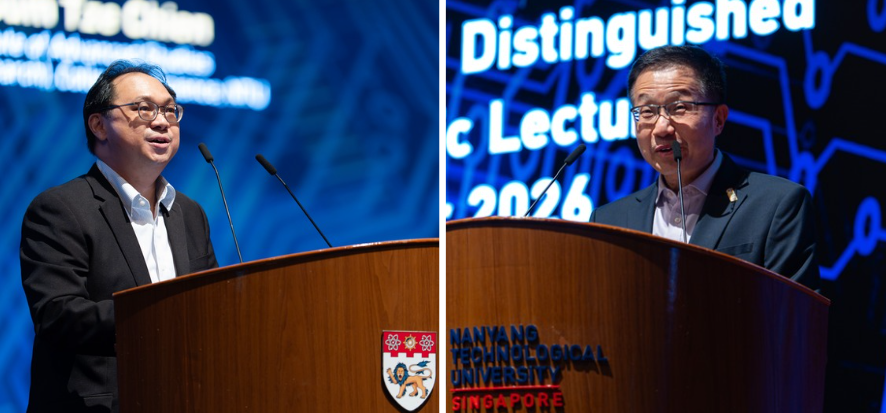 Prof Sum Tze Chien (left) and Prof Luke Ong (right) opened Prof LeCun’s lecture, emphasising academic exchange and deep learning
World Models
Prof LeCun opened his public lecture by considering whether AI can acquire common sense. He used the example of dishwashing to illustrate the difficulty of equipping machines with capabilities that people develop through ordinary experience. "A four-year-old child could have seen and can perform more tasks than LLM", Prof LeCun highlighted, a task that a child can perform may still require substantial training for a robotic system, drawing attention to the challenges of understanding and acting in the physical world.
Prof LeCun next addressed the importance of real-world data in the development of human-level AI. This placed learning from experience at the center of the discussion. The broader issue was how a machine could acquire an understanding of its environment that would remain useful when circumstances change.
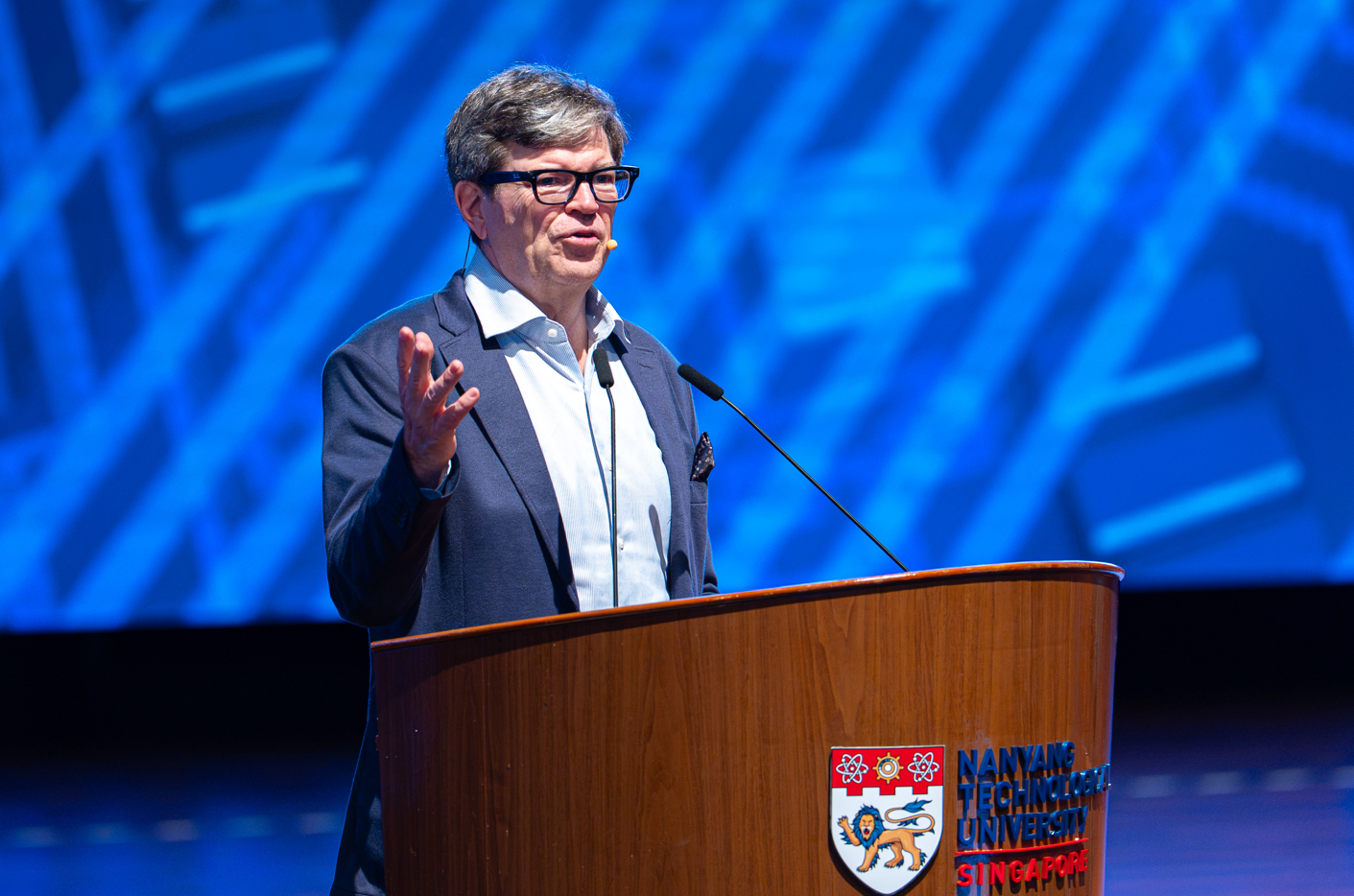 Prof LeCun used dishwashing to illustrate the challenge of equipping AI with common sense.
Turning to reasoning and action, he described search and optimisation as important components of intelligent behavior. He outlined an approach in which possible actions are considered in advance and evaluated against an objective. A world model provides predictions of possible outcomes, while the objective supplies a basis for selecting a course of action. He also discussed predictions operating at multiple levels of abstraction and over different time scales. This introduced the question of how predictive knowledge should be represented so that it can support reasoning at different levels of detail.
The complexity of the physical world presents a further challenge for prediction. Prof LeCun noted the difficulty of modeling an environment containing many changing and unpredictable details. He introduced the Joint Embedding Predictive Architecture (JEPA), a non-generative approach that learns abstract representations and performs prediction within that representation space. He explained that the approach seeks to retain useful and predictable information while setting aside irrelevant or unpredictable details. The aim is to learn representations that support prediction without requiring the model to reproduce every element of an observed input. This makes the choice of representation an important part of the proposed approach to machine intelligence.
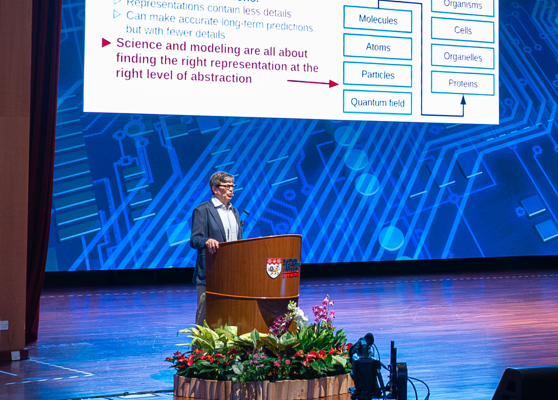 To tackle unpredictable details, Prof LeCun introduced JEPA, making predictions using abstract representations.
The public lecture turned to how observations can be converted into useful information and how learned representations can remain informative. Prof LeCun discussed approaches to learning and maintaining information in representations, including different contrastive strategies. The discussion connected the learning objective with the quality of the representation available for subsequent prediction. He also referred to the ability of humans to learn three-dimensional representations rapidly. In discussing current AI agents, he highlighted limitations in anticipating the consequences of actions and the continuing gap between training conditions and the situations encountered subsequently. These observations returned attention to the practical demands of deploying systems that must respond to unfamiliar circumstances.
Fireside Chat
Following the public lecture, Prof Bo An (Head of the Division of Artificial Intelligence, CCDS NTU) moderated a fireside chat, with discussions ranging from the challenges facing existing approaches, prediction in pixel space and the distinction between planning and imitation. Prof LeCun distinguished explicit planning, which involves search, from reproducing patterns of behavior encountered during training. The exchange considered how systems might improve their decision making and the role that world models could play in supporting that process.
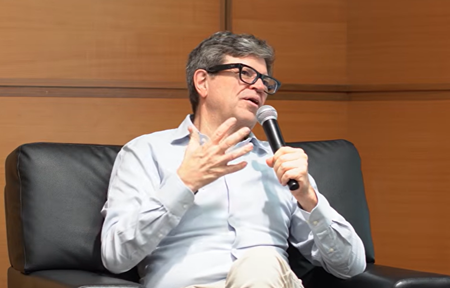
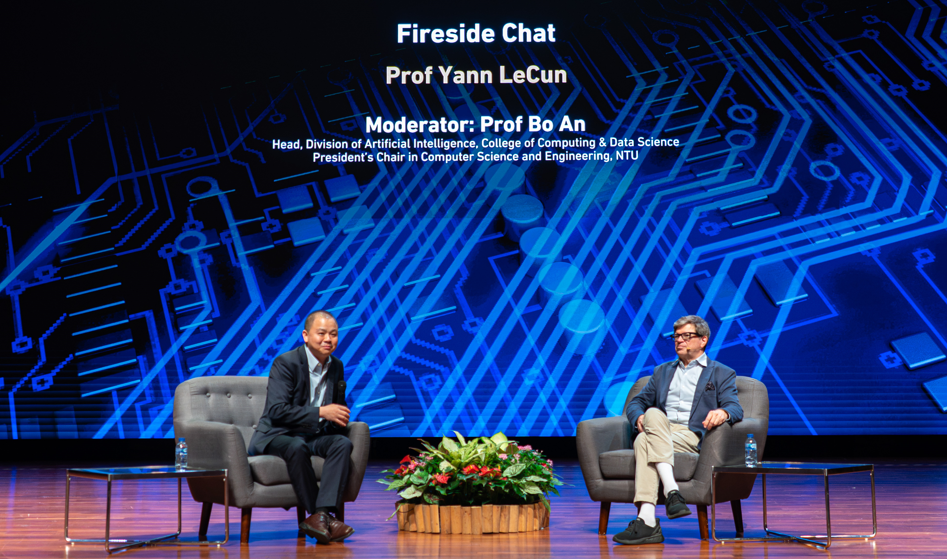 Prof Bo An moderated a fireside chat on how world models could support AI planning.
The conversation then addressed reinforcement learning. Prof LeCun highlighted the large number of interactions that may be required when learning through trial and error in complex environments. He contrasted these demands with settings such as games, where simulation makes repeated trials more readily available. Describing reinforcement learning as the “cherry on the cake”, he presented it as a complementary component of the broader approach to developing intelligent systems.
Discussion of the scope of world models included noisy, dynamic environments that cannot readily be described by a small set of equations. Prof LeCun also considered generalisation across tasks, noting that different situations require different levels of detail, and that future tasks may not be known during training. He argued that the underlying world model should be as general as possible, while a task-specific objective guides which aspects of a situation matter for decision making. This distinction allows broadly learned predictive knowledge to be considered separately from the requirements of a particular task.
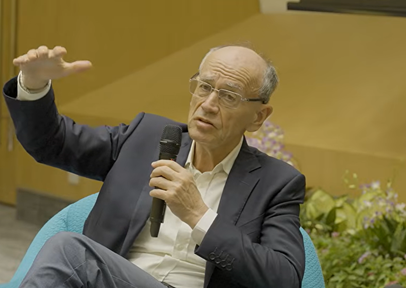
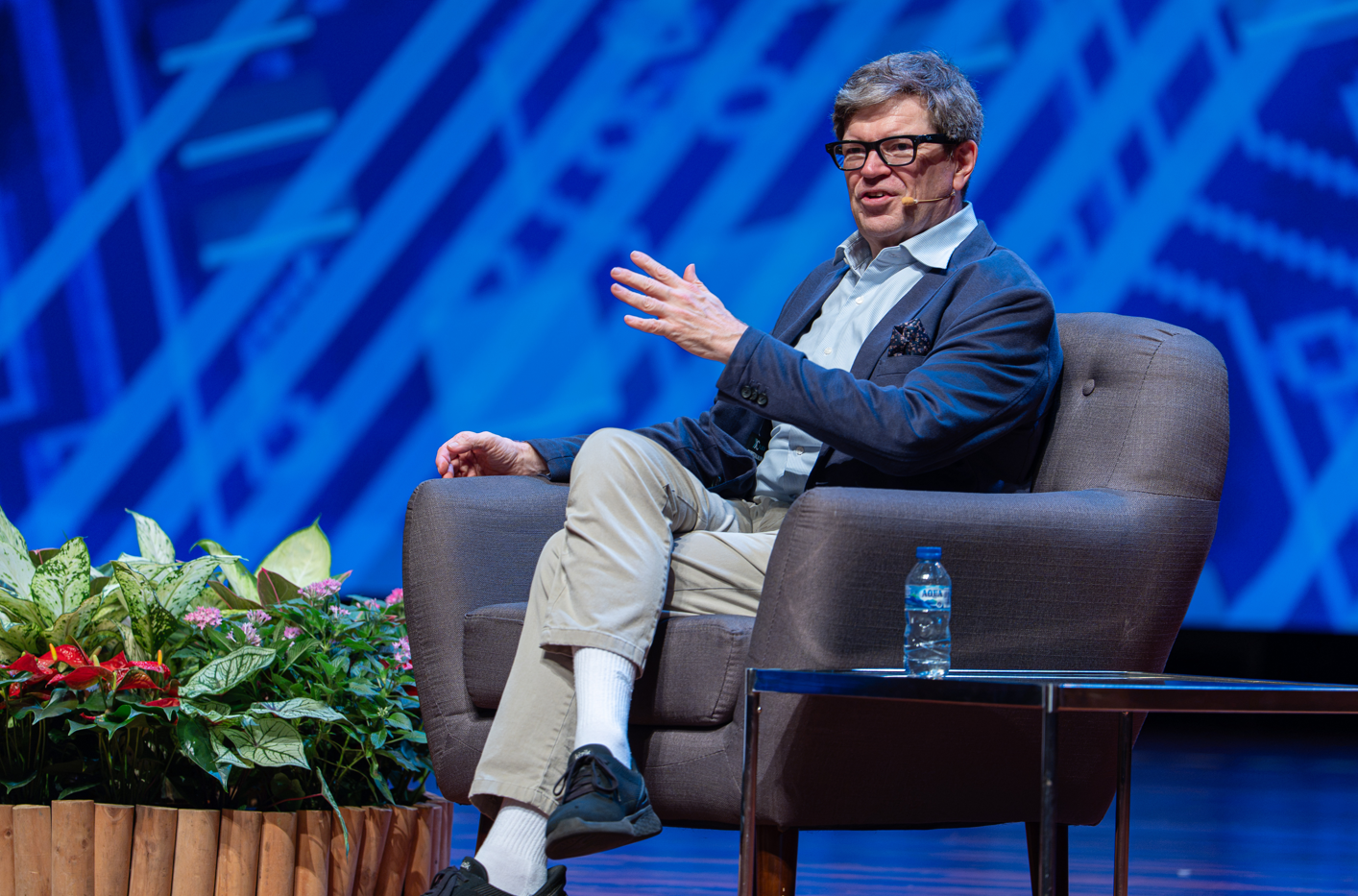 Prof LeCun encouraged students to pursue AI research with a clear vision and independent judgement.
Prof LeCun discussed self-supervised learning from video and the availability of broad observational data. He contrasted this with the difficulty of obtaining experience for highly specific real-world tasks. The exchange highlighted the challenge of using generally available observations to support applications whose detailed requirements may differ substantially.
The fireside chat also addressed whether it remained an appropriate time for students to enter AI and computer science. "Computer science is more alive than ever," said Prof LeCun, expressing confidence in the opportunities available and suggested that advances in AI can enable individuals to accomplish more. He encouraged students to develop a clear research vision and the independent judgement needed to identify worthwhile problems. He highlighted mathematics and physics as useful foundations and noted the opportunities to learn more rapidly in the present era. This advice connected the choice of a research direction with the knowledge and judgement required to pursue it.
Q&A Session
The Q&A session began with the use of different modalities in world models. Students asked whether different forms of input would require different encoders. Prof LeCun indicated that the encoder should reflect the modality being processed. A further question concerned how multiple streams of information might be handled within a JEPA-based system.
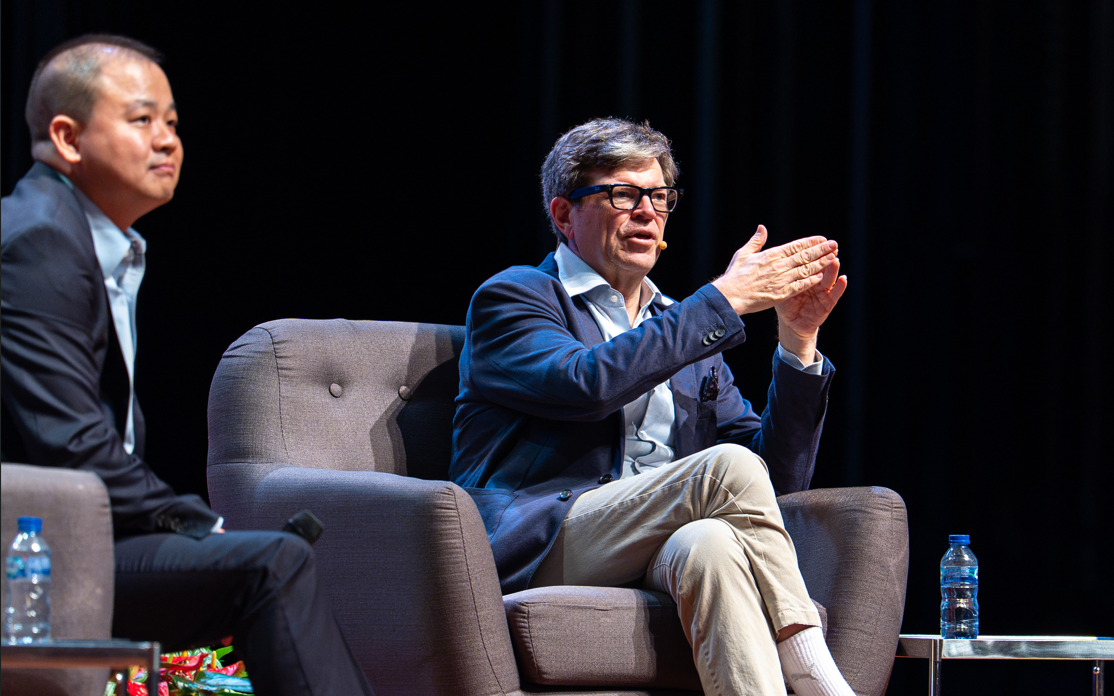 During the Q&A, students asked Prof LeCun whether different inputs required separate encoders and how JEPA could handle multiple information streams.
The session then addressed whether different levels of abstraction should be learned jointly or separately, and how an appropriate level might be selected for a particular problem, following by memory requirements and the computational demands of planning. Prof LeCun suggested that systems based on JEPA could require less memory, while planning could introduce additional computation. His response highlighted the need to distinguish potential memory savings from the resources required to evaluate possible actions. In closing, Prof LeCun set out his position on LLMs: “If you are interested in human-level AI, don’t work on LLMs.”
The lecture and subsequent dialogue provided an opportunity to examine the scientific questions shaping the development of world models and autonomous AI. Prof LeCun’s emphasis on learning from experience and anticipating the consequences of actions positioned the technical discussion within a broader consideration of intelligence. His advice on independent thinking and strong mathematical foundations connected these research challenges with the preparation of future researchers. Overall, Prof LeCun offered insights into how advances in machine learning may contribute to more capable AI systems.
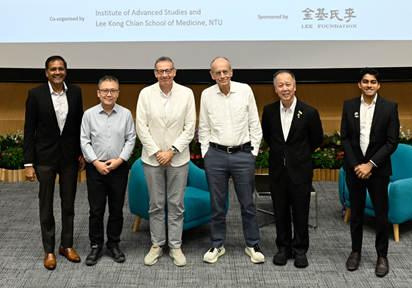
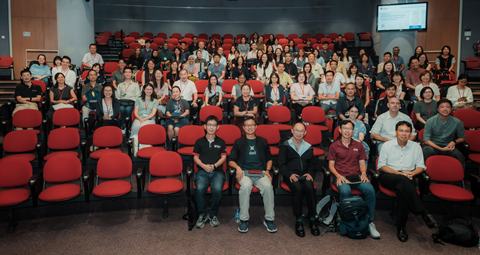
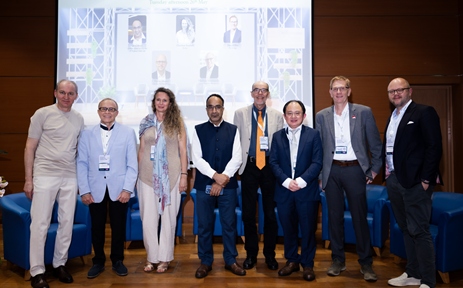
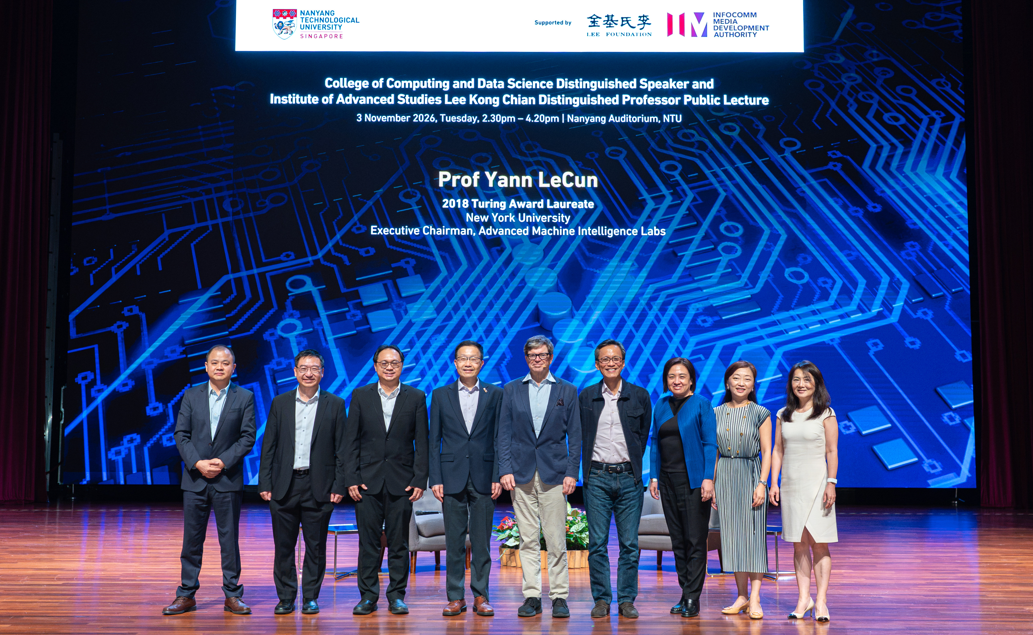 From left to right: Prof Bo An (CCDS, NTU), Prof Cham Tat-Jen (CCDS, NTU), Prof Sum Tze Chien (Director, IAS NTU), Prof Luke Ong (Vice President (AI and Digital Economy) and Dean, CCDS, NTU), Prof Yann LeCun, Mr Russell Tham (Chairman, IMDA), Dr Ong Chen Hui (BizTech Group, IMDA), Prof Shirley Meng (Vice President (Industry), NTU), and Prof Yang Shao-Horn (Vice President (Research), NTU)
"I enjoyed the discussions on the limitations of existing approaches and the origins behind the idea of world models"- Roy Debadrita (PhD Student, CCDS, NTU)
"This public lecture provided insightful perspectives to world models and current trends" - PhD student, CCDS, NTU
"The lecture delivery was easy to follow, I enjoyed the examples and visuals which made the audience think, as well as the Professor's thoughtful insights that piqued my interest." - Gao Wenbo (Undergraduate Student, MAE, NTU)
"The lecture was informative and engaging. I enjoyed learning about new ideas and perspectives." - Guo Jierong (PhD Student, MAE, NTU)