New Technology Captures First-Ever “Twitch” of the Eye’s Night-Vision Cells
Led by Nanyang Assistant Professor Tong Ling and a research team involving Nanyang Technological University, Singapore (NTU Singapore), University of Washington School of Medicine, Singapore Eye Research Institute (SERI), and Duke-NUS Medical School
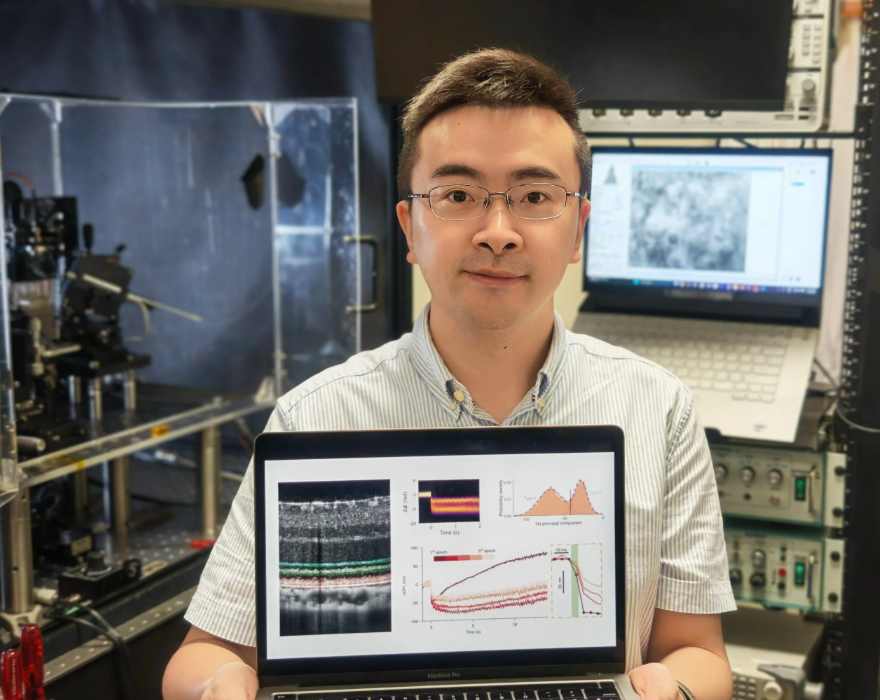
Led by Nanyang Assistant Professor Tong Ling, a research team involving Nanyang Technological University, Singapore (NTU Singapore), University of Washington School of Medicine, Singapore Eye Research Institute (SERI), and Duke-NUS Medical School has developed a breakthrough imaging technology that captures, for the first time, a tiny mechanical “twitch” in the eye’s night-vision cells when they detect light.
The previously unseen physical process accompanying the onset of low-light vision in the retina, discovered by Asst Prof Tong Ling and his team, opens new possibilities for non-invasive assessment of night vision, tracking age-related decline, and enabling earlier detection of retinal diseases in which night-vision loss can be an early warning sign.
About the Research
The study focuses on rod photoreceptors, which are responsible for vision in low-light conditions and make up the majority of light-sensing cells in the human retina. Using an advanced imaging method known as optoretinography, Asst Prof Tong’s team was able to measure nanoscale movements in these cells occurring within milliseconds after light exposure. This pioneering work provides new insights into the earliest stages of visual signal generation and may pave the way for improved diagnosis of retinal diseases such as age-related macular degeneration. The US–Singapore collaboration involved scientists from the University of Washington, Singapore Eye Research Institute (SERI), and Duke-NUS Medical School, bringing together expertise across chemistry, bioengineering, ophthalmology, and clinical research. Night vision loss affects hundreds of millions worldwide, particularly in ageing populations, yet remains difficult to assess and detect early. This research lays important groundwork for future clinical trials in Singapore using the new technology.
Click here to read full article.