Faces of CCEB: Prof Tan Howe Siang
Words from NTU CCEB’s physical chemist
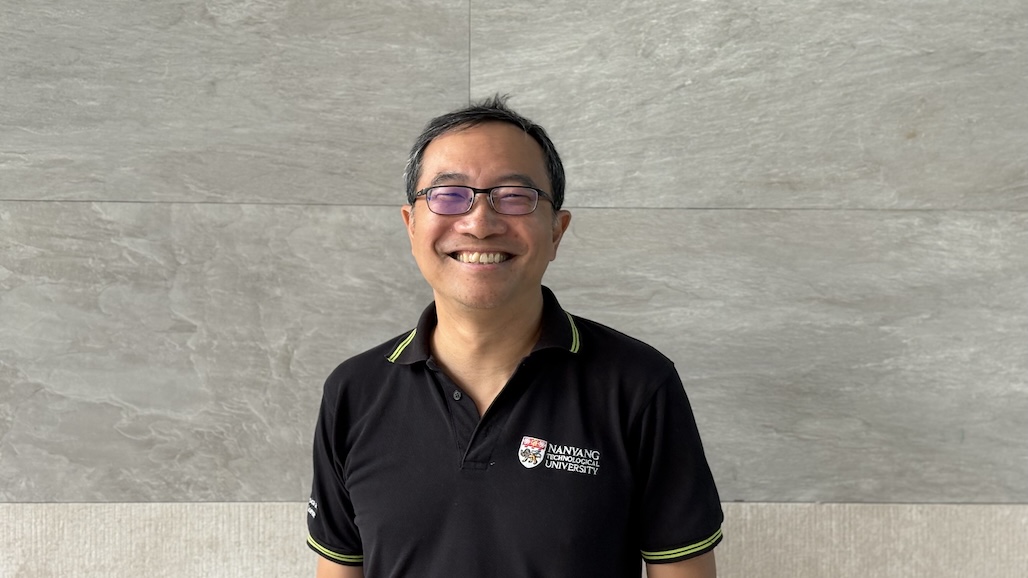
Professor Tan Howe Siang is Assistant Chair of Safety at the School of Chemistry, Chemical Engineering and Biotechnology (CCEB). He is a physical chemist and is the principal investigator of the Two-Dimensional Electronic Spectroscopy (2DES) Research Group at NTU. 2DES is a sophisticated type of Ultrafast Nonlinear Optical Spectroscopy capable of studying the femtosecond (10-15 s) changes and dynamics in complex molecular systems. In case you are curious what is so important about the femtosecond timescale, it is the approximate time taken for chemical bonds to be formed or broken. As we all know chemical reactions are all about molecules forming and breaking bonds. Outside of the lab, Prof Tan is an avid traveler and has visited about 100 countries, and enjoys hiking and climbing mountains. We sat down to ask him about his journey in science and what excites him.
Q: Tell us about your journey on how you came to physical chemistry?
A: Since young, I have been interested in geography. Plus, I was a scout in secondary school, which cultivated my love for the outdoors and hiking. In Junior College, a classmate of mine piqued my interest in astronomy, physics, and philosophy. I started being interested in big questions about the universe and wondered why things were the way they were.
In my undergraduate years, I did math, physics, and chemistry and discovered the niche of physical chemistry – the intersection between physics and chemistry. Physical chemistry allowed me to apply the rules of quantum mechanics and atomic physics to understand basic mechanisms in chemistry at the molecular level – such as the time-dependent nature of molecules.
Q: Could you break down your lab’s work into simpler terms?
A: The job of chemists, or molecular scientists, is to understand how molecules behave in different environments and how they change from one molecule to another by breaking and forming chemical bonds. To capture how molecules interact with each other, we need a very fast ‘camera’, and this is what ultrafast spectroscopy is. Two-Dimensional Electronic Spectroscopy (2DES) is a sophisticated kind of ultrafast spectroscopy technique that allows us to look at these molecular systems in high enough time and frequency resolution.
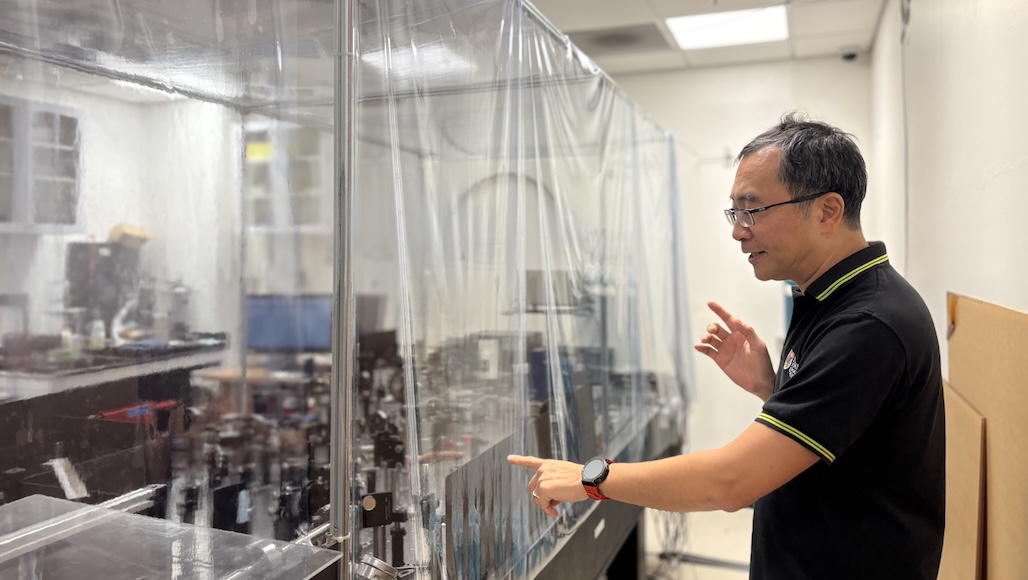
Prof Tan talking about how the 2DES equipment works by emitting light ‘bullets’
For our work on 2DES, we can understand how different molecules behave and how they interact with each other simultaneously. Chemical dynamics and reactions at the molecular level happen at ultra-fast speeds, usually less than a trillionth of a second. Our lab equipment uses ultrashort femtosecond light ‘bullets’ – or short laser pulses – to catch a molecule in action.
In the simplest terms, imagine trying to photograph race cars in an F1 race. There are multiple cars moving at a high speed, and you are trying to capture all of them simultaneously. Sometimes there is a crash, and the cars are altered due to the collision. In the same way, the molecules we are trying to study are moving at high speeds and we are trying to see how they behave and if they change when they interact with one another.
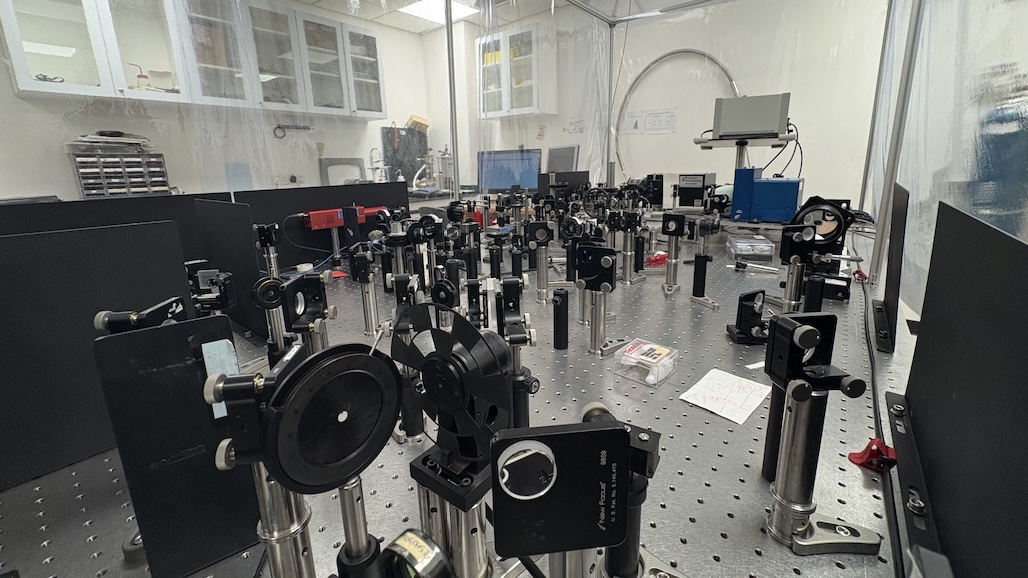
2DES Equipment where molecules and their interactions are studied closely
Q: Have you had any eureka moments in your time in science?
A: When I was doing my PhD, there was a technique in the laboratory that worked, though no one fully understood how it worked. One day, while I was just taking a shower, I had a Eureka moment and had a sudden burst of insight, and the mathematics underpinning the technique became clear to me. I realized that I had understood how and why the technique actually worked. This was a very satisfying moment in my life.
Q: On your blog, you mention you have travelled to about 100 countries. Tell us a little bit about life outside the lab?
A: All-in-all, I am a curious person or simply very kaypoh about the world. I am fundamentally interested in many things. I am curious to see why and how different societies work. I am interested in history and understanding how diverse cultures are. At the same time, I want to as much as possible, enjoy the sense of awe you get when you see amazing things, such as the Sahara Desert or Iguazu Falls, or something as simple as reading a great book. During weekends, I also volunteer as a museum docent at the Asian Civilization Museum and the Malay Heritage Centre. By bringing visitors through guided tours in these museums, I try to acquaint them with the historic or cultural artefacts, and their place in the complex fabric of human civilization.
Q: In your own words, why should prospective students do science?
A: In the age of AI, when we think ChatGPT can give us all the answers, we need to take a step back and ask ourselves what makes us human. I think that, limited as we are, wondering about how things work, is an essential part of being human. The capacity to go from not understanding something to understanding something, is to be human. In the end, we can get AI to do many things for us, but it cannot take away the joy and awe of ‘understanding’, for example, why two atoms can share electrons and form a chemical bond. This also includes the process of figuring how to go about ‘understanding’, and that includes pinpointing what to be “curious” about, through designing experiments, and developing hypothesis. This whole process is a most fundamental human endeavour called ‘Science’. So, if you want to be human, do science.😊
🎓 Find out more about CCEB's programmes here.
💬 Stay connected! Follow CCEB on LinkedIn, Instagram, and Facebook to keep up with our latest research highlights, student stories, and campus happenings.
Story by Sumita Thiagarajan, NTU CCEB