Faces of CCEB: Dr Ong Chi Wei
The educator helps students transform their creative ideas into functional prototypes to address real healthcare challenges
💬 Stay connected! Follow CCEB on LinkedIn, Instagram, and Facebook to keep up with our latest research highlights, student stories, and campus happenings.
Dr Ong Chi Wei, Lecturer (Bioengineering)
Nanyang Education Award (School)
School of Chemistry, Chemical Engineering and Biotechnology, NTU
| Celebrated for his interactive classes and interdisciplinary approach to learning, Dr. Ong Chi Wei was recently honoured with the Nanyang Education Award. In this feature, the bioengineering lecturer shares his teaching philosophy and how he guides students to transform classroom theories into functional biomedical devices from scratch. |
Q: The Nanyang Education Award is the highest honor conferred by the university to recognize outstanding educators. How has your interdisciplinary scientific journey shaped your unique philosophy on how engineering should be taught to the next generation?
My journey has taken me through different aspects of engineering, from computational modelling to biomedical engineering, medical device development. Having worked in both academia and industry, I have come to appreciate that engineering is not simply about solving equations or applying formulas. It is about using knowledge creatively to solve real-world problems and, ultimately, improve people's lives. This experience has shaped my teaching philosophy: engineering education should go beyond textbooks and examinations. Students should learn not only how to solve problems, but also how to identify the right problems to solve.
In my classes, I often bring real-world examples from healthcare, medical technology, and my previous research experiences into the classroom. For instance, when teaching learning, I connect theoretical concepts to applications such as cardiovascular disease prediction and the development of intelligent healthcare devices. This helps students appreciate why the knowledge they are learning matters. I also believe that engineering education should encourage students to step outside their comfort zones. The next generation of engineers will face increasingly complex challenges that cannot be solved by a single discipline. They need to be comfortable working across engineering, medicine, data science, and even business.
Most importantly, I want my students to develop curiosity, confidence, and a willingness to learn independently. Technologies will continue to evolve, but the ability to think critically, adapt, and solve unfamiliar problems will always remain valuable.
Q: Bioengineering undergraduates take the final year module Medical Device Design, which exposes them to designing medical devices from scratch. What are some memorable biomedical devices from this module?
Medical Device Design is one of the modules I particularly enjoy teaching because it gives students an opportunity to transform classroom knowledge into something tangible. What makes this module special is that students start by identifying a real healthcare problem, understanding the needs of patients or clinicians, and then working together to develop a functional prototype. Throughout the process, they must consider not only technical feasibility but also usability, patient safety, cost, and potential clinical impact.
One of the most rewarding aspects of teaching Medical Device Design is seeing students transform their creative ideas into functional prototypes that address real healthcare challenges. I always encourage students to look beyond technical specifications and consider how their innovations can improve patients' quality of life. Two particularly memorable projects are the Augmentative and Alternative Communication (AAC) device and Smart Glasses for individuals with clinical conditions or disabilities. The AAC device aims to support individuals with speech or communication difficulties by providing an alternative way to express their needs and communicate with caregivers. Students explored how artificial intelligence and user-friendly interfaces could make communication more accessible, personalised, and intuitive. What impressed me most was their effort to understand the challenges faced by patients and develop a solution that could make a meaningful difference in their daily lives. Another memorable project involved developing smart glasses to assist individuals with clinical conditions or disabilities. By integrating sensors, electronics, and intelligent technologies, the students explored how wearable devices could provide real-time assistance, enhance independence, and improve users' quality of life. This project demonstrated how engineering innovation can be translated into practical solutions for people with special healthcare needs.
I am especially impressed when students move beyond simply making a device work and begin asking important questions: Would a patient be comfortable using this? Would a clinician find it useful? Can the device be made affordable and accessible? One of the most rewarding moments for me is seeing students demonstrate their prototypes at the end of the semester. Many begin the course with limited experience in electronics, programming, or product development. Yet, through teamwork, experimentation, and perseverance, they manage to build something meaningful. For me, the most memorable device is not necessarily the most technologically sophisticated one, but the one that demonstrates a genuine understanding of the people it is designed to help.
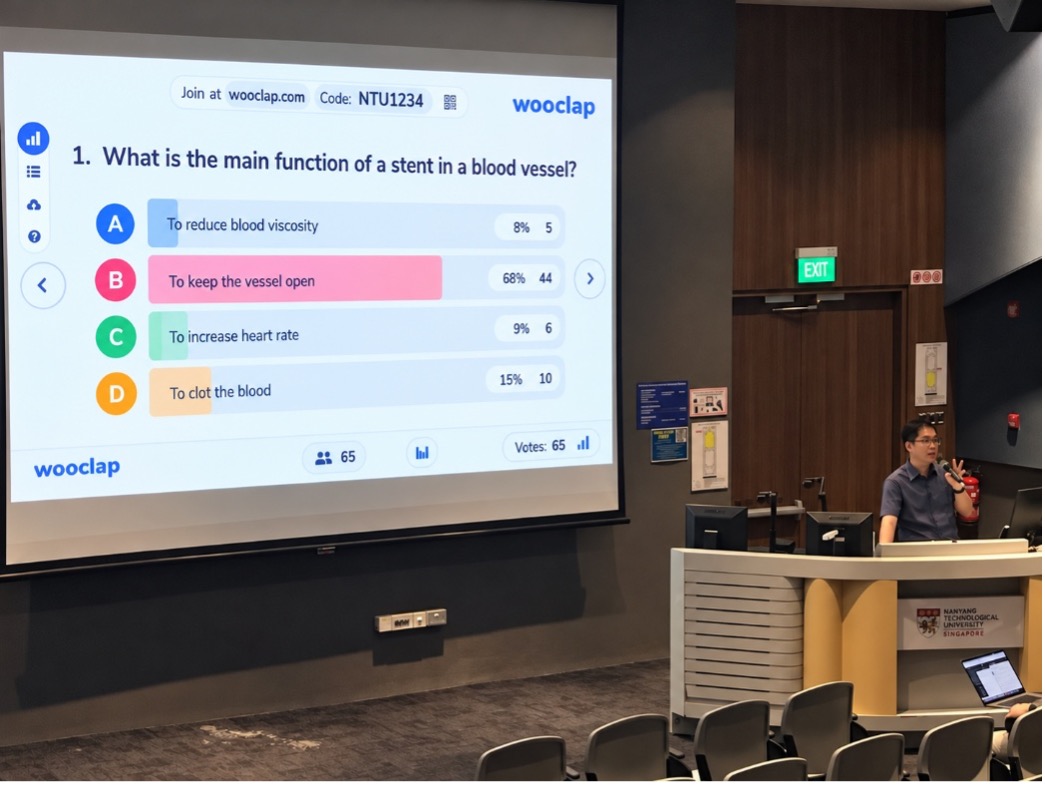
Your students at CCEB have praised you online as an engaging lecturer, specifically highlighting your interactive 'Wooclap' sessions and how you generously save conference goodie bags to hand out as classroom prizes. How do you approach designing these high-energy, interactive lectures, and why is cultivating a fun, low-stress environment so critical for tackling highly rigorous STEM subjects?
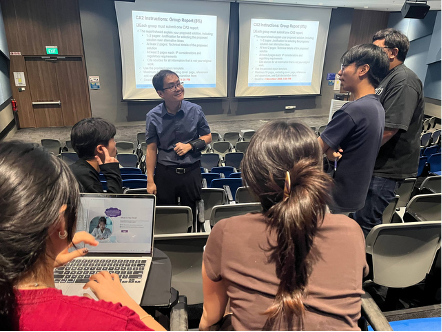
I believe that students learn best when they are actively involved in the learning process rather than simply listening to a lecturer for three hours. Engineering subjects can be challenging, especially when students encounter complex mathematical equations, programming, or unfamiliar scientific concepts. If students feel intimidated or afraid of making mistakes, they may hesitate to participate or ask questions.
That is why I try to make my lectures interactive, engaging, and, whenever possible, fun. I frequently incorporate interactive platforms such as NTU NALA, and ATAS into my lectures to engage students through live quizzes, polls, and short learning activities. These platforms allow students to assess their understanding immediately while providing me with real-time feedback on their learning progress. When I notice that many students have selected an incorrect answer, I take the opportunity to revisit the concept, explain it from a different perspective, or provide additional examples. This approach helps me adapt my teaching to students' learning needs and creates a more engaging, inclusive, and supportive classroom environment.
I also enjoy introducing small prizes during these activities. Whenever I attend conferences, I sometimes save the goodie bags and souvenirs to give away as classroom prizes. It is a simple gesture, but it often brings excitement and laughter into the classroom. Of course, the prizes are not the main objective. What matters is creating an environment where students feel comfortable participating, even when they are unsure of the answer. I always tell my students that making mistakes during learning is perfectly acceptable. In fact, mistakes are often where the most meaningful learning happens.
At the same time, I do not believe that making learning enjoyable means reducing academic rigour. Students still need to master difficult concepts and develop strong analytical skills. However, we can make the learning journey enjoyable without compromising the depth or quality of education. If students leave my lecture feeling that they have learned something challenging while also enjoying the experience, I consider that a successful class.
What is one thing you want to impart to the students of CCEB?
If there is one message I would like to share with my students, it is this: Never stop being curious, never be afraid of making mistakes, and always believe in your potential to learn and succeed. As an educator, I strongly believe that every student has the potential to grow, learn, and achieve success, although each may progress at a different pace and in different ways.
Engineering is not about knowing all the answers. It is about having the courage to ask questions, explore new ideas, and find solutions when the answers are not immediately obvious. Throughout your university journey, you may encounter difficult modules, unsuccessful experiments, disappointing results, or projects that do not work as expected. However, these experiences are all part of the learning journey and help shape you into a better engineer. I hope my students understand that making mistakes does not mean failure; rather, it provides an opportunity to reflect, improve, and grow.
I also want students to remember that while academic grades are important, they do not define your potential or determine your future success. Every student has unique strengths and talents, and I believe that with the right mindset, encouragement, and perseverance, everyone can achieve meaningful progress. Your attitude, integrity, resilience, teamwork, and willingness to keep learning are equally important qualities that will carry you far beyond university.
As educators, we may only have a few semesters with our students, but I hope the lessons they take away will remain with them long after graduation. I would be especially proud if my students eventually use the knowledge and skills they have gained at CCEB to develop technologies that improve people's lives, whether in healthcare, sustainability, or other areas of engineering.
Most importantly, I hope they remember that learning can be both challenging and enjoyable, and that they should never underestimate what they are capable of achieving. If my students graduate with greater confidence, curiosity, resilience, and the courage to make a positive difference in society, then I feel I have fulfilled my role as an educator.
🎓 Find out more about CCEB's programmes here.
Story by Sumita Thiagarajan, NTU CCEB