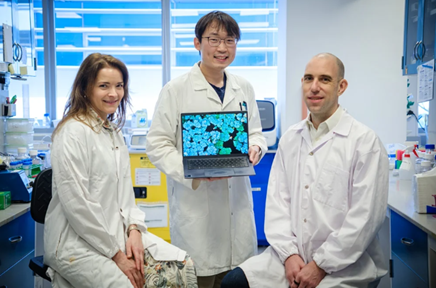
SBS Researchers Uncover a Way to Supercharge Plant Immunity
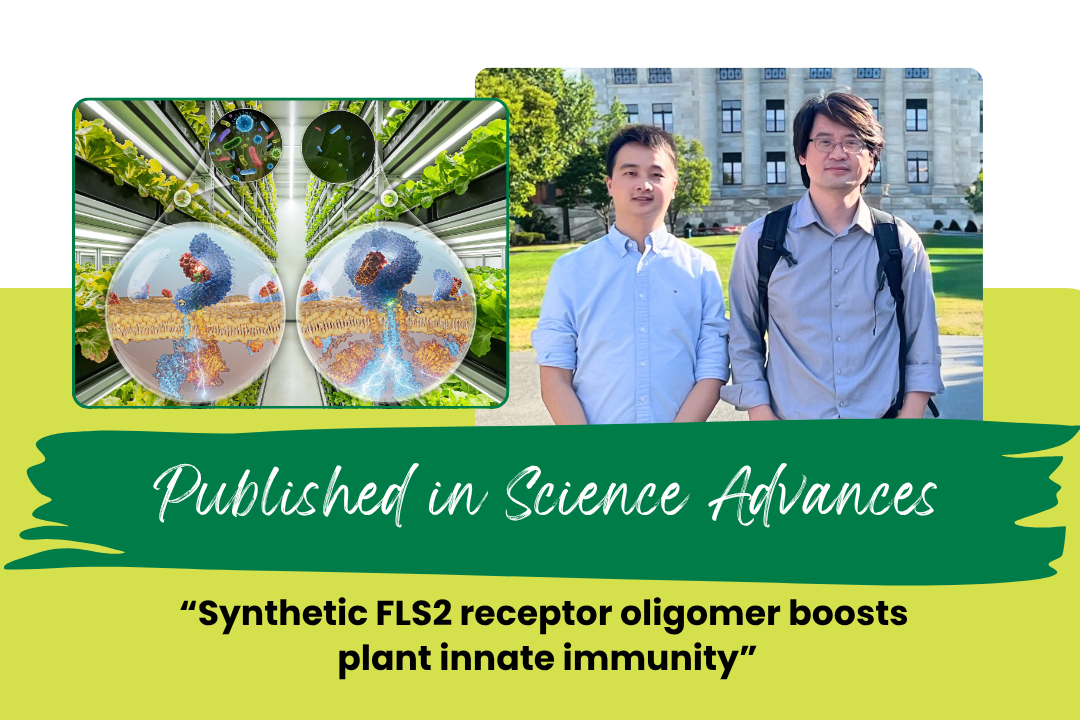
Plants have their own sophisticated defence systems to detect harmful microbes and respond to disease. Now, researchers from NTU’s School of Biological Sciences (SBS), led by Prof. Miao Yansong, have found a way to strengthen this natural immune response by precisely controlling how immune receptors are organised on the surface of plant cells.
Published in Science Advances, the study demonstrates how getting the right number of immune receptors working together can help plants mount a stronger and more sustained defence against bacterial infection.
The research was led by Prof. Miao Yansong, with first author Dr. Ma Zhiming and co-authors from NTU. The team combined synthetic protein engineering with single-molecule imaging to investigate how an important plant immune receptor, known as flagellin sensing 2 (FLS2), detects bacterial threats and activates plant defence.
Putting the right number of “guards” on watch
Plants have receptors on the surface of their cells that act like guards at a watchtower, detecting signs of potentially harmful bacteria and other microbes.
One of these receptors, FLS2, recognises flagellin – a protein associated with many bacteria. When FLS2 detects this warning signal, it helps trigger the plant’s immune response.
The researchers wanted to understand whether changing how these receptors are organised could influence the strength and duration of the plant’s defence response.
Using synthetic protein engineering, they precisely controlled how FLS2 receptors group together. They then used single-molecule imaging to monitor the behaviour of the receptors and study how different arrangements affected plant immunity.
The team found that grouping the receptors into pairs strengthened the plant’s immune response, while still allowing the receptors to be removed and replaced normally after they had performed their role.
As Prof. Miao explains, the principle is similar to putting more guards at a watchtower: having the right number makes it easier to spot an intruder and respond quickly, but having too many can get in the way.
More is not always better
The research also revealed an important balance in how plant immune receptors are organised.
While larger receptor assemblies could trigger a strong initial response, oversized clusters interfered with the normal renewal of the receptors. This weakened the plant’s ability to maintain its defence response over time.
In contrast, the engineered receptor pairs were able to provide both strong initial signalling and sustained responses to repeated microbial warning signals.
This highlights the importance of precisely controlling receptor assembly – not simply increasing the number of immune receptors – to achieve a durable immune response.
Stronger defence without affecting normal growth
The researchers tested their engineered immune system in Arabidopsis thaliana, a widely used model plant from the same family as vegetables such as chye sim and kai lan.
Under laboratory conditions, the engineered plants showed about 53% less bacterial growth than control plants without the enhanced immune response. Importantly, the researchers found no detectable effects on normal plant growth under the conditions tested.
The findings demonstrate how modifying the organisation of an existing plant defence system can improve its ability to respond to disease, without complex rewiring of the plant’s immune network.
From model plants to future disease-resilient crops
The findings could eventually open new possibilities for strengthening disease resistance in food crops.
This could be particularly relevant to indoor and vertical farming, where large numbers of similar crops are often grown close together. If a disease-causing pathogen enters such an environment, it can spread rapidly through the crop.
The team is now exploring how the receptor-engineering principle could be adapted for food crops, including leafy vegetables and other high-value crops suitable for indoor farming.
The researchers are also investigating approaches that could eventually be applied directly to plants that are already growing, rather than relying only on genetically engineered seeds or plants.
Further research will be needed to identify and test the optimal immune-receptor arrangements for different crops and determine whether the enhanced immune response remains effective against different pathogens under larger-scale growing conditions.
Opening new avenues for plant defence
The research has also resulted in two patent applications through NTUitive, NTU’s innovation and enterprise company.
The first covers a synthetic protein-engineering method that allows researchers to control how receptors group together on the surface of plant cells and identify arrangements that produce stronger, sustained immune responses.
The second covers a live-cell imaging and analysis platform that allows researchers to measure how individual receptors assemble on the surface of living plant cells.
Together, these technologies provide researchers with a way to quantify how plant immune sensors behave and determine how they can be engineered for improved performance.
The study provides a new framework for understanding how the organisation of immune receptors influences both immediate and long-lasting plant defence, while opening up potential avenues for developing more disease-resilient crops for sustainable agriculture.
Congratulations to Prof. Miao Yansong and the research team from SBS on this significant research achievement.
Read the full paper here.