Researchers Highlight New Frontiers in Plant Phase Separation Research
Researchers Set New Frontiers in Plant Phase Separation
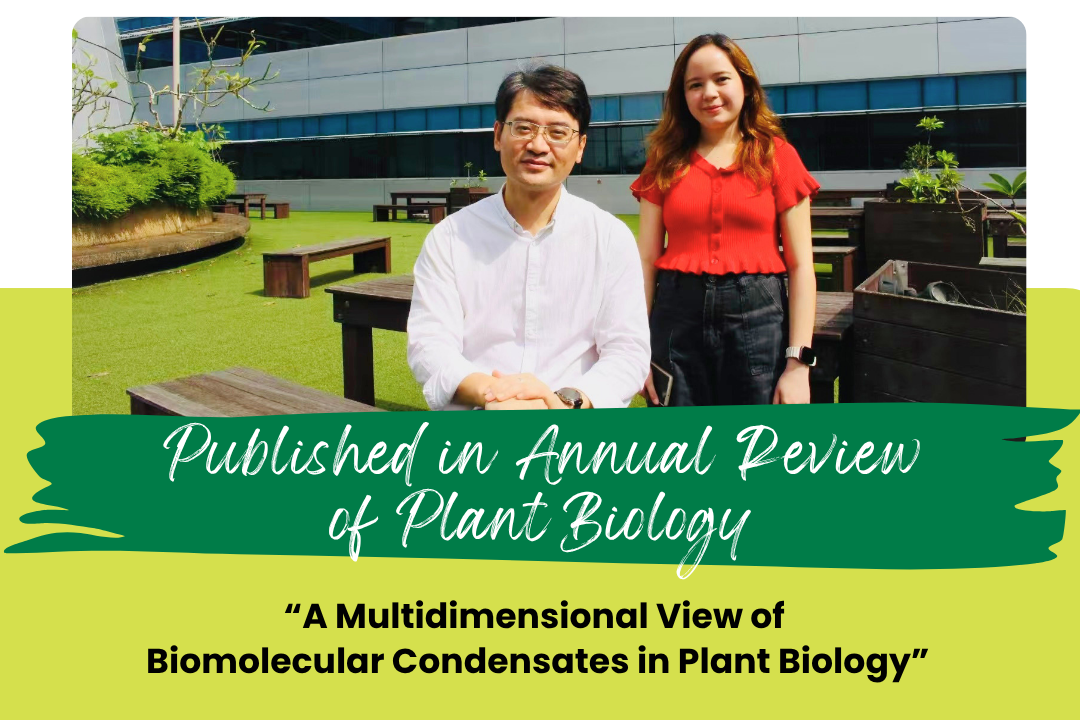
Researchers from the School of Biological Sciences (SBS), Nanyang Technological University, Singapore, together with collaborators from Tsinghua University and the Shenzhen University of Advanced Technology, have published a major invited review article in Annual Review of Plant Biology, one of the most prestigious and highly selective journals in plant science.
The review article, co-corresponded by SBS Associate Professor Miao Yansong, Fang Xiaofeng from Tsinghua University, and Wang Yanning from Shenzhen University of Advanced Technology, presents a forward-looking synthesis of how plants organise life at the molecular level through phase separation.
Why Phase Separation Matters for Plants
One of the most transformative ideas in modern cell biology is the concept of biomolecular condensates, in which molecules such as proteins and RNA assemble into tiny, dynamic clusters within cells. These condensates form through phase separation, a process by which biomolecules spontaneously organise into dynamic molecular clusters without the need for surrounding membranes. In this way, condensates act as flexible “signalling hubs” that enable plant cells to rapidly respond to changing conditions.

Figure adapted from Miao Y. et al., Annual Review of Plant Biology (2026), originally created using BioRender. Plants use tiny liquid-like molecular clusters to rapidly organise cellular responses and survive environmental stress.
For plants, this form of molecular organisation is especially critical. Unlike animals, plants cannot move away from environmental stress such as heat, drought, or pathogen attack. By bringing key molecules together at the right place and time, condensates help plants regulate cell signalling, immune responses, growth, gene expression, and adaptation to environmental stress more efficiently.
A Multidimensional Framework for a Fast-Evolving Field
The article presents a comprehensive and multidimensional framework for understanding biomolecular condensates across multiple levels of plant biology, spanning their biophysical properties and ensemble dynamics, as well as their functional roles across diverse cellular compartments, including plasma membranes, the cytoskeleton, intracellular compartments, and chromatin.
By integrating findings across these contexts, the researchers offer a multidimensional perspective that provides new conceptual tools for understanding plant growth, environmental sensing, and defence mechanisms.
The review also highlights key challenges in the field, including understanding condensate composition, material properties, and context-dependent behaviours across different cellular environments.
SBS Contribution to a High-Impact Global Field
Associate Professor Yansong Miao has been at the forefront of research into plant cell signalling and biomolecular condensation. His work has contributed to establishing phase separation as a key principle in plant biology, offering new insights into how plant cells organise information and regulate biological processes.
This publication reflects SBS’ growing presence in an emerging and highly interdisciplinary field that bridges plant science, biophysics, and molecular analytics. It also underscores the School’s contribution to advancing conceptual frontiers in life sciences through international collaboration and cross-disciplinary research.
Training the Next Generation of Scientists
The review also highlights SBS’ strength in interdisciplinary research and its commitment to developing young researchers.
Associate Professor Miao co-authored the article with Ms Eden Vina Lamoste Grate, an SBS alumna who completed her MSc at SBS and is currently an Interdisciplinary Graduate Programme PhD student under his supervision at the Institute for Digital Molecular Analytics and Science (IDMxS). Her academic progression reflects SBS’ commitment to training researchers working at the interface of plant biology, cell biology, and molecular sciences.
Shaping the Future of Plant Science
As global interest and research into biomolecular condensates continue to expand, the field is opening new avenues for understanding how plants survive and adapt in increasingly challenging environments. Insights from this research may eventually contribute to advances in crop resilience, stress tolerance, and sustainable agricultural innovation.
Through international collaboration, SBS researchers continue to contribute to this growing field and advance our understanding of the fundamental principles of life at the cellular level, with potential implications for the future of biotechnology.
Read the full paper here.