New Mechanism Links Cell Structure to Growth Signalling
The Hippo and Wnt signalling pathways play essential roles in regulating how cells grow, divide and differentiate to build and maintain healthy tissues. Dysregulation of these pathways is a hallmark of many cancers, yet how cells coordinate communication between them remains poorly understood.
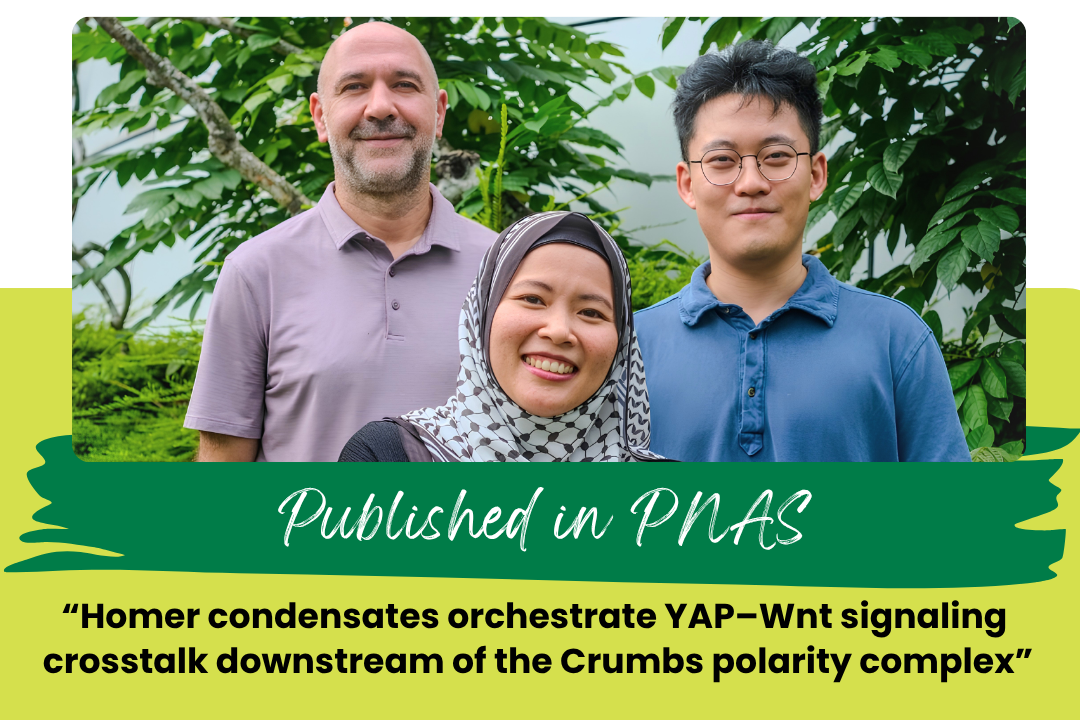
Researchers from the School of Biological Sciences (SBS), Nanyang Technological University, Singapore, including Assistant Professor Alexander Ludwig and first author Siti Maryam J.M. Yatim, have uncovered a previously unknown mechanism that links cell architecture to growth signalling. Their findings provide new insights into how disruptions in tissue organisation may contribute to cancer development.
Biomolecular Condensates as Signalling Hubs
In their study, the researchers discovered that specific cell polarity proteins assemble into small droplet-like structures known as biomolecular condensates, which act as signalling hubs that coordinate crosstalk between the Hippo and Wnt pathways. By organising signalling molecules in space, these condensates enable cells to translate information about their structural organisation into precise cellular responses.
The team identified Homer proteins as condensate-forming effectors of the Crumbs polarity complex that coordinate signalling between the Yes-associated protein (YAP) and Wnt pathways in epithelial and cancer cells.
Shedding Light on Tissue Organisation and Cancer Biology
The study establishes biomolecular condensation as a key organising principle for YAP-Wnt pathway coordination and provides insight into how the spatial organisation of signalling networks governs cell behaviour and tissue homeostasis.
By uncovering how cells integrate structural and signalling information, the findings advance our understanding of the fundamental biology underlying tissue organisation and growth regulation. They also provide new perspectives on how disruptions in these processes may contribute to cancer development.
Congratulations to Asst. Prof. Alexander Ludwig, first author Siti Maryam J.M. Yatim, Chen Yuhong and their collaborators on their publication in PNAS!
Read the full paper here.