Turning broadband fibre into ultra-sharp earthquake sensors
Using a commercial fibre-optic cable beneath New Zealand's Southern Alps, an NTU-led research has mapped a tectonic boundary to reveal how mega-earthquakes might unfold.

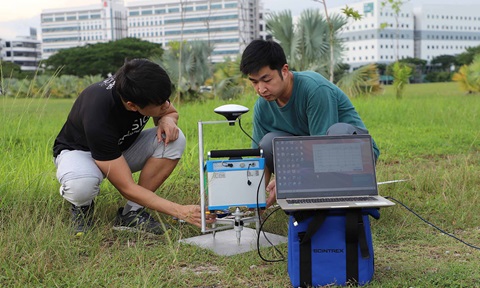
NTU Singapore’s Asst Prof Lai Voon Hui (left) working on the study with Prof Meghan Miller of Australian National University in New Zealand back in 2023. Photo Credit: Chorus.
Along the rugged spine of New Zealand’s South Island lies the Alpine Fault, a major tectonic boundary between the Australian and Pacific plates. The fault last unleashed a major earthquake in 1717, and geoscientists estimate a 75 per cent probability of a magnitude 7 or greater rupture occurring within the next 50 years.
Yet predicting how violently the ground will shake or how far a rupture might tear has long been hindered by our inability to observe inside the fault zone at depth with fine enough details.
Now, an international research team consisting of researchers from Nanyang Technological University, Singapore (NTU Singapore), The Australian National University (ANU), Te Herenga Waka—Victoria University of Wellington (VUW), the Chinese Academy of Sciences, and New Zealand telecommunications infrastructure company Chorus, has managed to see this blind spot.
Listening with sound in darkness
By repurposing an existing commercial broadband fibre-optic cable into a massive, hyper-sensitive seismic antenna, the team captured the sharpest view ever achieved of the Alpine Fault’s internal architecture. Working with Chorus, New Zealand’s largest telecommunications company, they sent laser pulses down an unused, or dark, strand of optical fibre running 30 kilometres along the Haast Pass highway.
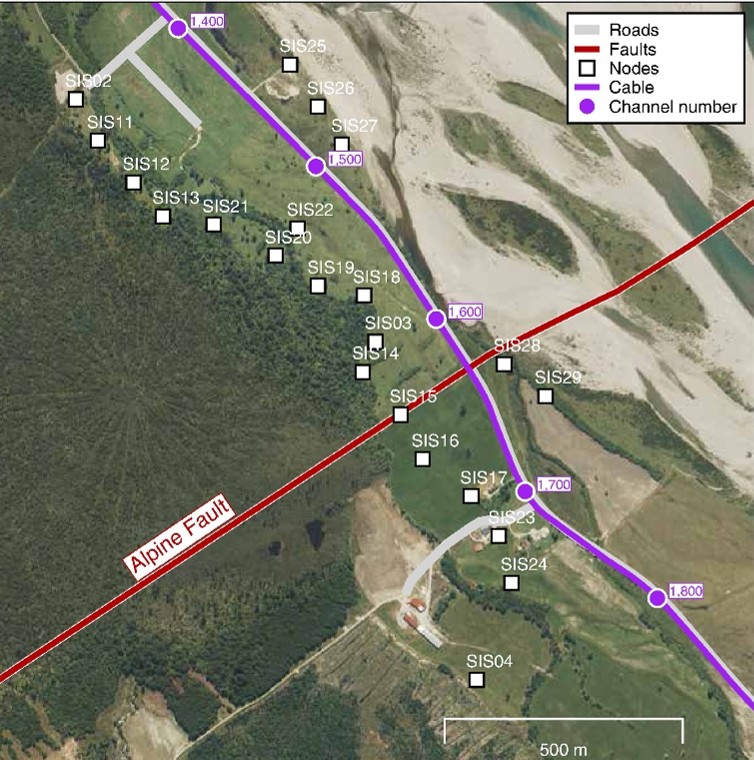
Detail map showing cable crossing the Alpine Fault. Photo Credit: Chorus.
As seismic waves pass through the earth, they microscopically stretch and compress the glass fibre. By measuring these minute laser reflections, the research team turned the 30-kilometre cable into thousands of virtual seismic sensors spaced just 4 metres apart. Over 140 days of recording across two campaigns in 2023, the fibre captured both the ambient hum of traffic and ocean swells, as well as 67 local earthquakes.
NTU Singapore’s Asst Prof Lai Voon Hui, lead author of the study, said: “Seismic waves trapped inside a fault behave a little like light travelling along an optical fibre. By recording them with the fibre itself, we could pick out the signature of individual fault strands only about 10 metres wide. This is something a conventional network of seismometers simply cannot resolve.”
Unmasking the fault’s hidden anatomy
Within the earthquake recordings, the research team identified 16 events that generated fault-zone guided waves, or distinct bursts of seismic energy channelled and trapped inside the fractured rock of the fault zone.
Through advanced computer simulations matching these guided waves, the team discovered that the fault is not a single uniform breach. Instead, it consists of a roughly 200 metre-wide zone of shattered rock harbouring up to six narrow, hyper-localised slip cores, each measuring roughly 10 metres across.
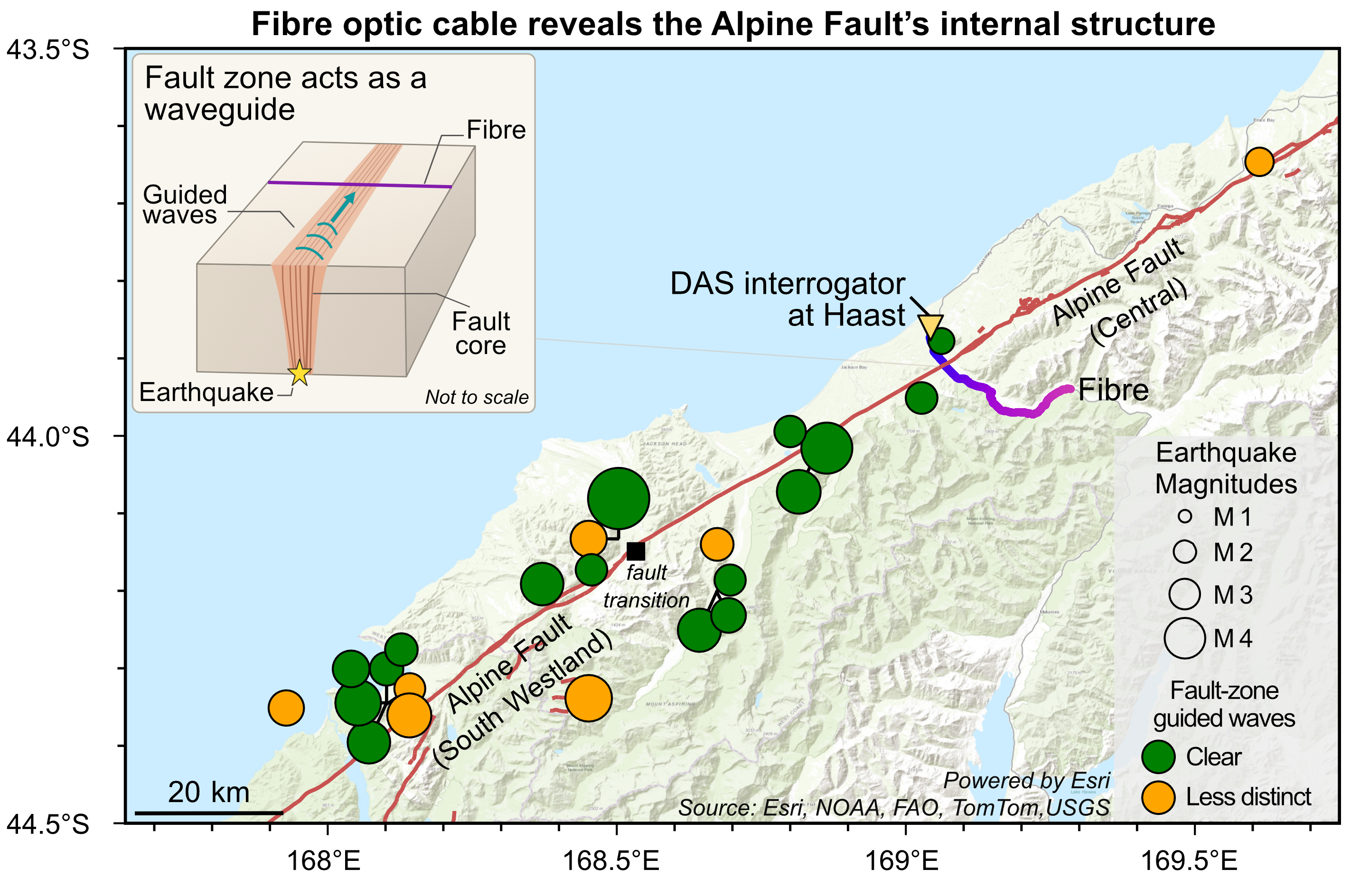 A fibre-optic cable near Haast recorded earthquake waves guided by the Alpine Fault, revealing several narrow fault cores within a wider zone of damaged rock. Circle size shows earthquake magnitude. Green circles mark earthquakes with clear guided waves, and orange circles mark those with less distinct guided waves. Photo Credit: NTU Singapore.
Crucially, the primary slipping core was found to be continuous along approximately 180 kilometres of the fault line. Most notably, this core extends uninterrupted across a major structural bend near the Martyr River, the boundary dividing the Central and South Westland segments of the Alpine Fault. In prehistoric ruptures, earthquakes have sometimes stopped dead at the Martyr River bend, while at other times, they have ruptured right through it.
The team’s observation that the principal slipping core is physically continuous across this structural bend at earthquake depths provides direct seismological evidence that the two segments remain connected where earthquakes occur. While this structural connection does not alter the projected timing of the next earthquake, it significantly strengthens the scientific foundation for disaster planning and hazard mitigation. Supporting predictive models have estimated an 82 per cent likelihood of a joint-segment rupture exceeding magnitude 8.
Repurposing everyday infrastructure for global resilience
Beyond its direct implications for civil defence and hazard planning in New Zealand, the project underscores the transformative potential of existing telecommunications infrastructure for environmental monitoring worldwide.
Because the experiment utilised an existing, spare fibre strand, it ran without interrupting commercial internet traffic or compromising customer data. The study demonstrates that digital communications corridors can double as extraordinarily dense seismic observatories, opening new frontiers for geophysical discovery without the heavy capital cost of dedicated sensor deployments.
“Fibre-optic cables already criss-cross active tectonic faults and populous urban centres across the globe,” said Asst Prof Lai. “Instead of deploying costly specialised sensor networks from scratch, we can harness these pre-existing digital highways to continuously listen to our planet. Repurposing these dark fibres allows us to transform standard telecommunications infrastructure into permanent, high-density seismic observatories for ongoing hazard assessment and early warning.”
By uniting high-resolution optical physics with deep-earth geophysics, Asst Prof Lai and her collaborators have set a new benchmark for seismic imaging, turning the silent infrastructure of our digital world into an early-warning system for future earthquakes.
The paper, titled “DAS Reveals Continuous, Multicore Architecture of the Alpine Fault, New Zealand” was first published online in Science Advances, on 25 November 2026. DOI: 10.1126/sciadv.aei3238.