
Quantum scales below the surface
Assoc Prof Rainer Dumke is mapping the underground with atoms and gravity.
.jpg?sfvrsn=a9c05adf_1 "Measuresments taken with a classical spring gravimeter (NTU Singapore research)")
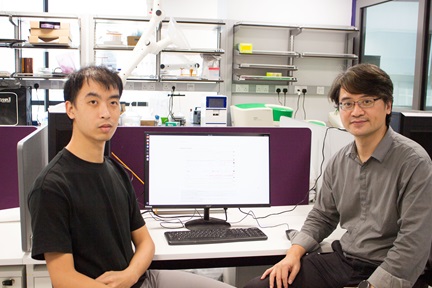
Researchers from the Centre for Quantum Technologies and NTU’s Earth Observatory of Singapore taking measurements with a classical spring gravimeter equipped with a global positioning system antenna. Credit: Centre for Quantum Technologies.
By Rainer Dumke
Gravity is not the same everywhere. Its pull is slightly stronger over dense rocks, and slightly weaker over empty or water‑filled spaces in the ground.
By measuring these tiny differences, you can infer what lies underground without drilling: aquifers, faults, geothermal energy sources and even the slow “breathing” of a volcano.
The challenge is that such signals are minuscule, measuring only a millionth of the Earth’s gravity or smaller. Furthermore, current instruments for surveying these gravity signals can “drift” and lose their accuracy over time.
Our team’s solution was to develop a cutting-edge, research-grade device – called an absolute atomic gravimeter – and take it into the wild to serve as a daily “quantum reference point” for a conventional gravity survey. The result: crisp gravity maps in difficult terrain that are accurate enough to pick out subtle subsurface features and precisely identify them.
A HYBRID RECIPE
Most gravity surveys use compact devices called spring gravimeters, which measure gravity based on how much the spring attached to a weighted object stretches when the object is pulled by gravity. These light and mobile sensors allow one to collect hundreds of data points a day, but their readings drift with temperature changes and mechanical wear over time.
Absolute atomic gravimeters work differently. They launch clouds of ultra-cold atoms and measure gravity through a process that shines lasers at the falling atoms to assess how their wave properties are affected by changes in gravity.
Atomic gravimeters are thus drift‑free and reliable “quantum reference points” because they measure gravity using the unchanging quantum properties of atoms. However, they are bulkier and more cumbersome to deploy.
So, in our research, we combined the best of both sensors – the portability of spring gravimeters and the high accuracy of atomic gravimeters. In a two‑day pilot at an NTU geothermal test site, we used a spring gravimeter to measure changes in gravity underground along a line of points and compared those readings against our on‑site atomic gravimeter, which served as an absolute, reference anchor.
For every point, we took six measurements a day with the spring gravimeter. To address drift in these measurements, we used a formula to correct each reading with steady readings from the atomic gravimeter.
The corrected readings revealed a potential low‑density geological fault zone that could channel hot fluids, consistent with independent sonar-like measurements recorded in the same area studied.
Encouraged, we applied the same approach in a more rugged setting: a remote tract of dense tropical woodland in northern Singapore. We set up the atomic gravimeter in a shipping container and let it run overnight for two weeks.
We calibrated two spring gravimeters every evening against the atomic gravimeter that served as an absolute reference point, before taking them out for measurements in the morning. Doing so, we corrected any drift in the spring gravimeters and could compare the readouts from the two sensors even when they were used at different times. The final gravity map we received was at such a high level of accuracy that we could distinguish differences in the density of underground matter as small as a few tenths of a gram per cubic centimetre – or less than the density of 1 cubic centimetre of cork material.
.jpg?sfvrsn=bb7c7ae_1 "Atomic gravimeter housed in a white shipping container (NTU Singapore research)")
The atomic gravimeter built by our research team was transported to a woodland area in northern Singapore and housed in a white shipping container, which was air-conditioned to regulate the temperature the gravimeter operated in because the temperature outside fluctuated drastically from 25 to 34.4 degrees Celsius. Credit: Centre for Quantum Technologies.
MAKING QUANTUM GEAR FIELD READY
Two engineering advances made our findings possible. First, a simpler laser system. Atomic gravimeters need several laser beams of specific, related frequencies to work, so they often become bulky because they require different parts to produce lasers of varying frequencies.
For our atomic gravimeter, we designed a more compact part that relies on a single laser to generate lasers of different frequencies, using electro‑optic and acousto‑optic modulators.
We also “locked” the lasers generated, so that even when our atomic gravimeter shook during transport, it did not result in misaligned lasers that affected measurements.
Second, we used active vibration and tilt control. Readouts from an atomic gravimeter are extremely sensitive to the motion of a mirror used to shine laser beams at the falling atoms. We built a compact isolation platform that cuts vertical vibrations of the mirror by up to 300 times, stabilising how much the mirror can tilt.
When running our atomic gravimeter for an hour, we were able to measure changes in gravity as subtle as 2.8 billion times weaker than Earth’s gravity. The readings measured were also stable over a longer period.
WHY IT MATTERS AND WHAT’S NEXT
For Singapore, our hybrid approach to measuring gravity suggests a practical way to monitor subterranean resources and risks in places where dense vegetation, soft ground and urban vibration have hampered precise gravity surveys.
Our method also lets us stitch together measurements taken on different days, seasons or even years. This means we can observe how groundwater moves, refine geothermal prospects and check the integrity of buried infrastructure confidently and safely. Our atomic gravimeter can also be easily transported in a container on roads, wherever a solid reference anchor is needed.
We are now engineering a new‑generation platform with autonomous tilt control and satellite uplink to reduce the equipment setup time from days to hours, as well as enable accurate gravity measurements deeper into forests and even in coastal areas.
.jpg?sfvrsn=c58d1ff7_1 "Atomic gravimeter (NTU Singapore research)")
Our research team’s atomic gravimeter inside a repurposed shipping container. Credit: Centre for Quantum Technologies.
---
Assoc Prof Rainer Dumke from NTU’s School of Physical & Mathematical Sciences is Deputy Director of the Centre for Quantum Technologies’ NTU cluster.
His research interests include investigating the wave properties of ultra-cold atoms and using them to develop compact chips. These chips have many uses, for example, in developing atom interferometers as sensors to make precise measurements, and in quantum computers and other systems to store and process information.
Details of the research can be found in Scientific Reports (2024), DOI: 10.1038/s41598-024-57253-1; AVS Quantum Science (2023), DOI: 10.1116/5.0166281; AVS Quantum Science (2022), DOI: 10.1116/5.0119151; and Physical Review Applied (2022), DOI: 10.1103/PhysRevApplied.18.044037.
The article appeared first in NTU's research & innovation magazine Pushing Frontiers (issue #26, May 2026).

.tmb-listing.jpg?sfvrsn=95c9fb05_2)
.tmb-listing.jpg?sfvrsn=abbd2980_1)