
Democratising SARS-CoV-2 diagnostics: Assoc Prof Eric Yap
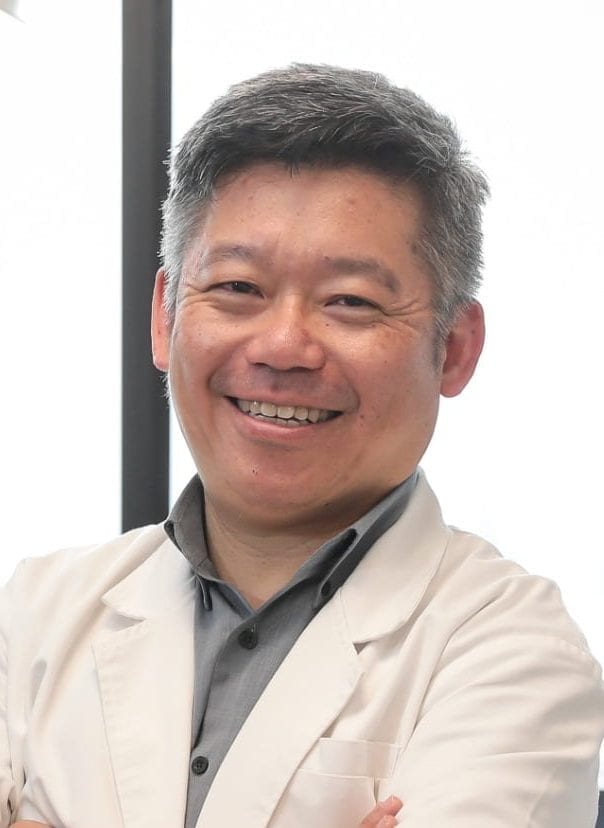
Assoc Prof Eric Yap develops ultrafast and highly sensitive tests for SARS-CoV-2.
Standard testing for presence of SARS-CoV-2 in patient samples requires specialised equipment and reagents and typically takes at least 24 hours from sampling to reporting, hindering swift action to control the spread of COVID-19.
Drawing on his dual backgrounds in medicine and science, and in collaboration with colleagues in NTU’s engineering schools, medical geneticist Assoc Prof Eric Yap aims to overcome the shortcomings of current tests.
“Our goal is to develop ultrafast and automated tests that yield results in minutes, and that can be performed by healthcare workers in the clinic with the same accuracy and sensitivity as in specialised laboratories,” says Assoc Prof Yap, who is principal investigator in the Medical Genomics Lab at NTU’s Lee Kong Chian School of Medicine (LKCMedicine).
Incorporating novel polymerase chain reaction (PCR), microfluidic and optical technologies, his team has been working on accelerating, simplifying and democratising the use of PCR—a core method in molecular biology—in laboratories with limited equipment and capabilities. The researchers developed a protocol for rapid and extraction-free PCR detection of SARS-CoV-2 genetic sequences, which has been published in Genes. A variant of the method has been implemented in the NTU Clinical Diagnostic Laboratory at LKCMedicine, which is headed by Assoc Prof Yap and certified for SARS-CoV-2 testing of clinical samples. As of November 2020, the Lab—which was set up in April 2020 as part of NTU’s response to the COVID-19 pandemic—has tested more than 10,000 swab samples using the direct PCR method and helped to boost national lab testing capacity.
To allow the wider use of COVID-19 testing in countries and regions where laboratory capabilities are limited, Assoc Prof Yap is also working to convert household appliances into portable PCR thermocyclers and to simplify equipment for the detection of PCR-amplified viral genetic material.
.tmb-listing.jpg?sfvrsn=8d60272d_1)



.tmb-listing.jpg?sfvrsn=95c9fb05_2)