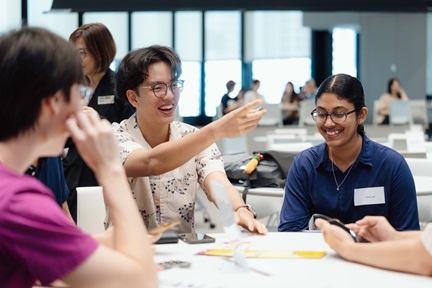
An enriching experience overseas
Name: Yap Hong Wei
Institute/Country: Hokkaido University School of Medicine, Sapporo, Japan
Department posting: Acute and Critical Medicine, Cardiology, Neurology
The variety of patients that Japanese doctors see is different than Singapore, as their healthcare system is structured slightly differently. The university hospital was considered top tier and hence the cases seen here are more complex or severe. I think one of my biggest takeaways was the patient-doctor and doctor-doctor interactions in Japan. Everyone was treated with respect and as equals, and friendliness and kind words were exchanged even when everyone was tired and busy. They consciously remembered to first see everyone as fellow humans before their title, disposition or conditions.
Name: Elena Angela Hartawan
Institution/Country: Seoul National University College of Medicine, Seoul, South Korea
Department posting: Rheumatology, Plastics and Reconstructive Surgery
Living alone in Korea for six weeks has definitely taught me the importance of being independent and resourceful, especially when I came with almost zero proficiency in Korean. From getting around the different hospitals on my own to taking the initiative to ask for help and guidance from my mentors, I've learnt to be self-sufficient and resilient, especially when problems with language and communications arose. In future, as an SAP/ PGY1, I hope to be able to face adversity with composure and humility, as I have done in Korea, and better myself with each challenge I face.
Name: Kok Cheng Yit Zachary
Institution/Country: Buddhist Compassion Relief Tzu Chi Foundation (Singapore), Buddhist Hualien Tzuchi Hospital, Hualien, Taiwan
Department posting: Cardiology, Nephrology, Silent Mentors Programme
Over the course of six days, we had the opportunity to learn from cadavers – our silent mentors. More than simply learning anatomy all over again, we were given a chance to attempt several procedures in a safe environment. These helped us revise skills we were already familiar with such as intubation and urine catheterisation, and exposed us to new skills like chest tube insertions and central line insertions. On the last day, we paid our last respects to our silent mentors. Throughout the entire course of the programme, the idea of respect was repeated: respect for the silent mentors for their contributions to medical education even after their deaths; respect for the silent mentors' families for allowing the programme and making the arrangements to transport the body to the school; respect for the teachers and volunteers for their efforts to make sure that the programme went smoothly and the objectives were met. This programme has taught me more than just procedures but to also have respect for our patients who have also been our "teachers" since the very first day. I am truly grateful to have been granted such a valuable experience.
Name: Rachel Teo
Institution/Country: Christian Medical College, Vellore, Tamil Nadu, India
Department posting: Child Health, Endocrine Surgery, Medicine I, Neurology
An important lesson I learnt during my elective was the need for doctors to keep their medical knowledge up to date with the changing demographics of patients and prevalence of diseases. When I attended the grand ward rounds with the Medicine team, I was impressed by the extensive knowledge the doctors had about snake bites – from recognition of different species of snakes, to the common presentations and management, as it is an entity not so commonly discussed in Singapore. It made me realise the significance of understanding the population's needs, be it in Singapore or in any other country. While medical school guides us through the common conditions we will face when we start working, we need to keep an open mind and continue learning about emerging conditions as we progress through the years.
Name: Pirateb Paramasivam Meenakshi Sundaram
Institution/Country:
Oxford University and John Radcliffe Hospital, Oxford, United Kingdom
Department posting: General Medicine
I found being able to function as a junior doctor (or Singapore's House Officer equivalent) to be the most enjoyable aspect. I had numerous opportunities to speak to patients who were newly presented to the Emergency Department, and come up with a diagnosis and management plan before presenting it to the Registrar. This allowed me to not just refine my clinical knowledge, but learn how to be a functional member of the medical team as well. This experience would certainly be beneficial for me when I start SAP come February and go on to start work as a junior doctor next May. Overall, it was a very enriching experience at Oxford and my only regret is not being able to spend more time there.
Name: Muhammad Fadzil bin Kamarudin
Institute/Country: Chiang Mai University, Maharaj Chiangmai Nakhon Hospital, Chiang Mai, Thailand
Department posting: Emergency Medicine
In Chiang Mai, I saw how surgeons have to be au fait with prescribing chemotherapy for their cancer patients as they do not have enough oncologists, unlike the hospitals in Singapore where care is very sub-specialised. This has taught me that no matter how specialised a doctor you become in the future, the patients' overall well-being always comes first and you have to go the extra mile for them.