Antimicrobial Resistance Symposium off to a great start
.JPG)
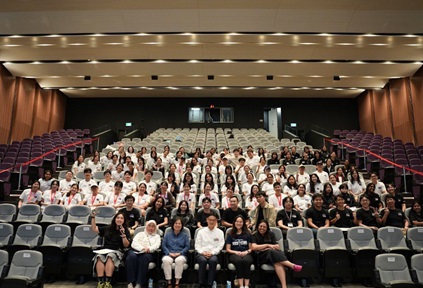
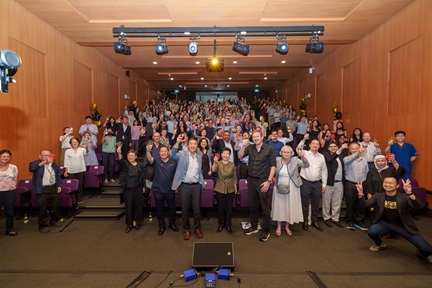
Lee Kong Chian School of Medicine successfully hosted the "Antimicrobial Resistance in the Asia-Pacific & Its impact on Singapore" symposium on 13 November 2018 with some 300 delegates present at the LKCMedicine Clinical Sciences Building. The symposium was graced by Guest-of-Honour Assoc Prof Benjamin Ong, Director of Medical Services, Ministry of Health, Singapore.
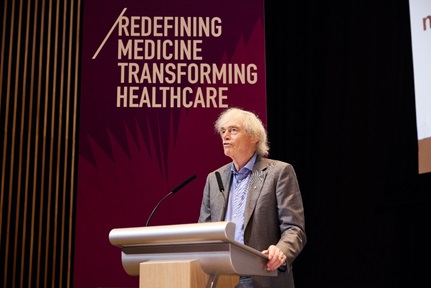
LKCMedicine Dean Prof James Best kicked off the event by congratulating the organising committee for the collaborative effort in his opening remarks. A/Prof Ong then delivered his speech during which he stressed that AMR is a translational issue and a huge challenge today.
.JPG)
"It is therefore pertinent that institutions, global bodies and governments join hands at the local, regional and international level to tackle this challenge," said A/Prof Ong.
He was followed by Director of the National Centre for Infectious Diseases (NCID) Prof Leo Yee-Sin who gave the audience an introduction to the national role and responsibility of the NCID.
.JPG)
The opening segment also featured a video on antimicrobial resistance (AMR) put together by students from NTU Wee Kim Wee School of Communication & Information. That aptly set the tone for the keynote lecture on "The State of the World's Antibiotics in 2018" by Prof Ramanan Laxminarayan, Founder and Director of the Center for Disease Dynamics, Economics & Policy in Washington DC.
.JPG)
The following segment was a line-up of "Perspectives" lectures and plenaries which started with the theme on "AMR surveillance". The first two lectures were delivered by Prof Paul Turner, Director, Cambodia-Oxford Medical Research Unit, and Assoc Prof Vernon Lee, Director, Communicable Diseases Division, Ministry of Health, Singapore who gave their insights on the regional surveillance efforts and One Health Approach to AMR. This was followed by two panel discussions participated by speaker representatives from Myanmar, Timor Leste, Papua New Guinea, Thailand, Indonesia, Cambodia, and Singapore who presented on the efforts, challenges and barriers on human surveillance. Singapore's role in the Southeast Asian region was also shared, while the role of industry, government, and academics in tackling AMR was emphasised.
The second theme was on "Socio-economic aspects of AMR". The audience heard from Prof Mark Jit, Professor of Vaccine Epidemiology of the London School of Hygiene and Tropical Medicine on the economic consequences of AMR; Prof Joergen Schlundt, Director, NTU Food Technology Centre (NAFTEC) on the long-term economic benefits, and the action to reduce use of antibiotics in humans and animals, before Assoc Prof Hsu Li Yang, Clinical Director of the NCID asked a thought-provoking question: "Who pays for drug-resistant infections in the hospital setting?". These perspectives lectures were followed by a panel discussion with active participation from the audience who shared their thoughts about the social misconceptions of antibiotics and vaccinations; demand for antibiotics especially in countries where healthcare access is limited; and the concept of individual and community risk in the context of AMR.
The last theme was on "Innovative technologies to address AMR", with a lecture delivered by Prof Ram Sasisekharan who shared his insights on the use of technologies to shorten the regulatory timeline for drug development. A panel discussion followed, helmed by several scientists and bioengineers from the Massachusetts Institute of Technology and NTU, and CEO of a start-up company who spoke about the various innovative approaches, from surveillance, diagnosis to therapeutics in tackling AMR. The panel also touched on the various aspects of the journey of development, from regulation, policy, funding to the imperative for innovations. During the day, the audience also heard from poster presenters from various institutions in Singapore and overseas about their work on AMR, from the molecular mechanism that confers resistance to the antibiotic management in digital health professional education.
The symposium ended with LKCMedicine Professor of Infectious Diseases Annelies Wilder-Smith who is also LKCMedicine Lead for Global Health and Vaccinology giving the closing remarks and thanking the organising committee, speakers and panellists, and the local team for organising the highly-successful event.
Presenters’ Slides
Keynote Lecture | |
| The State of the World’s Antibiotics in 2018 by Prof Ramanan Laxminarayan Founder and Director, Centre for Disease Dynamics, Economics & Policy, Washington D.C., United States of America Senior Research Scholar, Princeton University, United States of America  The_State_of_the_World's_Antibiotics_in_2018_Ramanan_Laxminarayan.pdf The_State_of_the_World's_Antibiotics_in_2018_Ramanan_Laxminarayan.pdf | |
| Theme One: Antimicrobial Resistance Surveillance | |
| Regional Surveillance & the Wellcome Experience by Prof Paul Turner Director, Cambodia-Oxford Medical Research Unit, Angkor Hospital for Children, Cambodia Regional_Surveillance_and_the_Wellcome_Trust_Experience_Paul_Turner.pdf | |
| Singapore’s One Health Approach to Antimicrobial Resistance by Assoc Prof Vernon Lee Director, Communicable Diseases Division, Ministry of Health, Singapore Singapore's_One_Health_Approach_to_Antimicrobial_Resistance_Vernon_Lee.pdf | |
| Antimicrobial Resistance Surveillance by Dr Gladys Tan Director, Host-pathogen Interactions Laboratory, DSO National Laboratories, Singapore Antimicrobial_Resistance_Surveillance_Gladys_Tan.pdf | |
| Combatting Drug-resistant Tuberculosis at International Frontlines by Dr Htin Lin Aung Directorate, Medical Services Research Centre, Nay Pyi Taw, Myanmar. Sir Charles Hercus Health Research Fellow, University of Otago, New Zealand Combatting_Drug_Resistant_Tuberculosis_at_International_Frontlines_Htin_Lin_Aung.pdf | |
| Antimicrobial Resistance Surveillance by Dr Anis Karuniawati Lecturer, Department of Microbiology, Medical Faculty, Universitas Indonesia, Indonesia Antimicrobial_Resistance_Surveillance_Anis_Karuniawati.pdf | |
| Barriers to a Coordinated Regional Network on AMR Surveillance by Assoc Prof Direk Limmathurotsakul Head of Microbiology, Mahidol Oxford Tropical Medical Research Unit, Thailand Barriers_to_a_Coordinated_Regional_Network_on_AMR_Surveillance_Direk_Limmathurotsakul.pdf | |
| Population WGS: Actionable Data by Dr Ng Oon Tek Senior Consultant, National Centre for Infectious Diseases, Tan Tock Seng Hospital, Singapore Population WGS_Actionable_Data_Ng_Oon Tek.pdf | |
| Theme Two: Socio-economic Aspects of Antimicrobial Resistance | |
| Economic Consequence of Antimicrobial Resistance by Prof Mark Jit Professor of Vaccine Epidemiology, London School of Hygiene and Tropical Medicine, United Kingdom Economic_Consequences_of Antimicrobial_Resistance_Mark_Jit.pdf | |
Long-term Economic Benefits of Reduction in Antibiotic Use in Humans and Animals by Prof Joergen Schlundt Director, Nanyang Technological University Food Technology Centre; Michael Fam Chair Professor of Food Science, School of Chemical and Biomedical Engineering, Nanyang Technological University, Singapore Long_Term_Economic_Benefits_of_Reduction_in_Antibiotic_Use_in_Humans_and_Animals_Joergen_Schlundt.pdf | |
| Who Pays for Drug-resistant Infections in the Hospital Setting? by Assoc Prof Hsu Li Yang Clinical Director, National Centre for Infectious Diseases, Tan Tock Seng Hospital, Singapore Who-Pays_For_Drug_Resistant_Infections_in_the_Hospital_Setting_Hsu_Li_Yang.pdf | |
| Communication & AMR: Considering Psychosocial Determinants of Health Behaviours by Prof May O. Lwin Associate Dean (Special Projects), College of Humanities, Arts and Social Sciences; Professor of Communication, Wee Kim Wee School of Communication and Information, Nanyang Technological University, Singapore Communication_and_AMR_Considering Psychosocial_Determinants_of_Health_Behaviors_May_O_Lwin.pdf |